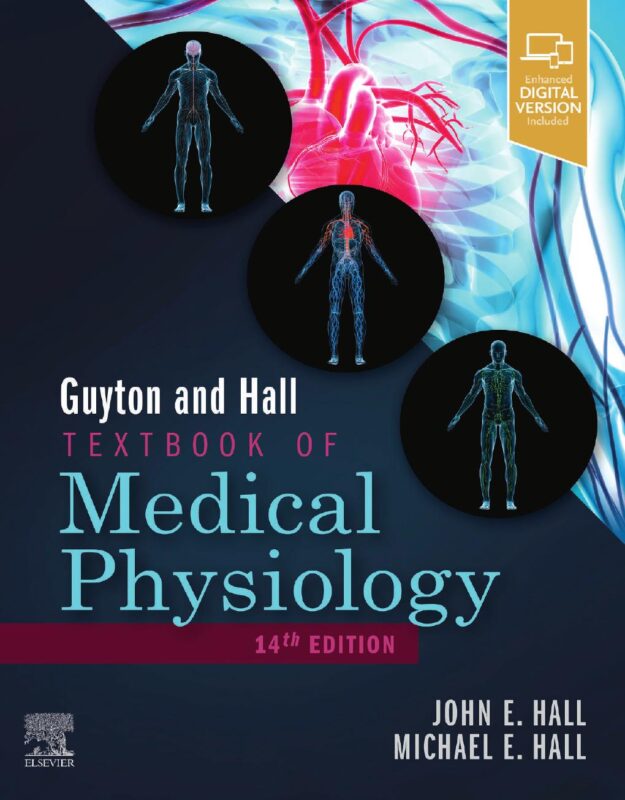
Guyton and Hall Textbook of Medical Physiology 14th Edition By John E. Hall
$28.00
Secure checkout
Instant digital download
PDF document
Document details
- Pages
- 1,157
- File size
- 36.8 MB
- Format
- Digital PDF
- Course
- Education
- Category
- eBook[PDF]
Sign in or create a free account to continue. Your purchase will be saved in My Downloads.
About this ebook
The Guyton and Hall Textbook of Medical Physiology 14th Edition by John E. Hall and Michael E. Hall is organized into 15 units encompassing 85 masterfully edited chapters. The textbook focuses heavily on how the human body maintains homeostasis while bridging basic physical and chemical principles with pathophysiology. [1, 2, 3, 4]
The comprehensive list of covered topics, grouped by their official units, includes: [1]
General & Cellular Basis of Physiology
- Unit I: Introduction to Physiology: The Cell and General Physiology – Functional organization of the human body, control of the "internal environment", cell structure/functions, and genetic control of protein synthesis. [1]
- Unit II: Membrane Physiology, Nerve, and Muscle – Transport of substances through cell membranes, membrane potentials, action potentials, skeletal muscle contraction, and smooth muscle excitation. [1]
Cardiovascular & Circulatory Systems
- Unit III: The Heart – Cardiac muscle mechanics, the heart as a pump, rhythmical excitation, and electrocardiogram (ECG) analysis.
- Unit IV: The Circulation – Biophysics of pressure, flow, and resistance; vascular distensibility; microcirculation and the lymphatic system; local and humoral control of blood flow; and nervous regulation of arterial pressure. [1]
Body Fluids, Kidneys, & Blood
- Unit V: The Body Fluids and Kidneys – Fluid compartments, urine formation by the kidneys, glomerular filtration, renal tubular processing, regulation of extracellular fluid osmolarity, and acid-base balance. [1, 2]
- Unit VI: Blood Cells, Immunity, and Blood Coagulation – Erythrocytes, leukocytes, resistance to infection, immunity, blood types, transfusion medicine, hemostasis, and blood clotting. [1]
Respiratory & Extreme Environments
- Unit VII: Respiration – Pulmonary ventilation, pulmonary circulation, gas exchange membranes, transport of oxygen and carbon dioxide, and regulation of respiration.
- Unit VIII: Aviation, Space, and Deep-Sea Diving Physiology – Body responses to low oxygen pressures, high altitude, space travel, and hyperbaric conditions under deep-sea diving. [1, 2]
The Nervous System & Neurophysiology
- Unit IX: The Nervous System: A. General Principles and Sensory Physiology – Design of the nervous system, synapse function, tactile/mechanoreceptive sensations, and somatic pathways.
- Unit X: The Nervous System: B. The Special Senses – Physiology of the eye (optics, retinal function, neurophysiology of vision), hearing, taste, and smell.
- Unit XI: The Nervous System: C. Motor and Integrative Neurophysiology – Spinal cord motor functions, cortical and brainstem control of motor movement, cerebellum and basal ganglia function, cerebral cortex intellectual functions, sleep, and the autonomic nervous system. [1]
Gastrointestinal, Metabolism, & Endocrine Systems
- Unit XII: Gastrointestinal Physiology – Digestion, propulsion, mixing of food, sekretory functions of the GI tract, absorption, and hepatic portal physiology.
- Unit XIII: Metabolism and Temperature Regulation – Carbohydrate, lipid, and protein metabolism; energetics; metabolic rate; and the physiological mechanisms controlling body temperature.
- Unit XIV: Endocrinology and Reproduction – Pituitary, thyroid, adrenocortical, pancreatic, and parathyroid hormones; calcium-phosphate metabolism; and male and female reproductive physiology.
- Unit XV: Sports Physiology – Muscles in exercise, respiration and cardiovascular dynamics during sports, and body heat in athletics. [1]
File included
tmpphpqvlI32
36.8 MB
Related ebooks