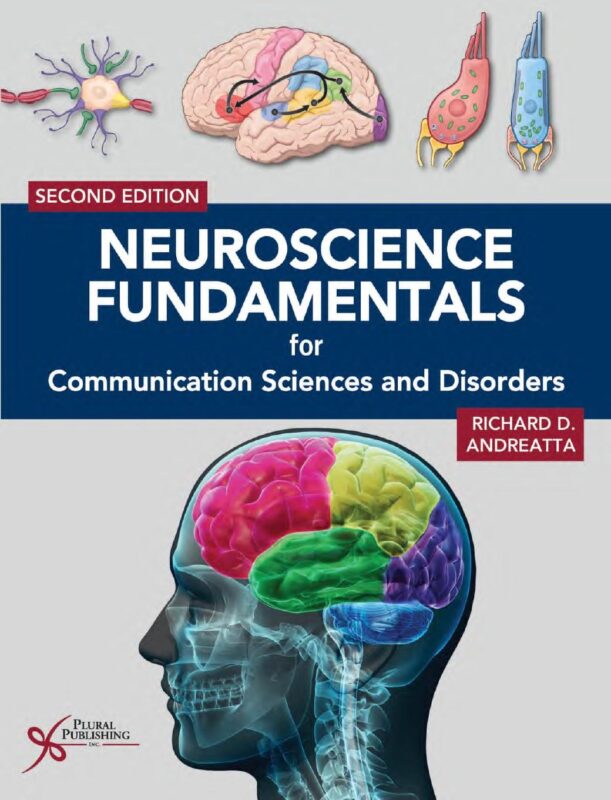
Neuroscience Fundamentals for Communication Sciences and Disorders 2nd Edition By Richard Andreatta
$30.00
Secure checkout
Instant digital download
PDF document
Document details
- Pages
- 833
- File size
- 206.79 KB
- Format
- Digital PDF
- Course
- Communication
- Category
- eBook[PDF]
Sign in or create a free account to continue. Your purchase will be saved in My Downloads.
About this ebook
The Second Edition of Neuroscience Fundamentals for Communication Sciences and Disorders by Richard D. Andreatta is structured to provide an integrative look at neuroanatomy, neurophysiology, and clinical relationships. In the second edition, the author streamlined and reorganized the material—dividing previous dense chapters into six shorter, more digestible ones and creating a dedicated chapter for the cranial nerves. [1, 2, 3]
The primary topics covered across the core chapters of the text include: [1]
🧠 Cellular Foundations & Neural Signaling
- Neuroscience Introduction: Contextual layout of how neuroscience relates to human behavioral and communication disorders.
- Structure & Function of Neurons: The biology of a neuron, including structural components (soma, membrane, cytoskeleton), cytoplasm, and gene expression.
- Glial Cells: An analysis of glial classifications and their supportive roles in the nervous system.
- Neural Signaling & Synapses: The mechanics of electrochemical transmission, resting/action potentials, and synaptic function. [1, 2]
🏛️ Gross Neuroanatomy & Infrastructure
- Anatomical Nomenclature: Orientation terms, planes of sections, and structural axes used to navigate the human nervous system.
- Embryology & Early Development: The prenatal development and formation of the human neural structure.
- The Spinal Cord & Brainstem: Fundamental anatomy of the lower central nervous system pathways.
- Cranial Nerves: A dedicated, standalone chapter highlighting the specific pathways crucial for speech, swallowing, and hearing.
- The Diencephalon & Cerebrum: Deep brain architecture including the thalamus and hypothalamus.
- The Cerebral Cortex: Detailed examination of surface topography, lobes, and functional regions.
- CNS Infrastructure: Protective coverings (meninges), ventricular system, cerebrospinal fluid (CSF), and cerebrovascular blood supply. [1, 2]
👁️ Sensory & Perceptual Systems
- Somatosensory System: The mechanisms behind touch, temperature, body position (proprioception), and pain processing.
- Auditory & Vestibular Systems: Inner ear transduction pathways essential for balance and processing sound.
- Visual System: Central pathways and processing involved in vision.
- Chemical Senses: Structural details and processing systems for olfaction (smell) and gustation (taste). [1]
File included
tmpphpZCS4NE
206.79 KB
Related ebooks