Instructor Manual For Criminology Today An Integrative Introduction 11th Edition By Frank Schmalleger
$30.00
Secure checkout
Instant digital download
PDF document
Document details
- Pages
- 156
- File size
- 2.32 MB
- Format
- Digital PDF
- Course
- Criminology
- Category
- SOLUTIONS MANUAL
Sign in or create a free account to continue. Your purchase will be saved in My Downloads.
About this ebook
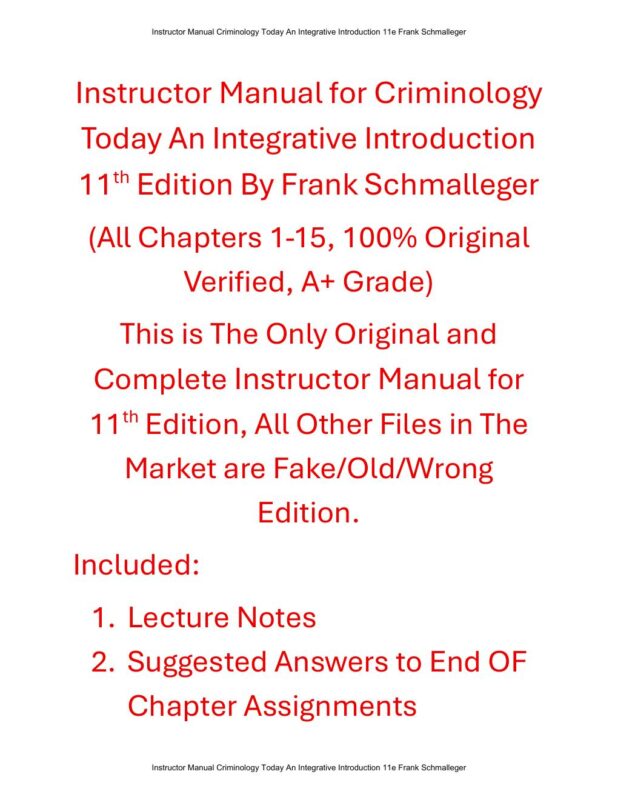
The Instructor Manual for Criminology Today: An Integrative Introduction (11th Edition) by Frank Schmalleger covers 16 chapters organized into four core parts, detailing the origins, theories, and modern realities of criminal behavior. The manual frames these topics through the book's signature debate of social problems versus individual responsibility, while providing sample syllabi, lecture notes, discussion ideas, and test banks. [1, 2, 3, 4]
The complete list of topics and chapters outlined in the instructor manual includes:
Part 1: Crime and Criminology
- Chapter 1: What Is Criminology? – Defining crime, deviant behavior, and the role of criminologists in understanding criminals.
- Chapter 2: Where Do Theories Come From? – Transitioning from ideas to evidence, focusing on research methods, social policy, and theory development. [1, 2, 3]
Part 2: Crime Causation
- Chapter 3: Classical and Neoclassical Thought – Exploring rational choice, situational choice theory, and crime as a calculation of costs versus benefits. [1, 2]
- Chapter 4: Early Biological Perspectives on Criminal Behavior – Historical views of crime rooted in physical traits and inherited tendencies. [1, 2]
- Chapter 5: Biosocial and Other Contemporary Perspectives – The modern interaction between genetics, body chemistry, neurocriminology, and the environment. [1, 2]
- Chapter 6: Psychological and Psychiatric Foundations of Criminal Behavior – Evaluating how personality, cognitive processes, and mental health influence criminal mindsets. [1, 2]
Part 3: Crime Causation Revisited
- Chapter 7: Social Structure Theories – Investigating how poverty, broken neighborhoods, and socio-economic placement drive crime.
- Chapter 8: Theories of Social Process and Social Development – Analyzing how individuals learn criminal behavior through social interactions and peer groups.
- Chapter 9: Social Conflict and Emergent Theories – Examining crime through the lens of power struggles, social inequality, and systemic relations. [1, 2, 3]
Part 4: The Crime Picture
- Chapter 10: Criminal Victimization – Shifting the focus to the victim's experience, victimization patterns, and victim rights.
- Chapter 11: Crimes Against Persons – Violent offenses including homicide, assault, rape, and modern trends like carjacking.
- Chapter 12: Crimes Against Property – Detailed breakdowns of burglary, larceny, motor vehicle theft, and arson.
- Chapter 13: White-Collar and Organized Crime – Profiling occupational crime, corporate fraud, and illicit syndicate operations.
- Chapter 14: Drug and Sex Crimes – Reviewing recreational offenses, prostitution, and modern public safety issues like the fentanyl crisis.
- Chapter 15: Technology and Crime – Cybercrime, digital evidence, and security measures like the Cybersecurity and Infrastructure Security Agency (CISA) Act.
- Chapter 16: Globalization and Terrorism – Global crime trends, transnational syndicates, and the evolution of international terrorism. [1, 2, 3, 4, 5]
File included
tmpphpPwCsur
2.32 MB
Related ebooks