
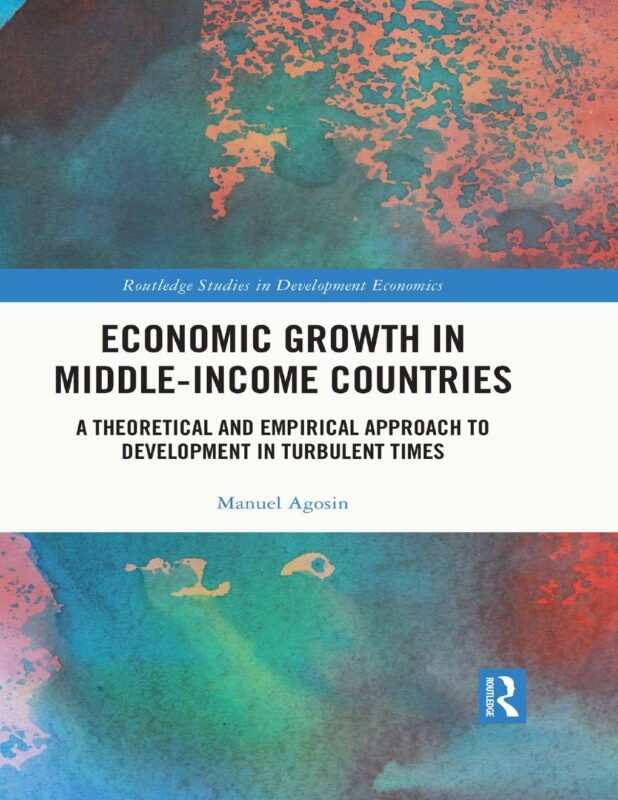
Economic Growth in Middle-Income Countries A Theoretical and Empirical Approach to Development in Turbulent Times By Manuel Agosin
$30.00
Secure checkout
Instant digital download
PDF document
Document details
- Pages
- 260
- File size
- 12.28 MB
- Format
- Digital PDF
- Course
- Education
- Category
- eBook[PDF]
Sign in or create a free account to continue. Your purchase will be saved in My Downloads.
About this ebook
Economic growth in middle-income countries (MICs) is driven by capital accumulation, structural transformation, and institutional development. As nations transition out of low-income status, they encounter unique structural bottlenecks—most notably the "middle-income trap"—where traditional growth drivers lose their efficacy.
Understanding this transition requires a balanced look at both established economic theories and empirical realities.
1. Theoretical Frameworks
Economic theory provides several lenses through which to view the progression and stagnation of middle-income economies.
Neoclassical Growth Models (Solow-Swan)
- Capital Deepening: Growth initially accelerates through high rates of physical and human capital investment.
- Diminishing Returns: As capital builds up, the marginal product of capital falls.
- The TFP Imperative: Sustained growth eventually relies entirely on Total Factor Productivity (TFP) driven by technological progress, rather than just adding more machinery or labor.
Dual-Economy & Structuralist Models (Arthur Lewis)
- Labor Reallocation: Early growth comes from shifting surplus labor from low-productivity agriculture to high-productivity manufacturing.
- The Lewisian Turning Point: Eventually, the surplus labor supply is exhausted. Wages begin to rise rapidly, eroding the country’s competitive edge in cheap, labor-intensive exports.
Endogenous Growth & Innovation Theory (Romer, Aghion-Howitt)
- Imitation vs. Innovation: Low-income countries grow by adopting existing foreign technologies. Middle-income countries must transition to indigenous innovation and R&D.
- Human Capital: The focus shifts from universal primary education to specialized tertiary education and technical skills.
2. Core Empirical Themes and Topics
Empirical literature focuses on the practical policy variables that separate MICs that successfully transition to high-income status from those that stagnate.
+--------------------------+-----------------------------------------------------------+

| Core Growth Pillars      | Key Empirical Focus Areas                                 |
+--------------------------+-----------------------------------------------------------+

| Structural Change        | Moving from low-tech assembly to high-value design/tech   |
| Macro-Financial Stability| Managing sudden capital stops, inflation, and external debt |
| Institutional Quality    | Strengthening property rights and reducing corruption     |
| Social Safety Nets       | Mitigating inequality to maintain social cohesion         |
+--------------------------+-----------------------------------------------------------+
The Middle-Income Trap (MIT)
- Definition: A phenomenon where a country gets stuck at a certain income level ($1,000 to $12,000 GNI per capita) for decades.
- Empirical Causes: Inability to compete with low-wage economies in manufacturing or with high-wage economies in high-tech innovations.
Trade and Global Value Chains (GVCs)
- Upgrading: Empirical studies analyze how MICs can move up the value chain (e.g., from assembling smartphones to designing semiconductors).
- Export Diversification: Reducing reliance on primary commodities to protect against global price volatility.
Institutions and Governance
- The Rule of Law: Empirical evidence consistently shows that transitions to high income require transparent legal frameworks, secure intellectual property rights, and strong regulatory institutions.
- Crony Capitalism: Middle-income growth often stalls when politically connected monopolies stifle market competition and block new, innovative firms.
3. Empirical Methodologies Used in the Literature
To test these theoretical assumptions, economists typically rely on three main empirical approaches:
- Cross-Country Growth Regressions: Utilizing panel data (e.g., Penn World Tables) to analyze the long-term impact of variables like institutional quality, inflation, and trade openness on GDP growth.
- Growth Diagnostics (Hausmann-Rodrik-Velasco): A methodology that identifies the specific "binding constraints" (e.g., poor infrastructure, lack of finance, or high taxation) holding back a particular country's investment.
- Country Case Studies: Comparative historical analyses—such as contrasting the rapid rise of the East Asian Tigers (South Korea, Taiwan) with the relative stagnation of several Latin American economies (Brazil, Argentina)—to isolate successful policy mixes.
File included
tmpphpcl4a9h
12.28 MB
Related ebooks