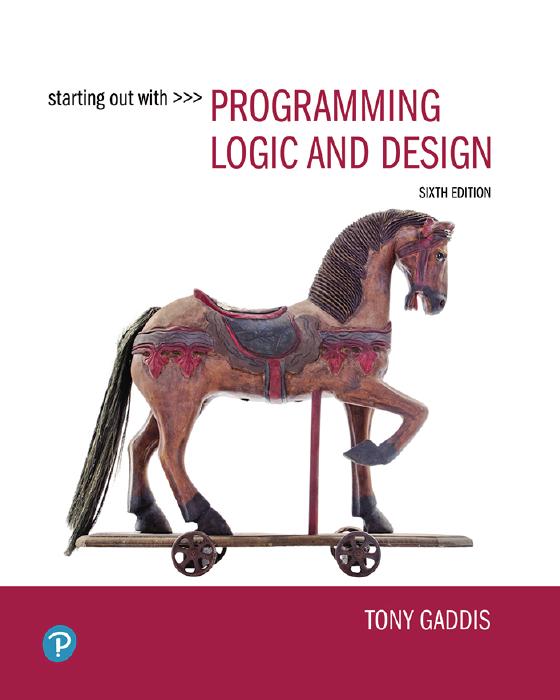
Starting Out With Programming Logic and Design 6th Edition By Tony Gaddis
$30.00
Secure checkout
Instant digital download
PDF document
Document details
- Pages
- 833
- File size
- 14.31 MB
- Format
- Digital PDF
- Course
- Education
- Category
- eBook[PDF]
Sign in or create a free account to continue. Your purchase will be saved in My Downloads.
About this ebook
The Starting Out with Programming Logic and Design (6th Edition) by Tony Gaddis introduces fundamental, language-independent computer programming concepts. It uses pseudocode and flowcharts to teach foundational logic structures without getting bogged down by the syntax requirements of a specific programming language.
The textbook is sequentially organized into specific chapters that cover core logic paradigms, algorithmic structures, data management, and an introduction to object-oriented frameworks:
Core Programming and Algorithmic Structures
- Chapter 1: Introduction to Computers and Programming – Basics of hardware, software, how programs work, the program development cycle, and designing an algorithm.
- Chapter 2: Input, Processing, and Output – Handling data entry, basic calculations, displaying output, variables, data types, and assignment statements.
- Chapter 3: Decision Structures and Boolean Logic – Directing a program's execution flow via relational operators,
if-thenandif-then-elsestatements, nested decisions, and logical operators. - Chapter 4: Repetition Structures – How to repeat code blocks using loops (such as condition-controlled loops like
whileand count-controlled loops likefor). - Chapter 5: Modules – Shifting from monolithic code into modular programming, defining modules, passing arguments, and local vs. global variables.
- Chapter 6: Functions – Introduction to library functions and writing custom value-returning functions.
Data Structuring and Defensive Programming
- Chapter 7: Input Validation – Designing defensive logic to detect, catch, and handle garbage data or improper inputs before a program crashes.
- Chapter 8: Arrays – Storing and working with sequences of data, tracking array bounds, using parallel arrays, and understanding two-dimensional array processing.
- Chapter 7 / 9: Sorting and Searching Arrays – Core algorithmic operations for sorting array structures (such as Bubble Sort and Selection Sort) and searching data sequences (such as Sequential Search and Binary Search).
- Chapter 10: Files – Introducing persistent storage concepts, opening/closing files, sequential file access, and processing records.
Advanced & System Design Concepts
- Chapter 11: Menu-Driven Programs – Formatting software to interact seamlessly with human users through layered modular menus.
- Chapter 12: Text Processing – Validating, converting, and manipulating raw string data formats.
- Chapter 13: Recursion – Defining tasks in terms of themselves and building structural recursive problem-solving loops.
- Chapter 14: Object-Oriented Programming (OOP) – Transitioning from procedural code into abstract real-world paradigms, featuring classes, objects, encapsulation, and class inheritance.
- Chapter 15: GUI Applications and Event-Driven Programming – Introducing windows-based interfaces, structural components (buttons, labels), and setting up response logic for user-triggered events.
File included
tmpphpFeJhx6
14.31 MB
Related ebooks