
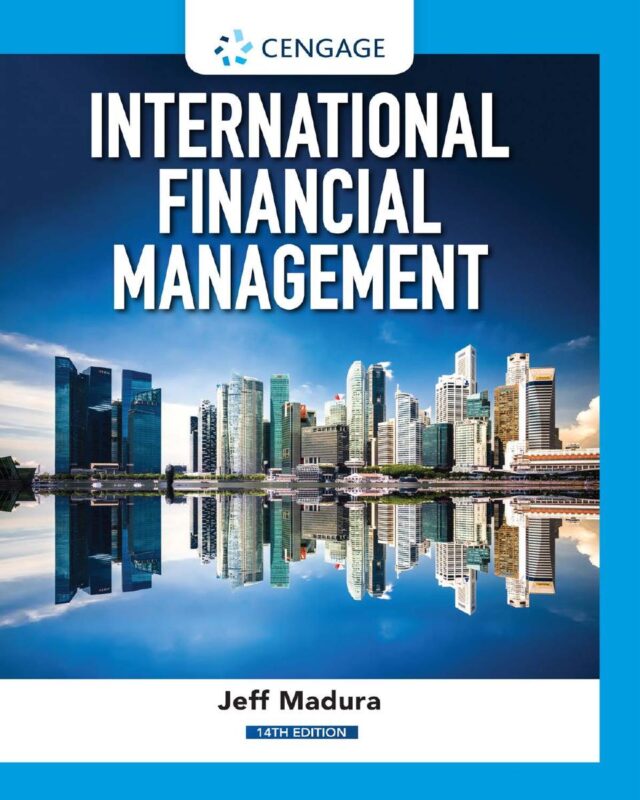
International Financial Management 14th Edition By Jeff Madura
$30.00
Secure checkout
Instant digital download
PDF document
Document details
- Pages
- 738
- File size
- 11.58 MB
- Format
- Digital PDF
- Course
- Management
- Category
- eBook[PDF]
Sign in or create a free account to continue. Your purchase will be saved in My Downloads.
About this ebook
The textbook "International Financial Management" (14th Edition) by Jeff Madura covers the structural framework of multinational financial management across 21 chapters divided into 5 core parts. The text focuses heavily on how multinational corporations (MNCs) maximize shareholder wealth while navigating global trade policies, volatile exchange rates, and international investment risks. [1]
🗒 Part I: The International Financial Environment
This foundational section explores how global financial markets operate and how macroeconomic policy drives cross-border fund flows. [1]
- Chapter 1: Multinational Financial Management: An Overview – Introduction to MNC goals, agency problems, and why firms pursue international expansion (e.g., product cycle and imperfect markets theories). [1, 2]
- Chapter 2: International Flow of Funds – Tracking balance of payments (current and financial accounts) and factors influencing international trade. [1, 2]
- Chapter 3: International Financial Markets – Foreign exchange, Eurocurrency, Eurobond, and international stock markets. [1]
- Chapter 4: Exchange Rate Determination – Analyzing demand and supply shifts that move currency values. [1, 2]
- Chapter 5: Currency Derivatives – Understanding and pricing forward contracts, currency futures, currency options, and currency swaps. [1, 2]
📈 Part II: Exchange Rate Behavior
This section details the economic relationships and government activities that trigger shifts in currency prices. [1, 2]
- Chapter 6: Government Influence on Exchange Rates – Fixed vs. floating rate systems, central bank intervention policies, and foreign exchange controls. [1, 2]
- Chapter 7: International Arbitrage and Interest Rate Parity – Locational, triangular, and covered interest arbitrage alongside Interest Rate Parity (IRP) theory. [1]
- Chapter 8: Relationships among Inflation, Interest Rates, and Exchange Rates – Evaluating Purchasing Power Parity (PPP) and the International Fisher Effect (IFE). [1]
🔎 Part III: Exchange Rate Risk Management
- Chapter 9: Forecasting Exchange Rates – Technical, fundamental, market-based, and mixed forecasting methodologies.
- Chapter 10: Measuring Exposure to Exchange Rate Fluctuations – Differentiating transaction, economic, and translation exposure types.
- Chapter 11: Managing Transaction Exposure – Selective hedging techniques utilizing forward, money market, futures, and options hedges.
- Chapter 12: Managing Economic Exposure and Translation Exposure – Restructuring operations to reduce long-term cash flow volatility and accounting risk. [1]
📊 Part IV: Long-Term Asset and Liability Management
This section dives into long-term capital allocations, international corporate restructuring, and global capital structures. [1]
- Chapter 13: Direct Foreign Investment (DFI) – Benefits, barriers to entry, and risk-return motivations for establishing international business facilities.
- Chapter 14: Multinational Capital Budgeting – Constructing parent vs. subsidiary cash flow models, accounting for foreign taxes, blocked funds, and exchange rate scenarios.
- Chapter 15: International Corporate Governance and Control – Corporate governance frameworks, international mergers and acquisitions, and valuation of foreign targets.
- Chapter 16: Country Risk Analysis – Assessing political and economic risk factors to establish risk ratings for global projects.
- Chapter 17: Multinational Cost of Capital and Capital Structure – Computing the global cost of capital and determining debt vs. equity ratios across international branches.
- Chapter 18: Long-Term Debt Financing – Assessing international loan, Eurobond, and currency swap markets for financing global projects. [1, 2, 3, 4, 5, 6, 7, 8]
➡️ Part V: Short-Term Asset and Liability Management
The final section handles tactical day-to-day liquidity, short-term debt, and trade finance. [1]
- Chapter 19: Financing International Trade – Managing risk via letters of credit, drafts, bill of lading, factoring, and forfaiting.
- Chapter 20: Short-Term Financing – Sourcing short-term credit from foreign markets and managing currency-denominated credit risk.
- Chapter 21: International Cash Management – Optimizing cash collections, optimizing global cash balances, and managing short-term investment yields. [1, 2]
File included
tmpphpRQegHz
11.58 MB
Related ebooks