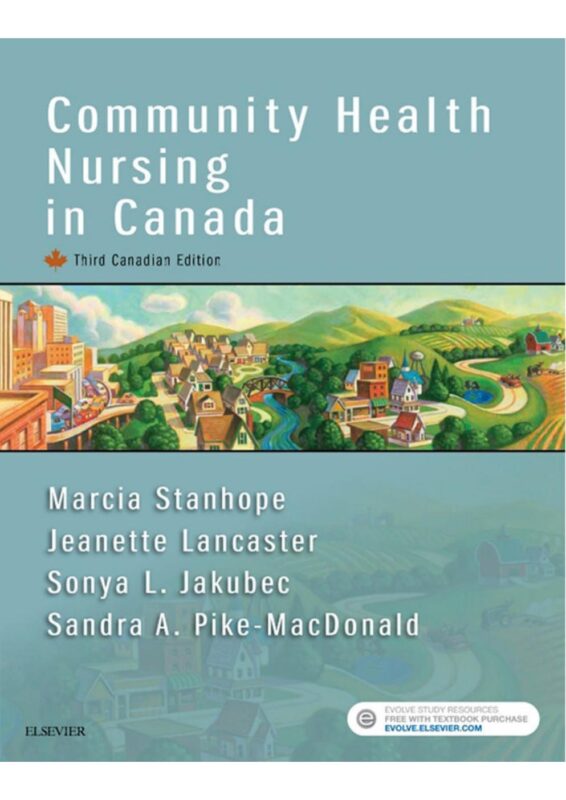
Community Health Nursing in Canada 3rd Edition By Sandra MacDonald, Sonya Jakubec, Marcia Stanhope, Jeanette Lancaster
$30.00
Secure checkout
Instant digital download
PDF document
Document details
- Pages
- 1,481
- File size
- 30.39 MB
- Format
- Digital PDF
- Course
- NURSING
- Category
- eBook[PDF]
Sign in or create a free account to continue. Your purchase will be saved in My Downloads.
About this ebook
The textbook Community Health Nursing in Canada (3rd Edition), co-authored by Sandra A. MacDonald, Sonya L. Jakubec, Marcia Stanhope, and Jeanette Lancaster, shifts the focus of care from individuals to broader population-centered and community-centered health practices across the Canadian landscape. [1, 2]
1. Foundations and Evolution of Community Health Nursing
- Historical Context: The evolution of public health and community nursing from its roots to modern practice within the Canadian Healthcare System.
- Primary Health Care Framework: Distinguishing between primary care and primary health care, heavily focusing on social justice, equity, and public accessibility. [1]
- Professional Standards: Exploration of the Community Health Nurses of Canada (CHNC) Standards of Practice. [1, 2]
2. Conceptual and Theoretical Frameworks
- Determinants of Health: How social, economic, cultural, and environmental factors impact individual and community well-being.
- Epidemiology: Basic concepts, tools, data utilization, and measuring health status or disease distribution across Canadian populations.
- Health Promotion and Illness Prevention: Utilizing frameworks like the Ottawa Charter for Health Promotion alongside structural levels of prevention (primary, secondary, tertiary). [1, 2, 3, 4]
3. Community Assessment and Practice Tools
- Community-as-Partner Model: Strategies for assessing a community's core, strengths, subsystems, and unique liabilities.
- Evidence-Informed Practice: Synthesizing the best available Canadian research, clinical expertise, and community preferences to implement effective interventions.
- Ethics and Advocacy: Addressing ethical dilemmas unique to aggregate populations, political advocacy, and policy-making. [, 2]
4. Working with Diverse and Vulnerable Aggregates
- Cultural Considerations: Exploring cultural safety, humility, and health equity when working with diverse populations across provinces and territories. [1, 2]
- Marginalized Populations: Tailoring care for aggregates facing structural inequities, such as those experiencing homelessness, mental health struggles, or substance use dependencies. [1]
- Indigenous Health: Early introductory concepts and frameworks related to the specific health needs and self-determination of First Nations, Inuit, and Métis communities. [1, 2]
5. Nursing Across the Lifespan & Unit Aggregates
- Family Health: Models for family assessment, structural analysis, and intervention strategies in the community.
- Child, Youth, and Adult Health: Addressing age-specific demographic risks, chronic illness prevention, and wellness initiatives. [, 2]
6. Specializations in Community Health Nursing
- Public Health Nursing: Population-level disease prevention, environmental health tracking, and communicable disease control.
- Home Health Nursing: Direct care management, palliative options, and rehabilitative support within residential settings.
- Occupational and School Health: Promoting safety regulations in the workplace and fostering active health promotion programs for youth. [1, 2, 3]
File included
tmpphp7URTbu
30.39 MB
Related ebooks