
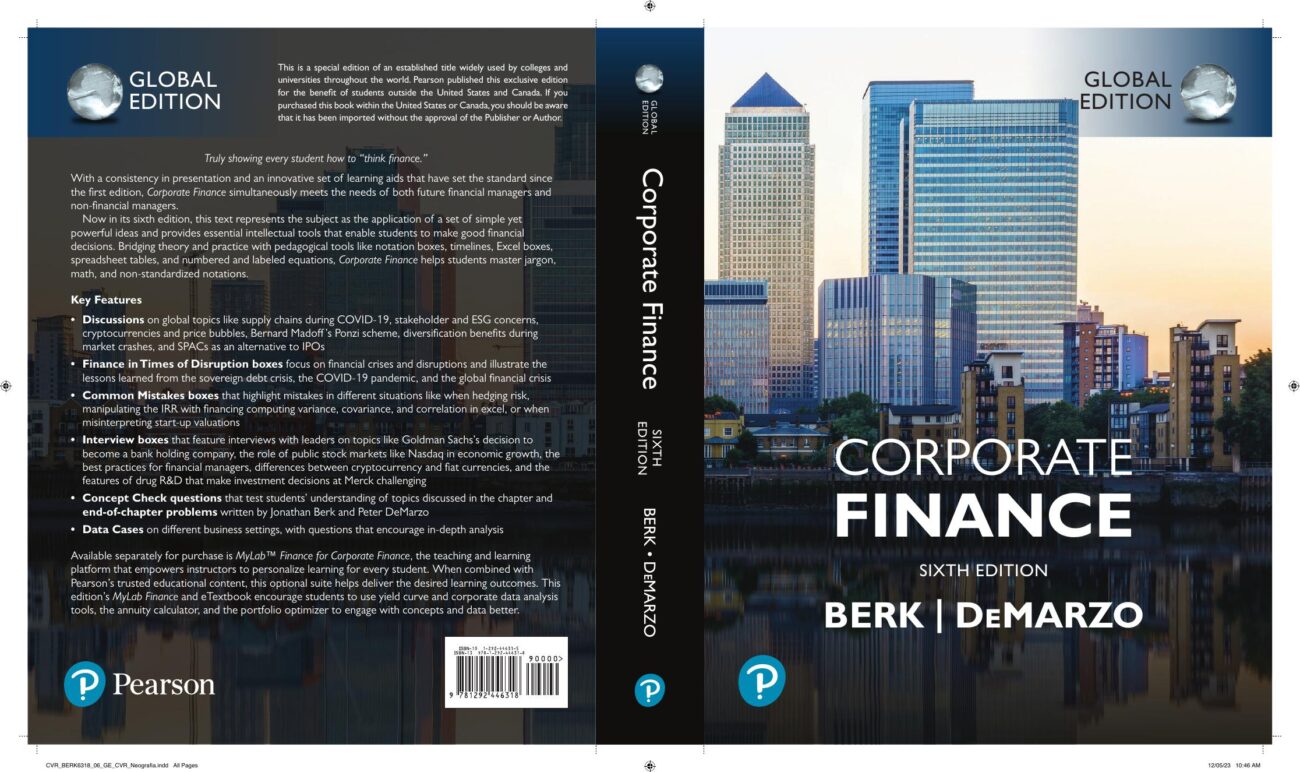
Corporate Finance 6th Global Edition By Jonathan Berk, Peter DeMarzo
$30.00
Secure checkout
Instant digital download
PDF document
Document details
- Pages
- 1,197
- File size
- 12.99 MB
- Format
- Digital PDF
- Course
- Education
- Category
- eBook[PDF]
Sign in or create a free account to continue. Your purchase will be saved in My Downloads.
About this ebook
The 6th Global Edition of Corporate Finance by Jonathan Berk and Peter DeMarzo is structured around a unifying core concept: The Law of One Price. [1, 2]
The textbook is divided into 10 core parts encompassing 31 chapters, covering everything from foundational financial mechanics to advanced quantitative modeling: [1, 3]
➡️ Part 1: Introduction
- The Corporation and Financial Markets: Legal corporate structures, sole proprietorships, partnerships, and an introduction to FinTech.
- Financial Statement Analysis: Holistic evaluation of corporate balance sheets, income statements, cash flows, and key financial ratios.
- Financial Decision Making and the Law of One Price: Core valuation frameworks, costs versus benefits, and market arbitrage. [1, 2, 3, 4, 5]
➡️ Part 2: Time, Money, and Interest Rates
- The Time Value of Money: The mechanics of discounting, compounding, and calculating net present value (NPV).
- Interest Rates: Determinants of nominal and real rates, the yield curve, and loan structures.
- Valuing Bonds: Principles of fixed-income pricing, corporate bonds, and credit risk. [1, 2, 3, 4]
➡️ Part 3: Valuing Projects and Firms
- Investment Decision Rules: Utilizing NPV as the baseline metric against internal rate of return (IRR) and payback periods.
- Fundamentals of Capital Budgeting: Forecasting earnings, determining free cash flows, and executing sensitivity analyses.
- Valuing Stocks: Dividend-discount models, total payout frameworks, and valuation via comparable multipliers. [1, 3, 4]
➡️ Part 4: Risk and Return
- Capital Markets and Pricing Risk: Historical risk versus return, portfolio diversification, and systematic versus unsystematic risk.
- Optimal Portfolio Choice & the CAPM: Mean-variance optimization, the efficient frontier, and the Capital Asset Pricing Model.
- Estimating the Cost of Capital: Calculating the cost of equity, debt, and the Weighted Average Cost of Capital (WACC).
- Investor Behavior and Market Efficiency: Behavioral biases, market anomalies, and the implications of efficient market hypotheses. [1, 3, 4, 5]
➡️ Part 5: Capital Structure
- Capital Structure in a Perfect Market: Modigliani-Miller propositions regarding debt-to-equity choices.
- Debt and Taxes: Corporate tax shields and the adjusted value of leveraged firms.
- Financial Distress, Incentives, and Information: Bankruptcy costs, agency conflicts, trade-off theory, and signaling.
- Payout Policy: Mechanics of corporate dividends versus stock repurchases. [1, 3, 4, 5]
➡️ Part 6: Advanced Valuation
- Capital Budgeting & Valuation with Leverage: Enterprise evaluation models including WACC, Adjusted Present Value (APV), and Flow-to-Equity (FTE).
- Valuation and Financial Modeling: Comprehensive case study building dynamic financial forecasts. [, 2, 3]
➡️ Part 7: Options
- Financial Options: Option payoffs, mechanics of puts and calls, and factors affecting option pricing.
- Option Valuation: Dynamic replicating portfolios, the Black-Scholes formula, and binomial trees.
- Real Options: Practical application of options theory to business flexibility, expansion, and project delays. [, 2, 3]
➡️ Part 8: Long-Term Financing
- Raising Equity Capital: Analyzing Venture Capital (VC), Initial Public Offerings (IPOs), and Special Purpose Acquisition Companies (SPACs).
- Debt Financing: Corporate bonds, bank loans, and private placements.
- Leasing: Operating versus finance leases, and the structural trade-offs of buying versus leasing. [1, 3]
➡️ Part 9: Short-Term Financing
- Working Capital Management: Optimizing inventory, cash collections, accounts receivable, and trade credit policies.
- Short-Term Financial Planning: Preparing seasonal cash budgets and arranging short-term bank financing. [1, 3]
➡️ Part 10: Special Topics
- Mergers and Acquisitions: Friendly vs. hostile takeovers, corporate synergies, and financial restructuring. [1]
- Corporate Governance: Board structures, executive incentives, proxy fights, and modern Environmental, Social, and Governance (ESG) frameworks. [1]
- Risk Management: Using financial derivatives (forwards, futures, options, swaps) to hedge operational and foreign exchange exposures. [1, 3]
- International Corporate Finance: Managing cash flows across multiple currencies, international taxation, and foreign cost of capital adjustments. [, 2]
File included
tmpphpEYxSlr
12.99 MB
Related ebooks