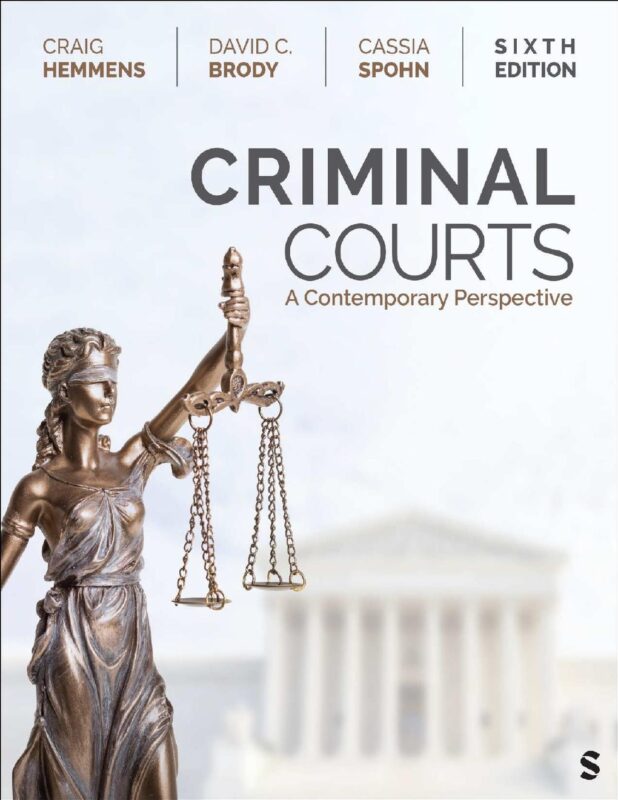
Criminal Courts: A Contemporary Perspective 6th Edition By Craig Hemmens, David Brody, Cassia Spohn
$30.00
Secure checkout
Instant digital download
PDF document
Document details
- Pages
- 396
- File size
- 5.83 MB
- Format
- Digital PDF
- Course
- Law
- Category
- eBook[PDF]
Sign in or create a free account to continue. Your purchase will be saved in My Downloads.
About this ebook
The 6th Edition of Criminal Courts: A Contemporary Perspective by Craig Hemmens, David Brody, and Cassia Spohn covers the foundational principles, core actors, and evolving legal frameworks of the American judicial system. [1, 2]
The textbook is published by SAGE Publications and organizes its material into logical chronological segments: [1, 2]
Part 1: Foundations of Criminal Courts
- The Judicial Function: Exploring the historic purpose, social role, and core responsibilities of courts in the broader criminal justice sector. [1, 2]
- Legal Frameworks & Sources of Law: Examining statutory, constitutional, administrative, and case law alongside principles like stare decisis. [1]
- Structure and Jurisdiction: Breaking down the dual court system, navigating the distinctions between federal and state systems, and analyzing geographic versus subject-matter jurisdiction. [1]
Part 2: Key Courtroom Actors
- Judges: Investigating roles, responsibilities, ethical accountabilities, and methods of selection (e.g., appointments, elections, merit selection). [1]
- Prosecutors: Examining prosecutorial discretion, charging choices, plea-bargaining strategies, and legal prioritization. [1]
- Defense Attorneys: Outlining public versus private representation, indigent defense systems (assigned counsel, contract systems, public defenders), and limits on the constitutional right to counsel. [1, 2]
- Defendants and Victims: Analyzing constitutional protections, court experiences, and the ongoing balance between victims' and defendants' rights. [1, 2]
Part 3: The Court Process & Procedures
- Pretrial Procedures: Looking closely at bookings, initial appearances, grand juries, preliminary hearings, and court-administered bail policies.
- The Criminal Trial: Discussing jury selection (voir dire), rules of evidence, witness testimonies, burden of proof, and adversarial trial mechanics.
- Sentencing: Navigating how judges determine punishment, goals of sentencing, and structural considerations.
- Appeals and Post-Trial: Reviewing mechanisms for legal error corrections, appellate court jurisdiction, and wrongful conviction reviews. [1, 2, 3, 4, 5, 6]
Part 4: Special Topics & Modern Challenges
- Specialty & Problem-Solving Courts: Evaluation of drug courts, mental health courts, and domestic violence courts.
- Comparative Court Systems: Brief global context juxtaposing international or foreign court models with the U.S. adversarial process.
- Contemporary Legal Debates: Fully updated arguments tackling evolving marijuana laws, the death penalty, and policy-driven judicial reform
File included
tmpphptzFfbM
5.83 MB
Related ebooks