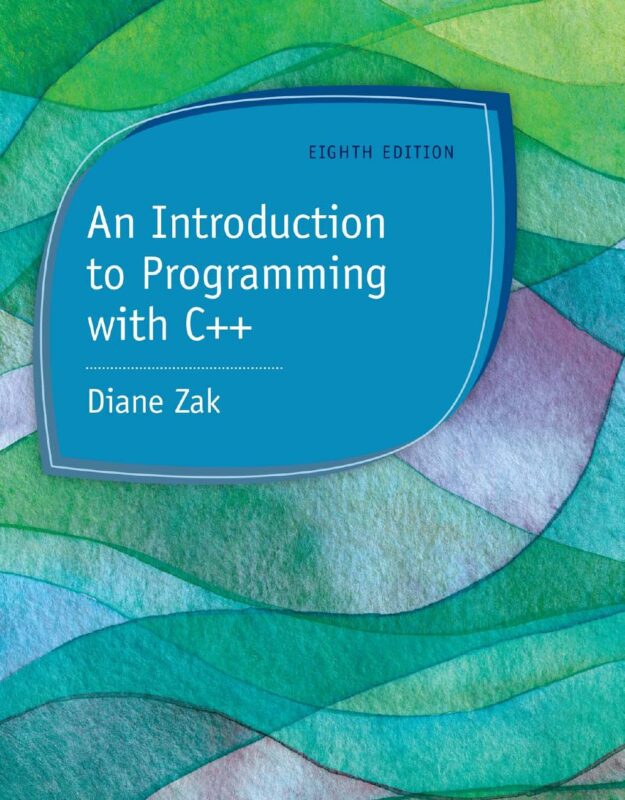
An Introduction to Programming with C++ 8th Edition By Diane Zak
$30.00
Secure checkout
Instant digital download
PDF document
Document details
- Pages
- 634
- File size
- 8.03 MB
- Format
- Digital PDF
- Course
- Education
- Category
- eBook[PDF]
Sign in or create a free account to continue. Your purchase will be saved in My Downloads.
About this ebook
An Introduction to Programming with C++, 8th Edition by Diane Zak spans 15 chapters designed to teach beginners how to plan, structure, and create well-designed software programs. [1, 2]
The book is structured sequentially to guide learners from basic logic and problem-solving through foundational control structures, and finally into data handling and object-oriented principles: [1, 2]
1. Foundational Programming & Logic
- Chapter 1: Intro to Programming – Overview of coding fundamentals, basic terminology, and compiler basics.
- Chapter 2: Beginning the Problem-Solving Process – Analyzing programmatic problems, structuring logic, and planning algorithms.
- Chapter 3: Variables & Constants – How data types are stored, allocated, and declared within memory.
- Chapter 4: Completing the Problem Solving Process – Finalizing program architecture, evaluating basic inputs, and creating functional code outputs. [1, 2]
2. Control Structures (Selection & Repetition)
- Chapter 5: The Selection Structure – Introduction to conditional paths (
if,if...elsestatements). - Chapter 6: More on the Selection Structure – Deepening complex criteria handling (nested logic and
switchstatements). - Chapter 7: The Repetition Structure – Introducing programmatic loops (
while,for,do...while). - Chapter 8: More on the Repetition Structure – Advanced looping patterns, nesting loops, and managing iterations safely. [1, 2]
3. Modularization & Functions
- Chapter 9: Value-returning Functions – Writing modular code blocks that perform operations and pass values back to the program.
- Chapter 10: Void Functions – Creating functions that perform isolated, structured tasks without needing to return specific data types. [1, 2]
4. Data Arrays, Strings, & File Input/Output
- Chapter 11: One-Dimensional Arrays – Storing and indexing linear datasets under a single variable header.
- Chapter 12: Two-Dimensional Arrays – Working with tabular grid systems or matrix datasets.
- Chapter 13: Strings – Deep dive into character sequence processing, parsing, and text manipulation.
- Chapter 14: Sequential Access Files – Reading data from external storage text files and exporting program data back out to permanent memory. [1, 2]
5. Object-Oriented Programming (OOP)
File included
ScholarFriends.com-an-introduction-to-programming-with-8th-edition-by-c-by-diane-zak.pdf
8.03 MB
Related ebooks