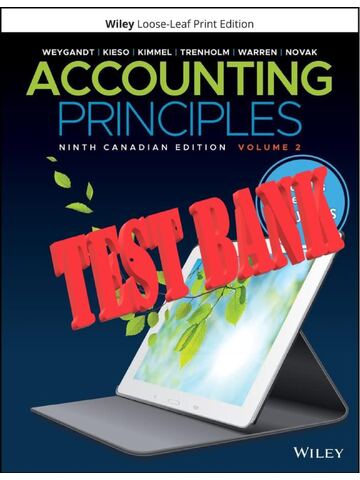
TEST BANK for Accounting Principles, Volume 2, 9th Canadian Edition by Jerry J. Weygandt, Donald E. Kieso and Paul D. Kimmel ISBN-13 978-1119786634 | All Chapter 9-18
$27.00
Secure checkout
Instant digital download
PDF document
Document details
- Pages
- 1,209
- File size
- 5.61 MB
- Format
- Digital PDF
- Course
- Accounting
- Category
- TEST BANKS
Sign in or create a free account to continue. Your purchase will be saved in My Downloads.
About this ebook
TEST BANK for Accounting Principles, Volume 2, 9th Canadian Edition by Jerry J. Weygandt, Donald E. Kieso, Paul D. Kimmel, Barbara Trenholm, Valerie Warren, and Lori Novak covers Chapters 9 through 18. This volume transitions students from basic bookkeeping into intermediate financial accounting applications, corporate structures, and statement analysis tailored to Canadian frameworks (ASPE and IFRS). [1, 2, 3, 4, 5]
Chapter-by-Chapter Core Topics
- Chapter 9: Long-Lived Assets
- Acquisition, cost determination, and depreciation of Property, Plant, and Equipment (PPE)
- Straight-line, diminishing-balance, and units-of-activity depreciation methods
- Accounting for asset revaluations, impairments, and disposals
- Intangible assets and goodwill recognition and amortization [1, 2, 3, 4, 5]
- Chapter 10: Current Liabilities and Payroll
- Chapter 11: Financial Reporting Concepts
- Chapter 12: Accounting for Partnerships
- Characteristics, formation, and structural configuration of partnerships
- Allocation of net profit or loss among partners based on ratios, capital balances, and salaries
- Accounting treatments for the admission of new partners, withdrawal of existing partners, and full partnership liquidation [1, 2, 3]
- Chapter 13: Introduction to Corporations
- Chapter 14: Corporations: Additional Topics and IFRS
- Chapter 15: Non-Current Liabilities
- Chapter 16: Investments
- Accounting for debt and equity investments under Canadian standards
- Classification and measurement: Fair Value Through Profit or Loss (FVTPL), Fair Value Through Other Comprehensive Income (FVTOCI), and Amortized Cost
- The Equity Method for strategic investments with significant influence [1, 2, 3, 4]
- Chapter 17: The Cash Flow Statement
- Chapter 18: Financial Statement Analysis
Real-World & Analytical Application Focus
Throughout these chapters, this edition incorporates digital-era toolsets to mirror professional Canadian workspaces: [1]
- Data Analytics Insights: Case-study sidebars focusing on how corporate data is evaluated to make financial decisions.
- Analytics in Action: Dedicated end-of-chapter mathematical and analytical problems.
- Excel Templates: Interactive application spreadsheets mapped to chapter tasks to reinforce technical spreadsheet skills. [1, 3, 4]
File included
TEST-BANK-for-Accounting-Principles-Volume-2-9th-Canadian-Edition-by-Jerry-J.-Weygandt-Donald-E.-Kieso-and-Paul-D.-Kimmel-ISBN-13-978-1119786634.-1.pdf
5.61 MB
Related ebooks