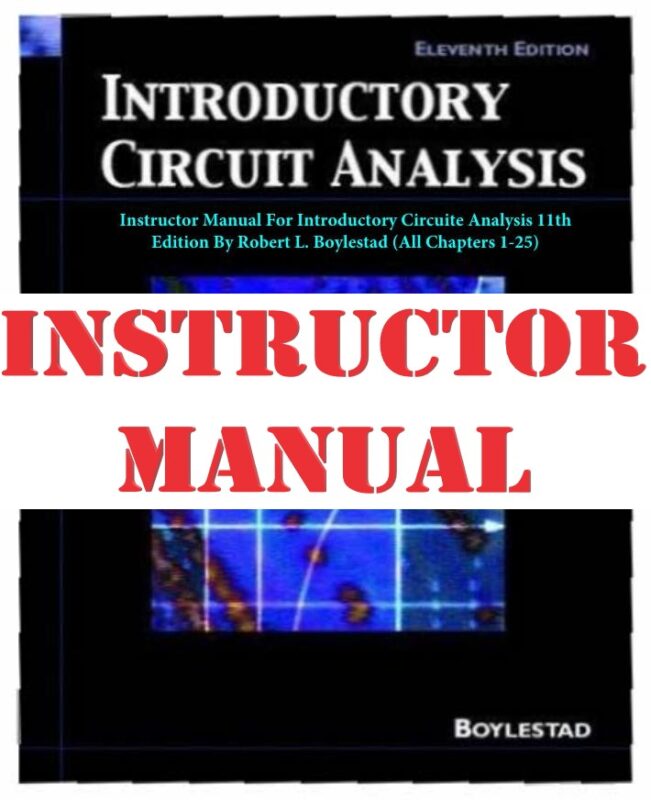
INSTRUCTOR MANUAL for Introductory Circuite Analysis 11th Edition By Robert L. Boylestad
$25.00
Secure checkout
Instant digital download
PDF document
Document details
- Pages
- 355
- File size
- 3.22 MB
- Format
- Digital PDF
- Course
- Education
- Category
- INSTRUCTOR MANUALS
Sign in or create a free account to continue. Your purchase will be saved in My Downloads.
About this ebook
INSTRUCTOR MANUAL for Introductory Circuit Analysis (11th Edition) by Robert L. Boylestad is a comprehensive textbook covering fundamental concepts in DC/AC circuit theory, analysis methodologies, and electrical components. Below is the complete list of all topics and chapters covered in this edition: [1, 2, 3]
Part I: Direct Current (DC) Circuits & Components
-
- Chapter 1: Introduction – Fundamental units, scientific notation, and measurement systems.
- Chapter 2: Voltage and Current – Atoms, electrical charge, voltage sources, ammeters, and voltmeters.
- Chapter 3: Resistance – Conductors, insulators, wire tables, temperature coefficients, and color coding.
- Chapter 4: Ohm's Law, Power, and Energy – Relationship between V, I, and R; efficiency, power calculations, and circuit breakers.
- Chapter 5: Series dc Circuits – Series resistors, Kirchhoff’s Voltage Law (KVL), voltage dividers, and internal resistance.
- Chapter 6: Parallel dc Circuits – Parallel elements, Kirchhoff’s Current Law (KCL), current dividers, and open/short circuits.
- Chapter 7: Series-Parallel Circuits – Network reduction techniques, ladder networks, and potentiometer loading.
- Chapter 8: Methods of Analysis and Selected Topics (dc) – Current sources, source conversions, mesh (loop) analysis, and nodal analysis.
- Chapter 9: Network Theorems – Superposition, Thévenin’s, Norton’s, and Maximum Power Transfer theorems.
- Chapter 10: Capacitors – Dielectrics, capacitance, transients (charging/discharging phases), and energy storage.
- Chapter 11: Inductors – Magnetic fields, inductance, RL transients, and inductor combinations.
- Chapter 12: Magnetic Circuits – Core materials, flux, reluctance, and hysteresis loops. [1, 2, 3, 4, 5, 6, 7, 8]
Part II: Alternating Current (AC) Circuits & Advanced Systems
-
- Chapter 13: Sinusoidal Alternating Waveforms – AC generation, frequency, phase relations, and average/RMS values.
- Chapter 14: The Basic Elements and Phasors – Response of R, L, and C elements to AC signals; phasor notation and complex numbers.
- Chapter 15: Series and Parallel ac Circuits – Impedance, admittance, phasor diagrams, and AC power relationships.
- Chapter 16: Series-Parallel ac Networks – Complex node and mesh configurations adapted for alternating currents.
- Chapter 17: Methods of Analysis and Selected Topics (ac) – Mesh analysis, nodal analysis, and bridge networks in AC systems.
- Chapter 18: Network Theorems (ac) – Application of Thévenin’s, Norton’s, and Superposition theorems to AC networks.
- Chapter 19: Power (ac) – Apparent power, reactive power, real power, and power factor correction.
- Chapter 20: Resonance – Series resonance, parallel resonance, quality factor (Q), and bandwidth.
- Chapter 21: Decibels, Filters, and Bode Plots – Logarithmic scales, low-pass/high-pass/bandpass filters, and frequency response plotting.
- Chapter 22: Transformers – Mutual inductance, iron-core transformers, impedance matching, and air-core transformers.
- Chapter 23: Polyphase Systems – Three-phase Y and Δ configurations, power measurements, and generation.
- Chapter 24: Pulse Waveforms and the R-C Response – Non-sinusoidal inputs, pulse parameters, and transient RC integration/differentiation.
- Chapter 25: Nonsinusoidal Circuits – Fourier series analysis and calculating circuit responses to complex waveforms. [1, 2, 3, 4, 5, 6]
File included
ScholarFriends.com-im-ready.pdf
3.22 MB
Related ebooks