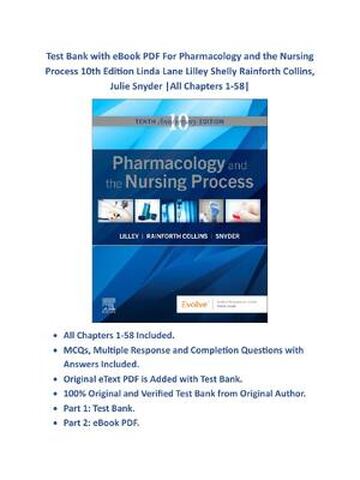
TEST BANK for Pharmacology and the Nursing Process 10th Edition Linda Lane Lilley | Test Bank
$30.00
Secure checkout
Instant digital download
PDF document
Document details
- Pages
- 310
- File size
- 7.44 MB
- Format
- Digital PDF
- Course
- Pharmacology
- Category
- TEST BANKS
Sign in or create a free account to continue. Your purchase will be saved in My Downloads.
About this ebook
TEST BANK for Pharmacology and the Nursing Process (10th Edition) by Linda Lane Lilley, Shelly Rainforth Collins, and Julie S. Snyder is structured around 58 chapters divided into 10 core parts. The textbook focuses heavily on safe medication administration by systematically integrating clinical drug knowledge with the five phases of the nursing process (Assessment, Human Need Statements, Planning, Implementation, and Evaluation). [1, 2, 3, 4]
The main topics and organizational parts covered in the 10th edition include:
Part 1: Pharmacology Basics
- The Nursing Process and Drug Therapy: How to apply patient-centered care and the "Nine Rights" of medication administration.
- Pharmacologic Principles: Core concepts of pharmacokinetics (absorption, distribution, metabolism, excretion) and pharmacodynamics.
- Lifespan Considerations: Tailoring drug therapy for pediatric, neonatal, and geriatric patients.
- Cultural, Legal, and Ethical Considerations: Institutional and societal factors governing drug safety, development, and administration.
- Medication Errors: Prevention strategies and proactive response plans.
- Patient Education & Consumer Health: Guiding patient understanding, over-the-counter (OTC) medications, and herbal or dietary supplements.
- Gene Therapy and Pharmacogenomics: Modern genomic influences on drug responses.
- Photo Atlas of Drug Administration: Visual, step-by-step techniques for safely delivering medications across various routes. [1, 2, 3, 4, 5, 6]
Parts 2 & 3: Central and Autonomic Nervous System Drugs
- Central Nervous System (CNS):
- Autonomic Nervous System (ANS):
- Adrenergic and adrenergic-blocking drugs
- Cholinergic and cholinergic-blocking drugs [1]
Parts 4 & 5: Cardiovascular, Renal, Endocrine, and Reproductive Drugs
- Cardiovascular & Renal Systems:
- Endocrine & Reproductive Systems:
- Pituitary, thyroid, and antithyroid medications
- Antidiabetic drugs and insulins
- Adrenal, women's health, and men's health reproductive drugs [1]
Parts 6, 7 & 8: Respiratory, Antiinfective, and Chemotherapeutic Drugs
- Respiratory System: Antihistamines, decongestants, antitussives, and bronchodilators (SABAs/LABAs). [1]
- Antiinfectives & Antiinflammatory Drugs:
- Chemotherapeutic Drugs & Biologic Modifiers: Antineoplastic medications, biologic response modifiers, and immunomodulating agents. [1, 2]
Parts 9 & 10: Gastrointestinal and Topic-Specific Drugs
File included
ScholarFriends.com-tb.pdf
7.44 MB
Related ebooks