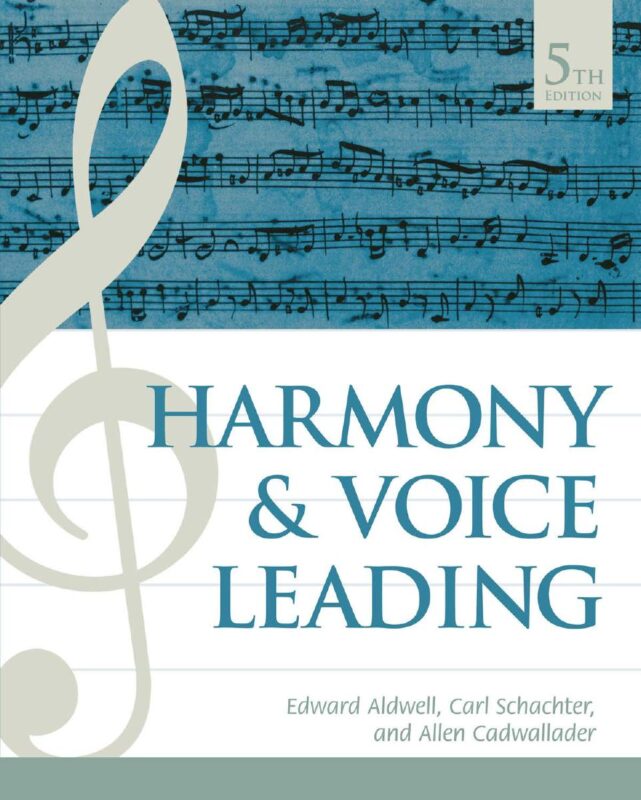
Harmony and Voice Leading 5th Edition By Edward Aldwell, Carl Schachter
$30.00
Secure checkout
Instant digital download
PDF document
Document details
- Pages
- 722
- File size
- 32.62 MB
- Format
- Digital PDF
- Course
- Education
- Category
- eBook[PDF]
Sign in or create a free account to continue. Your purchase will be saved in My Downloads.
About this ebook
The Harmony and Voice Leading (5th Edition) by Edward Aldwell, Carl Schachter, and Allen Cadwallader is a comprehensive, college-level textbook that covers the entirety of tonal music theory, diatonic harmony, counterpoint, and advanced chromaticism. [1, 2]
The book is celebrated for emphasizing the linear, horizontal flow of music (voice leading) alongside vertical chord structures, heavily drawing from Schenkerian analysis principles. The 5th edition also fully integrates the upper- and lower-case system of Roman numeral analysis starting in Unit 4. [1, 2]
Part I: The Primary Materials and Procedures
This introductory section covers the fundamental building blocks of music theory and linear motion. [1]
- Unit 1: Key, Scales, and Modes (Major/minor keys, tonality)
- Unit 2: Intervals (Overtone series, consonance vs. dissonance)
- Unit 3: Rhythm and Meter (Rhythmic organization and its relationship to dissonance)
- Unit 4: Triads and Seventh Chords (Introduction to chord qualities and structural texturing)
- Unit 5: Introduction to Counterpoint (A foundational look at Species Counterpoint, from 1st to 5th species)
- Unit 6: Procedures of Four-Part Writing (Chorale textures and standard voice-leading rules) [1, 2]
Part II: I-V-I and Its Elaborations
This section focuses on the most foundational harmonic progression in tonal music and how to expand it. [1]
- Unit 7: I, V, and V⁷ (Tonic and dominant relations in four parts)
- Unit 8: I⁶, V⁶, and \(vii^{\circ 6}\) (First inversions of primary chords)
- Unit 9: Inversions of V⁷ (V⁶₅, V⁴₃, and V⁴₂)
- Unit 10: Linear Substitutes for V: \(vii^{\circ 6}\) and Common-Tone Diminished Chords
- Unit 11: The I⁶₄ Chord and Introduction to Linear Progressions (Informally introducing Schenker's concept of linear progressions) [1]
Part III: 5/3 and 6/3 Chords in Diatonic Progressions
Students learn how to incorporate other diatonic scale degrees to create expansive phrases.
- The Leading to V: II and IV (Pre-dominant harmonies)
- The Cadential Progressions: Incorporating VI and III chords
- Contrapuntal Progressions: Linear uses of 5/3 and 6/3 chords, including basic chordal extensions
Part IV: Diatonic Seventh Chords and Harmonic Sequences
This section builds momentum through sequence and rhythmic dissonance.
- Secondary Seventh Chords: II⁷, IV⁷, VI⁷, and I⁷
- Harmonic Sequences: Descending fifths, ascending fifths, and linear contrapuntal sequences [1]
Part V: Chromatic Elements and Form
The final segments dive deeply into advanced harmonic techniques, voice-leading anomalies, and structural architecture. [1, 2]
- Tonal Modulation: Shifting between closely related keys
- Modal Mixture: Combining major and minor modes (borrowed chords)
- Chromatic Pre-Dominants: Neapolitan Sixth (N⁶) chords and Augmented Sixth chords (Italian, French, and German variants)
- Advanced Chromaticism: Tonicization, secondary dominants, and altered chords
- Musical Form: Large-scale structural analysis (binary, ternary, sonata elements, periods, and sentences) [1]
File included
tmpphpnSs5Rd
32.62 MB
Related ebooks