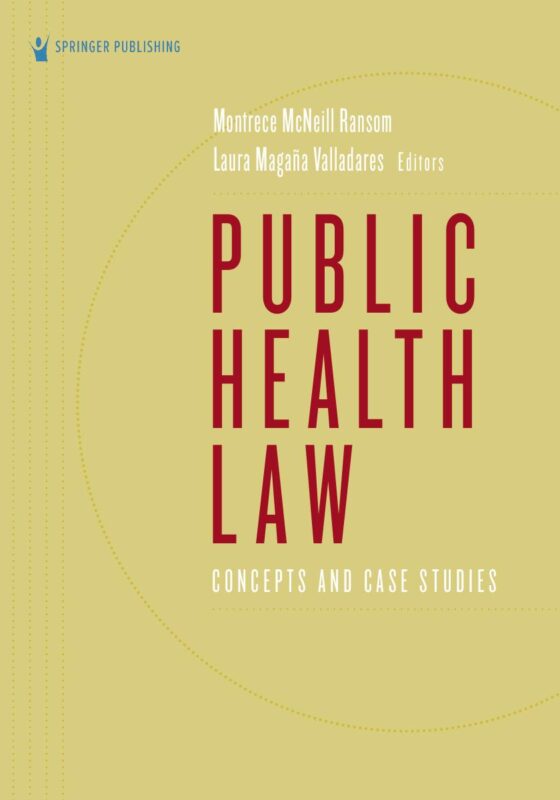
Public Health Law: Concepts and Case Studies By Montrece McNeill Ransom, Laura Magana Valladares
$30.00
Secure checkout
Instant digital download
PDF document
Document details
- Pages
- 375
- File size
- 2.7 MB
- Format
- Digital PDF
- Course
- Health Care
- Category
- eBook[PDF]
Sign in or create a free account to continue. Your purchase will be saved in My Downloads.
About this ebook
The textbook "Public Health Law: Concepts and Case Studies" by Montrece McNeill Ransom and Laura Magaña Valladares is systematically structured into three distinct parts spanning 21 chapters. It explores foundational legal frameworks, practical application through modern public health crises (including the COVID-19 pandemic), and interdisciplinary approaches to health equity. [1, 2, 3]
The full list of covered topics by section includes:
Part I: Law as the Foundation for Public Health Practice: Concepts
This section establishes the core legal mechanisms and limits of governmental authority within the United States. [, 2]
- U.S. Legal System: Sources of legislative and administrative authority.
- Constitutional Foundations: Fundamental legal doctrines and principles driving population health.
- Limitations on Authority: Deep dives into federal/state preemption and due process.
- Administrative Law: Regulatory processes and agency governance.
- Litigation: How lawsuits and judicial decisions shape public health policy. [1]
Part II: Law in the Everyday Practice of Public Health: Case Studies
This section applies legal theories to real-world scenarios, historical precedents, and health equity challenges across vulnerable populations. [1, 2]
- Immunization: Child and adult vaccination mandates, exemptions, and life-course laws.
- Infectious Diseases: Legal mechanisms for disease prevention, tracking, and outbreak control.
- Chronic Diseases: Legal levers used for chronic disease prevention and health lifestyle management.
- Intentional Injuries: Legal frameworks surrounding adolescent sexual violence prevention.
- Unintentional Injuries: Regulatory responses to the opioid use disorder epidemic.
- Emergency Law: Legal powers deployed during designated public health emergencies.
- Global Health Law: International health regulations and cross-border wellness initiatives.
- Environmental Health: The evolution of toxic substance, air, and water regulations.
- American Indians and Alaska Natives: Tribal law, sovereignty, and specific health protections.
- LGBTQ Populations: Civil rights, anti-discrimination laws, and gender-affirming healthcare access.
- Women’s Health: Legal protections regarding reproductive freedom and sexual health rights. [1]
Part III: Law: A Transdisciplinary Public Health Tool
The final section positions the law as an active tool that bridges science, epidemiology, and administrative decision-making. [1]
- Social Determinants: How structural laws systematically create or dismantle barriers to health equity.
- Health in All Policies (HiAP): Integrating public health benchmarks into non-health sectors like transportation and housing.
- Legal Epidemiology: The scientific study of law as a factor in disease distribution and prevention.
- Public Health Ethics: The intersection of morality, ethics, and population-level mandates when laws are vague.
- Executive Decision-Making: Strategic responsibilities, legal accountability, and structural consequences for health administrators. [1, 2, 3]
File included
tmpphp3Lm9UA
2.7 MB
Related ebooks