
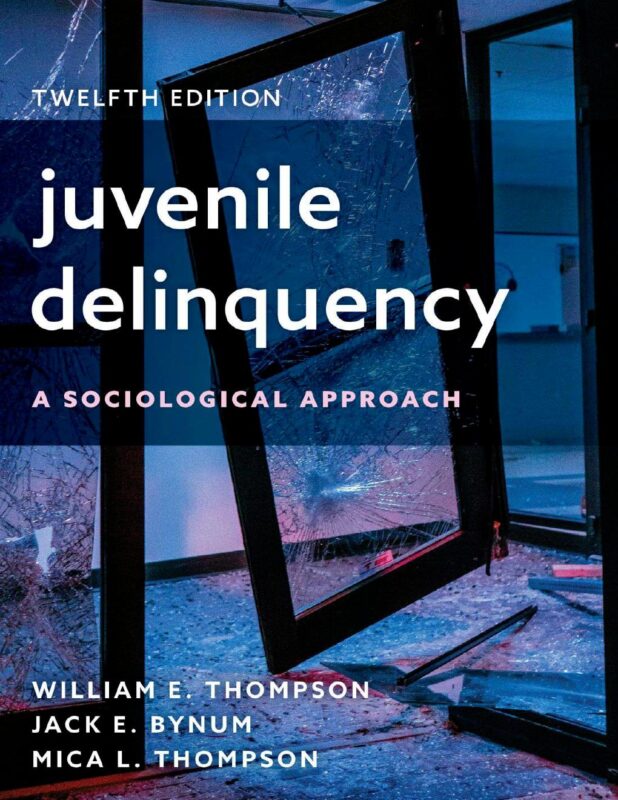
Juvenile Delinquency: A Sociological Approach 12th Edition By William Thompson, Jack Bynum, Mica Thompson
$30.00
Secure checkout
Instant digital download
PDF document
Document details
- Pages
- 363
- File size
- 15.1 MB
- Format
- Digital PDF
- Course
- Social Sciences
- Category
- eBook[PDF]
Sign in or create a free account to continue. Your purchase will be saved in My Downloads.
About this ebook
Juvenile Delinquency: A Sociological Approach (12th Edition) by William E. Thompson, Jack E. Bynum, and Mica L. Thompson explores delinquency by focusing on how it emerges from a youth's family, neighborhood, school, peer group, social class, and overall cultural environment. [1, 2]
The textbook is structurally organized into five core thematic parts: [1]
Part I: Conformity, Deviance, and Juvenile Delinquency
-
- The Act, Actor, and Audience: Defining the sociological perspective of delinquency and status offenses.
- Social Norms and Conformity: How society establishes boundaries, rules, and expectations for adolescent behavior.
- Dimensions of the Problem: Analyzing data, statistics, and trends related to the prevalence of youth crime. [1, 2, 3]
Part II: Causes of Juvenile Delinquency (Theoretical Frameworks)
-
- Non-Sociological Explanations: Classical, biological, and psychogenic (psychological) theories of individual deviance.
- Social Strain & Cultural Transmission: Exploring systemic theories like Anomie, general strain, and social disorganization (e.g., Shaw and McKay).
- Social Learning & Social Control: Investigating differential association, peer pressure, and weak social bonds.
- Labeling & Radical/Conflict Theories: Looking at how official societal labels stigmatize youth and reinforce criminal identities.
- Modern Lifecourse Theories: Maturation, rational choice, deterrence, and Feminist theories. [1, 2, 3, 4, 5, 6]
Part III: Juvenile Delinquency in a Social Context
-
- The Family Unit: The role of family dynamics, unstable homes, and parental oversight.
- Schools and Education: Impact of poor attendance, academic standards, and the school environment.
- Youth Subcultures: Highlighting the influence of youth peer groups, style, and independent norms.
- Juvenile Gangs: The structure, collective behavior, and criminal dynamics of adolescent street gangs. [1, 2, 3, 4]
Part IV: Applied Theory: Social Control and the Juvenile Justice System
Part V: Applied Theory: Strategies for Dealing with Juvenile Delinquency
Key Features New to the 12th Edition
- Intersectionality Sections: Every chapter includes a dedicated analysis of how social factors like race, sex, gender identity, and sexual orientation intersect with the juvenile justice experience.
- Global Focus Boxes: Cross-cultural comparisons looking at youth deviance in different global societies.
- Controversial Issues: Exploration of timely topics including TV/media violence, capital punishment for minors, and systemic biases. [1, 2, 3, 4]
File included
tmpphp2NxzTl
15.1 MB
Related ebooks