Solutions Manual For Criminal Justice Policy and Planning: Planned Change, 6th Edition By Wayne N. Welsh, Philip W. Harris, Bradley D. Edwards
$22.00
Secure checkout
Instant digital download
PDF document
Document details
- Pages
- 88
- File size
- 1.13 MB
- Format
- Digital PDF
- Course
- Business
- Category
- SOLUTIONS MANUAL
Sign in or create a free account to continue. Your purchase will be saved in My Downloads.
About this ebook
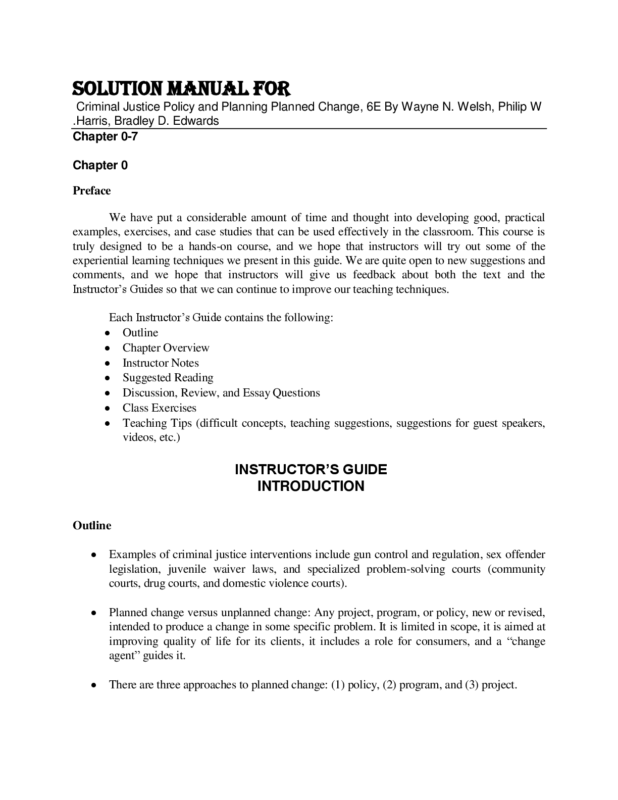
The Solutions Manual For Criminal Justice Policy and Planning: Planned Change (6th Edition) by Wayne N. Welsh, Philip W. Harris, and Bradley D. Edwards is structured around a seven-stage model for administering rational, planned change in the criminal justice system. [1, 2]
The book is available through publishers and platforms like Routledge and VitalSource. Below is a comprehensive breakdown of the specific topics and chapters covered in this edition. [1, 2]
The Seven-Stage Planning Model
The core framework of the book covers the entire life cycle of program and policy development: [1]
- Introduction: Defining planned change versus unplanned change and reacting to system crises.
- Chapter 1: Analyzing the Problem: Conducting systems analysis and defining criminal justice issues.
- Chapter 2: Setting Goals and Objectives: Specifying target populations and defining desired policy outcomes.
- Chapter 3: Designing the Program or Policy: Creating an explicit impact model to address the problem.
- Chapter 4: Action Planning: Developing operational plans, resource allocation, and cost projections.
- Chapter 5: Problem/Policy Implementation and Monitoring: Methods for collecting monitoring data and tracking ongoing program fidelity.
- Chapter 6: Evaluating Outcomes: Utilizing research designs to perform rigorous program evaluations.
- Chapter 7: Reassessment and Review: Modifying, institutionalizing, or terminating policies based on data.
- Appendix: A practical Seven-Stage Checklist for Program/Policy Planning and Analysis. [1, 2, 3]
Essential Procedures & Planning Tools
- Systems Analysis: Understanding how different parts of the justice system interact.
- Impact Modeling: Mapping out how a specific intervention logically leads to intended results.
- Target Population Identification: Defining exactly who a policy or program is meant to serve.
- Cost Projections: Estimating budget needs, resource constraints, and financial feasibility.
- Monitoring & Data Collection: Establishing data loops to oversee staff and client compliance. [1]
Real-World Case Studies & Innovations
File included
Solution-Manual-For-Criminal-Justice-Policy-and-Planning-Planned-Change-6E-By-Wayne-N.-Welsh-Philip-W.-Harris-Bradley-D.-Edwards.pdf
1.13 MB
Related ebooks