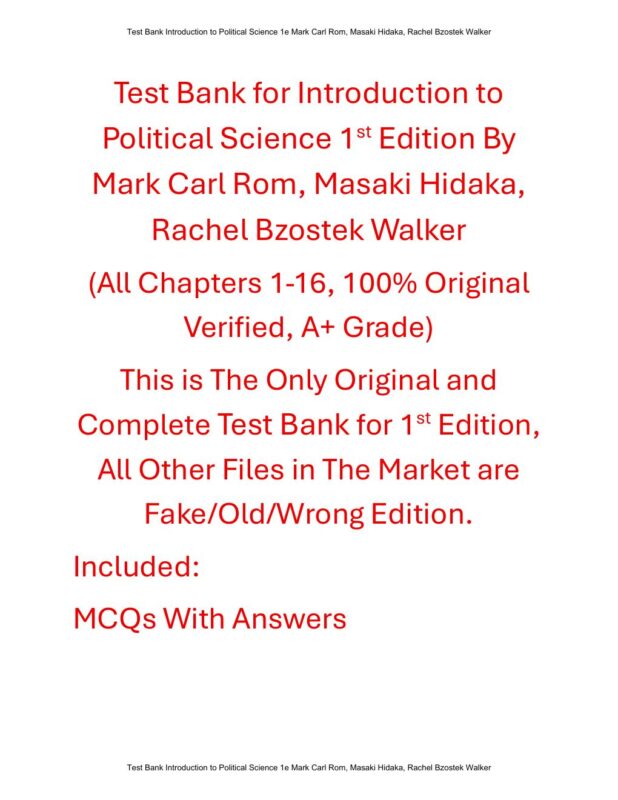
Test Bank For Introduction to Political Science 1st Edition By Mark Carl Rom, Masaki Hidaka, Rachel Bzostek Walker
$30.00
Secure checkout
Instant digital download
PDF document
Document details
- Pages
- 122
- File size
- 4.74 MB
- Format
- Digital PDF
- Course
- Political Science
- Category
- TEST BANKS
Sign in or create a free account to continue. Your purchase will be saved in My Downloads.
About this ebook
The 1st edition of Test Bank For Introduction to Political Science by Mark Carl Rom, Masaki Hidaka, and Rachel Bzostek Walker—published openly via OpenStax—is organized around five core building blocks. Instead of separating fields like comparative politics and international relations into rigid siloes, it weaves them together using individual, group, institutional, and global viewpoints. [1, 2, 3]
The textbook covers the following comprehensive topics structured by units:
Unit 1: Introduction to Political Science
- What Is Politics and Political Science?: Defining political power and the public interest. It contrasts normative political science (what politics should be) with empirical political science (data-driven tracking of what politics is). [1, 2]
Unit 2: Individuals
- Political Behavior: Examining human behavior, motivation, and personal decision-making in the political sphere. [1, 2]
- Political Ideologies: Overview of foundational and modern worldviews, covering liberalism, conservatism, populism, nationalism, fascism, and environmentalism. [1, 2]
- Political Socialization and Culture: How individuals acquire their beliefs through family, education, and social environments.
- Public Opinion: The mechanisms of public sentiment, poll construction, and exploring phenomena like social desirability and response bias. [1]
Unit 3: Groups
- Political Participation and Elections: Voting behavior, voter turnout, and barriers to participation globally.
- Interest Groups and Political Parties: How citizen groups pool resources to influence policy versus how political parties compete directly to win office.
- Civil Liberties: Fundamental constitutional protections like freedom of speech, assembly, and religion.
- Civil Rights: Concepts of legal equity, anti-discrimination laws, and social movements (such as Me Too) pushing for marginalized groups. [1, 2]
Unit 4: Institutions
- Legislatures: The structure, rules, and lawmaking responsibilities of assemblies and parliaments worldwide.
- Executives, Cabinets, and Bureaucracies: Executive management, governance execution, and administrative structures.
- Courts and Law: Legal frameworks, judicial review, and how judges interpret constitutions.
- The Media: The evolution of print, broadcast, and social media platforms, exploring their impact on elections and declining global trust. [1, 2, 3]
Unit 5: States and International Relations
- The State: Definitions of sovereignty, statehood, and political regimes (democracies versus authoritarian regimes).
- International Relations: Power measurement, state versus non-state actors, international anarchy, and systemic conflict analyzed through Realist, Liberal, and Critical worldviews.
- International Cooperation and Law: The operations of the United Nations, global agreements (like the Geneva Conventions), and international legal boundaries.
- International Political Economy: The intersection of global trade, finance, and domestic political decisions.
- Public Policy: The lifecycle of policy from agenda-setting and formulation to execution and global evaluation. [1, 2, 3, 4, 5]
File included
tmpphpHl9niz
4.74 MB
Related ebooks