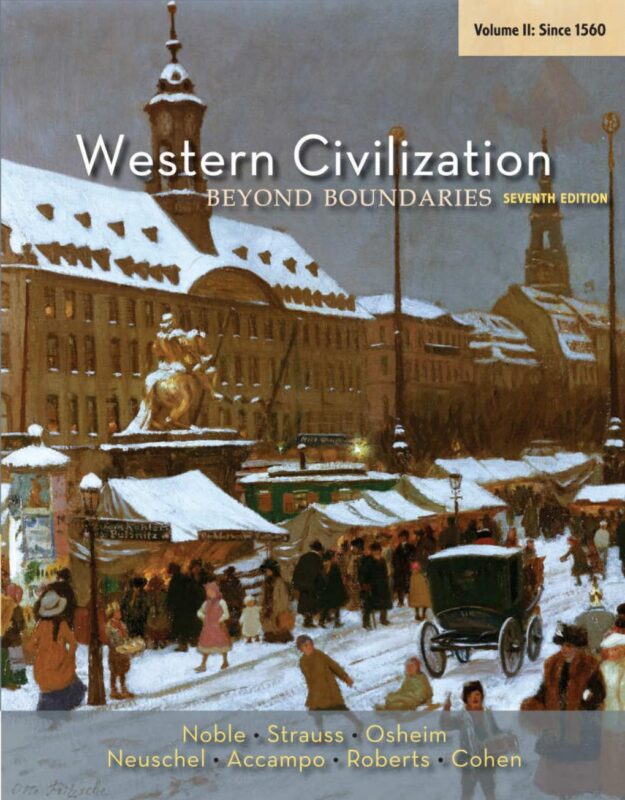
Western Civilization: Beyond Boundaries, Volume II: Since 1560 7th Edition By Thomas Noble, Barry Strauss, Duane Osheim, Kristen Neuschel, Elinor Accampo, David Roberts, William Cohen
$30.00
Secure checkout
Instant digital download
PDF document
Document details
- Pages
- 542
- File size
- 2.3 MB
- Format
- Digital PDF
- Course
- History
- Category
- eBook[PDF]
Sign in or create a free account to continue. Your purchase will be saved in My Downloads.
About this ebook
Western Civilization: Beyond Boundaries, Volume II: Since 1560 (7th Edition) by Thomas F.X. Noble, Barry Strauss, Duane Osheim, et al., covers the historical trajectory of Western civilization from the late Renaissance and early modern religious conflicts through to the 21st century. [1, 2]
The textbook is highly regarded for integrating a broader geographical scope—incorporating Eastern Europe, Scandinavia, and global European frontiers—while consistently exploring Europe's interaction with the wider world. [1, 2]
Volume II contains Chapters 15 through 30. The primary topics and chapter themes covered include: [1, 2]
Early Modern Europe & Transformation (Chapters 15–18)
- The Age of Religious Wars (1560–1648): The French Wars of Religion, the Dutch Revolt, the rise of Elizabethan England, and the devastation of the Thirty Years' War. [1]
- Absolutism and Constitutionalism (ca. 1640–1715): The consolidation of absolute monarchy under Louis XIV in France alongside the development of constitutionalism and the Glorious Revolution in England. [1, 2, 3]
- Power Shifts in Eastern Europe: The expansion of the Ottoman Empire, the rise of the Habsburg Monarchy in Austria, the emergence of Prussia, and the Westernization of Russia under Peter the Great. [1, 2]
- A Revolution in Worldview: The Scientific Revolution, the emergence of the new astronomy and physics (Galileo, Newton), and the intellectual shift into the Enlightenment. [1, 2]
Enlightenment, Expansion, and Revolution (Chapters 19–22)
- Eighteenth-Century Empire and Expansion: Global trade networks, the transatlantic slave trade, colonial rivalries between Britain and France, and social life in the 18th century.
- The French Revolution and Napoleon: The collapse of the Old Regime, the radical phase of the revolution (the Terror), the rise of Napoleon Bonaparte, and his restructuring of the European continent.
- The Industrial Revolution: The origins of industrialization in Great Britain, the spread of factories and steam power to continental Europe, and the sweeping social transformations, urbanization, and emergence of the working class. [1]
Ideologies and Nations in the 19th Century (Chapters 23–25)
- Ideological Conflicts and Restructuring (1815–1848): The Congress of Vienna, the battle between conservative restoration and rising liberal and socialist ideologies, culminating in the Revolutions of 1848.
- The Age of Nationalism: The unification of Italy (Cavour and Garibaldi) and Germany (Bismarck), alongside the modernization and changing social structures of nation-states.
- The Mass Society and Imperialism: Changes in late 19th-century European life, cultural shifts (Modernism), and the "Scramble for Africa" and Asia during the height of New Imperialism. [1]
The Global Wars and Totalitarian Crisis (Chapters 26–28)
- World War I and the Russian Revolution: The system of alliances, the outbreak of total war, trench warfare on the Western Front, the collapse of the Romanov dynasty, and the Bolshevik rise to power.
- The Interwar Crisis: The failures of the Treaty of Versailles, the Great Depression, the cultural anxieties of the 1920s and 30s, and the rise of totalitarian regimes (Fascism in Italy, Nazism in Germany, and Stalinism in the USSR).
- World War II and the Holocaust: Global military strategies, the horrors of the Holocaust, the devastation of European infrastructure, and the atomic conclusion of the war. [1]
The Contemporary Era (Chapters 29–30)
- The Cold War and Postwar Recovery: The division of Europe, the creation of NATO and the Warsaw Pact, decolonization across Africa and Asia, and the birth of the European Economic Community (EEC). [1]
- The Fall of communism and Globalization: The collapse of the Soviet Union (1991), the unification of Germany, the expansion of the European Union, post-Cold War ethnic conflicts, and the 21st-century challenges of global terrorism, economic shifts, and environmental issues. [1]
File included
tmpphpPwJdAb
2.3 MB
Related ebooks