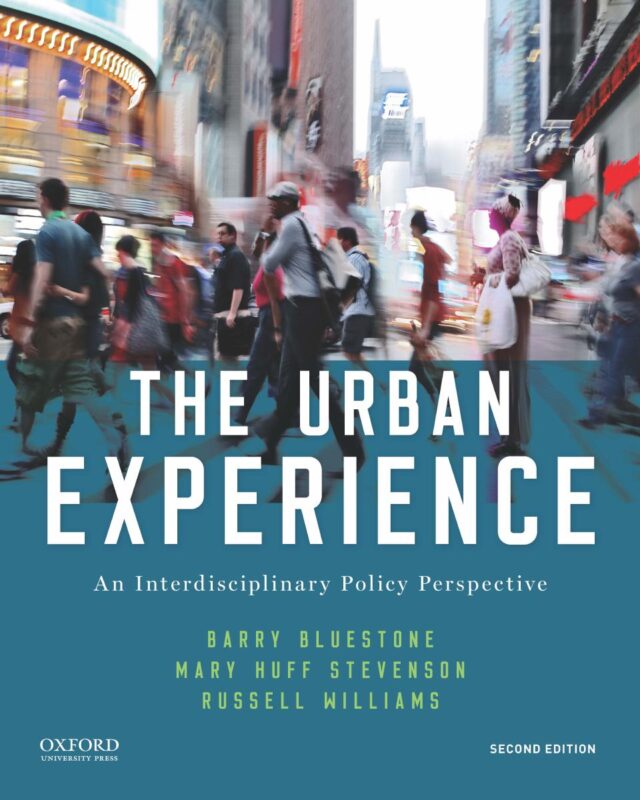
The Urban Experience An Interdisciplinary Policy Perspective 2nd Edition By Barry Bluestone, Mary Huff Stevenson, Russell Williams
$30.00
Secure checkout
Instant digital download
PDF document
Document details
- Pages
- 640
- File size
- 8.63 MB
- Format
- Digital PDF
- Course
- Business
- Category
- eBook[PDF]
Sign in or create a free account to continue. Your purchase will be saved in My Downloads.
About this ebook
The The Urban Experience: An Interdisciplinary Policy Perspective (2nd Edition), co-authored by Barry Bluestone, Mary Huff Stevenson, and Russell E. Williams, features a wealth of material organized into 17 chapters across four distinct parts. The book utilizes an interdisciplinary lens—combining economics, sociology, political science, urban studies, and public policy—structured around a central analytical framework called the Metropolitan Area Dynamic. [1, 2, 3]
The broad topics and themes covered in the text include:
Core Book Structure
According to academic reviews of the book's 600-page layout, the chapters are divided into four primary focal areas: [1]
- Part I: Introduction to Urban Life: An overview of the major dimensions, histories, and lived experiences of urban and suburban communities. [1, 2]
- Part II: Dynamics of Metropolitan Development: Explores how cities evolve, change, and expand over time under the influence of demographic and political shifts. [1, 2]
- Part III: Foundations of Prosperity: Examines the economic drivers that allow modern metropolitan areas to grow and maintain financial stability. [1]
- Part IV: Present-Day Policy Challenges: Direct coverage of contemporary crises and policy execution in 21st-century cities. [1, 2]
Key Themes and Topics Covered
Throughout these sections, the authors explicitly connect specific public policy sectors to broader societal dynamics, covering topics such as: [1]
- The Metropolitan Area Dynamic: Introduced in Chapter 1, this overarching framework tracks how demographic, economic, political, social, and policy forces continuously interact to reshape metropolitan areas.
- Economic Drivers & Commerce: Deep exploration of trade, local labor markets, and the changing role of U.S. metropolitan areas amid stiffening global economic competition.
- Infrastructure & Infrastructure Systems: Comprehensive analysis of city logistics, transit networks, and transportation planning.
- Housing and Land Use: Examination of housing markets, zoning, suburbanization, and neighborhood demographic shifts.
- Public Well-being & Safety: Policy evaluations surrounding municipal public safety strategies and urban healthcare infrastructure.
- Global and Environmental Challenges: Broadened comparative discussions detailing how cities globally confront large-scale modern issues like climate change, modern immigration/migration, and deep-seated socio-economic inequality. [1, 2]
File included
tmpphpSru1oS
8.63 MB
Related ebooks
![eBook Educational Research Fundamental Principles and Methods [rental 8th Edition] By James H McMillan](https://greatpricebooks.com/wp-content/uploads/2026/09/6krRzaeT2025-10-17-11-3568f2a8ae7845e.png)