
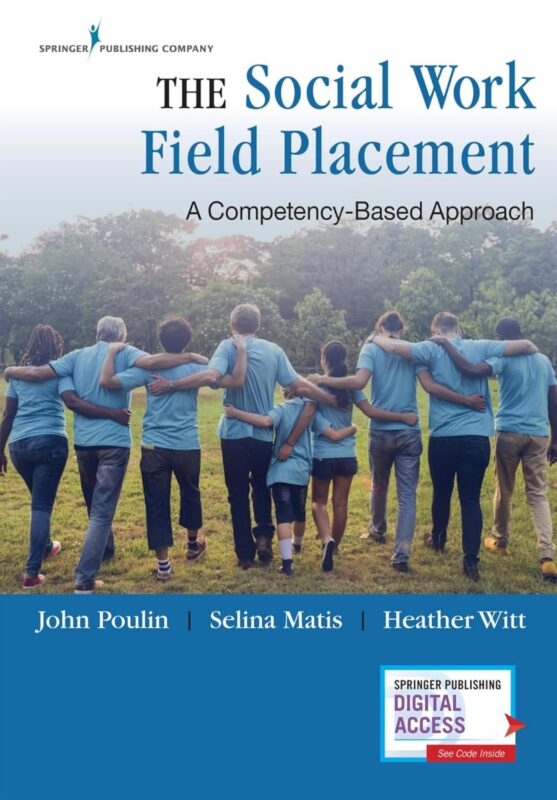
The Social Work Field Placement A Competency Based Approach 1st Edition By John Poulin, Selina Matis, Heather Witt
$30.00
Secure checkout
Instant digital download
PDF document
Document details
- Pages
- 359
- File size
- 4.11 MB
- Format
- Digital PDF
- Course
- Education
- Category
- eBook[PDF]
Sign in or create a free account to continue. Your purchase will be saved in My Downloads.
About this ebook
The Social Work Field Placement: A Competency-Based Approach" (1st Edition) by John Poulin, Selina Matis, and Heather Witt is explicitly structured around the nine core professional competencies established by the Council on Social Work Education (CSWE) Educational Policy and Accreditation Standards (EPAS). [1, 2, 3]
The textbook is divided into two primary sections that cover the following topics: [1]
Part I: Foundations for a Successful Field Placement
This section focuses on preparing BSW and MSW students for the structural, logistical, and cultural realities of their internship environment. Key topics include: [1, 2]
- Navigating the Agency: Understanding agency organizational culture and how it operates within its unique community context.
- Field Supervision: How to effectively utilize supervision, including managing expectations and creating a performance improvement plan.
- Integration of Learning: Purposefully linking classroom-acquired theory and social welfare policy research with real-world practice. [1, 2]
Part II: The Nine CSWE Social Work Competencies
Each subsequent chapter isolates one of the nine mandated CSWE professional competencies, using realistic case scenarios to teach students how to master and directly demonstrate them in the field. These core topics map directly to the competencies: [1, 2]
- Demonstrating Professional and Ethical Behavior – Navigating ethical dilemmas, professional boundaries, and utilizing supervision effectively in practice settings. [1, 2]
- Engaging Diversity and Difference in Practice – Recognizing and managing the impact of diversity, intersectionality, and personal biases when working with clients. [1]
- Advancing Human Rights and Social, Economic, and Environmental Justice – Applying strategies to combat oppression and advocate for structural justice across systems. [1, 2]
- Engaging in Practice-Informed Research and Research-Informed Practice – Using evidence-based research to guide field interventions and evaluating one's own practice outcomes. [1]
- Engaging in Policy Practice – Analyzing, proposing, and advocating for policies that advance social well-being, framed around current NASW priorities. [1]
- Engaging with Individuals, Families, Groups, Organizations, and Communities – Utilizing micro, mezzo, and macro framework strategies to build entry-level rapport and professional relationships. [1]
- Assessing Individuals, Families, Groups, Organizations, and Communities – Synthesizing client strengths, limitations, socioeconomic factors, and environmental contexts to form an accurate diagnosis or problem overview. [1]
- Intervening with Individuals, Families, Groups, Organizations, and Communities – Implementing evidence-based, collaborative intervention strategies tailored to specific practice settings. [1]
- Evaluating Practice with Individuals, Families, Groups, Organizations, and Communities – Critically appraising and data-tracking the effectiveness of programs and applied interventions using tools like reflection logs. [1, 2]
Integrated Learning Pedagogy
Within every competency-focused chapter, the authors cover topics through a consistent pedagogical lens: [1]
File included
ScholarFriends.com-the-social-work-field-placement-a-competency-based-approach-1st-edition-by-john-poulin-sel.pdf
4.11 MB
Related ebooks



