
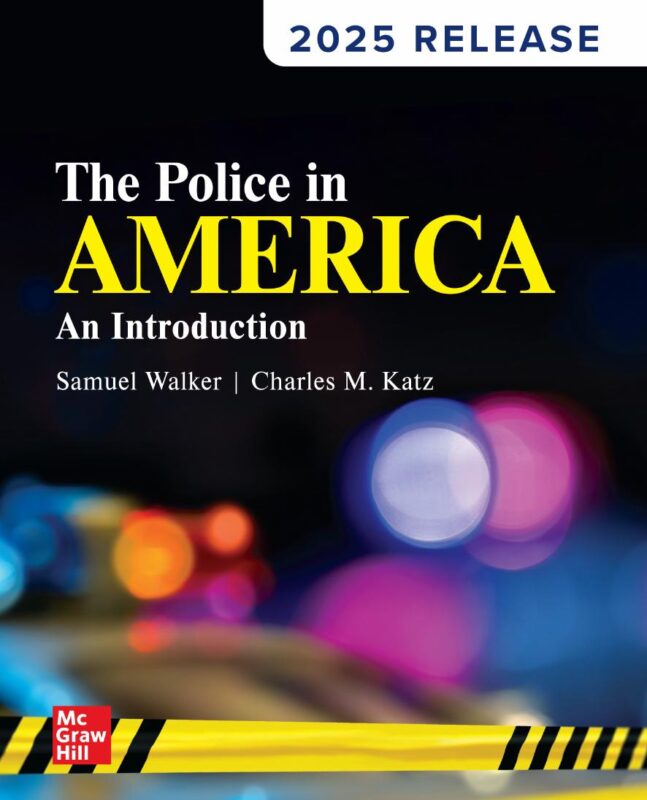
The Police in America An Introduction 2025 Release By Samuel Walker
$30.00
Secure checkout
Instant digital download
PDF document
Document details
- Pages
- 641
- File size
- 21.32 MB
- Format
- Digital PDF
- Course
- Education
- Category
- eBook[PDF]
Sign in or create a free account to continue. Your purchase will be saved in My Downloads.
About this ebook
The The Police in America: An Introduction (2025 Release), co-authored by Samuel Walker and Charles M. Katz and published by McGraw Hill, is a comprehensive survey of modern U.S. law enforcement. The book spans 15 chapters structured into five foundational parts that guide students through the history, daily routines, social dilemmas, and upcoming transformations of policing. [1, 2, 3]
Part I: Foundations
This section outlines the basic structural frameworks, social context, and legislative realities of modern police departments. [1]
- Police and Society: The civic role of the police and how public perception shapes modern law enforcement. [1]
- The History of the American Police: An evolutionary overview of policing eras, tracing historical transformations from early constable systems to modern professionalized forces. [1]
- The Contemporary Law Enforcement Industry: The fragmented nature of local, county, state, and federal law enforcement agencies operating across the country. [1]
Part II: Officers and Organizations
This section shifts focus to the institutional infrastructure of departments and the individuals who make up the police force. [1]
- Police Organizations: The bureaucratic and structural layout of police departments, detailing chain of command and administrative styles. [1]
- Entering Police Work: Recruitment, vetting, hiring criteria, academy training programs, and the changing demographics of incoming recruits. [1]
- On the Job: The occupational subculture, career paths, daily working conditions, and psychological pressures faced by active officers. [1]
Part III: Police Work
This section analyzes the operational tasks, proactive tactics, and tactical approaches used to maintain public safety. [1]
- Patrol as the Backbone of Policing: Strategies for regular vehicle or foot patrol, response dynamics, and workload distribution.
- Peacekeeping and Order Maintenance: Handling non-criminal calls, settling civil disputes, managing public spaces, and resolving de-escalation scenarios.
- The Police and Crime: Criminal investigation techniques, detective work, evidence gathering, and measuring crime control effectiveness.
- Innovations in Police Strategy: Modern operational paradigms such as community-oriented policing (COP), problem-oriented policing (POP), and data-driven methods like CompStat. [1, 2]
Part IV: Issues in Policing
This section deals directly with systemic, professional, and ethical issues surrounding systemic governance and civilian interactions. [1]
- Police Discretion: How officers exercise individual decision-making power on the street and the mechanisms used to control or guide that authority.
- Police-Community Relations: Exploring racial dynamics, building public trust, reducing bias, and historical areas of community friction.
- Police Corruption: Defining occupational misconduct, internal institutional failures, and methods to detect or mitigate corrupt practices.
- Accountability of the Police: Internal affairs procedures, civilian oversight boards, federal consent decrees, and mechanisms holding officers responsible for the use of force. [1, 2, 3]
Part V: Challenges for a New Century
The final chapter acts as a forward-looking analysis of modern law enforcement. [1]
File included
ScholarFriends.com-the-police-in-america-an-introduction-2025-release-by-samuel-walker.pdf
21.32 MB
Related ebooks



