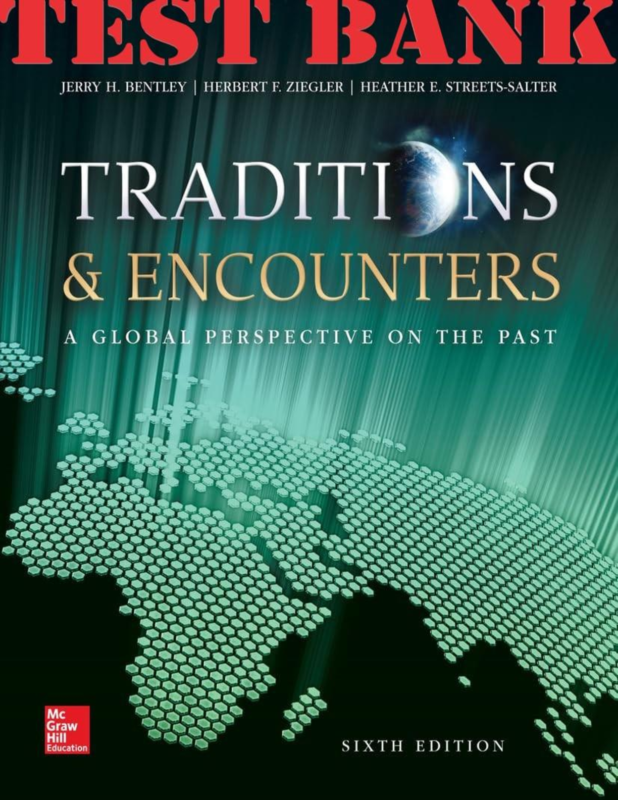
TEST BANK for Traditions & Encounters: A Global Perspective on the Past 6th Edition by Bentley, Ziegler, Streets Salter | All Chapters 1-38
$24.00
Secure checkout
Instant digital download
PDF document
Document details
- Pages
- 1,054
- File size
- 5.45 MB
- Format
- Digital PDF
- Course
- Education
- Category
- TEST BANKS
Sign in or create a free account to continue. Your purchase will be saved in My Downloads.
About this ebook
TEST BANK for Traditions & Encounters: A Global Perspective on the Past (6th Edition) by Jerry H. Bentley, Herbert F. Ziegler, and Heather Streets-Salter is structured around a seven-part chronological framework. Across 38 chapters, the textbook focuses on the historical development of individual societies ("traditions") and the profound cross-cultural interactions that linked them ("encounters"). [1, 2, 3]
Part 1: The Early Complex Societies (3500 to 500 B.C.E.)
This section explores the transition of human societies from foraging bands to structured, agricultural civilizations. [1]
- Chapter 1: Before History – Paleolithic foraging, the Neolithic revolution, and the origins of agriculture and urban life. [1]
- Chapter 2: Early Societies in Southwest Asia and the Indo-European Migrations – Mesopotamia, cuneiform, and early state building. [1, 2]
- Chapter 3: Early African Societies and the Bantu Migrations – Ancient Egyptian and Nubian civilizations alongside sub-Saharan Bantu migrations. [1]
- Chapter 4: Early Societies in South Asia – Harappan (Indus Valley) society and the rise of Vedic society. [1]
- Chapter 5: Early Society in Mainland East Asia – Neolithic societies, early Chinese dynasties (Xia, Shang, and Zhou), and family structures. [1]
- Chapter 6: Early Societies in the Americas and Oceania – Olmecs, early Andean societies, and the migration of Austronesian peoples. [1]
Part 2: The Formation of Classical Societies (ca. 500 B.C.E. to ca. 500 C.E.)
This section details the rise of large centralized empires, complex socio-economic structures, and foundational world religions. [1]
- Chapter 7: The Empires of Persia – Achaemenid, Seleucid, Parthian, and Sasanian imperial organization.
- Chapter 8: The Unification of China – Qin and Han dynasties, Confucianism, Legalism, and Daoism.
- Chapter 9: State, Society, and the Quest for Salvation in India – Mauryan and Gupta empires, Hinduism, Jainism, and early Buddhism.
- Chapter 10: Mediterranean Society: The Greek Phase – Minoan, Mycenaean, and classical Greek city-states, colonization, and culture.
- Chapter 11: Mediterranean Society: The Roman Phase – The Roman Republic, the expansion into the Roman Empire, and the rise of Christianity.
- Chapter 12: Cross-Cultural Exchanges on the Silk Roads – Trade networks, the spread of religion, and the impact of epidemic diseases during the late classical era. [1, 3]
Part 3: The Postclassical Era (500 to 1000 C.E.)
This section deals with the collapse of classical empires and the subsequent emergence of trans-regional political and religious networks. []
- Chapter 13: The Resurgence of Empire in East Asia – Sui, Tang, and Song dynasties, and the sinification of Korea, Vietnam, and Japan.
- Chapter 14: The Expansive Realm of Islam – The prophet Muhammad, the Umayyad and Abbasid caliphates, and the expansion of the Islamic economy.
- Chapter 15: India and the Indian Ocean Basin – Postclassical northern and southern India, and trans-regional trade networks across the Indian Ocean.
- Chapter 16: The Two Worlds of Christendom – The Byzantine Empire in the east and Western European feudal kingdoms. []
Part 4: The Acceleration of Cross-Cultural Interaction (1000 to 1500 C.E.)
This section outlines nomadic integrations, expanding trade circuits, and the devastation of global plagues. []
- Chapter 17: Nomadic Empires and Eurasian Integration – Turkish and Mongol conquests, Pax Mongolica, and Eurasian trade connections.
- Chapter 18: States and Societies of Sub-Saharan Africa – Islamic kingdoms (Ghana, Mali), Swahili city-states, and traditional social structures.
- Chapter 19: The Increasing Influence of Europe – High Middle Ages, the Holy Roman Empire, the Crusades, and scholasticism.
- Chapter 20: Worlds Apart: The Americas and Oceania – Aztec (Mexica) and Inca empires alongside Pacific island societies.
- Chapter 21: Expanding Horizons of Cross-Cultural Interaction – Diplomatic, missionary, and commercial travel (e.g., Ibn Battuta, Marco Polo) and the impact of the Black Death. [, 2, 3]
Part 5: The Origins of Global Interdependence (1500 to 1800)
This section looks at early modern globalization catalyzed by transoceanic voyages and imperialism. []
- Chapter 22: Transoceanic Encounters and Global Connections – European exploration, the Columbian Exchange, and global trade networks.
- Chapter 23: The Transformation of Europe – The Protestant Reformation, the Scientific Revolution, the Enlightenment, and the consolidation of sovereign states.
- Chapter 24: New Worlds: The Americas and Oceania – Spanish, Portuguese, French, and English colonization, and the exploitation of Indigenous societies.
- Chapter 25: Africa and the Atlantic World – The trans-Atlantic slave trade, the rise of West African empires, and the African diaspora.
- Chapter 26: Tradition and Change in East Asia – Ming and Qing dynasties in China and the Tokugawa Shogunate in Japan.
- Chapter 27: The Islamic Empires – The rise and decline of the Ottoman, Safavid, and Mughal empires. [, 2, 3, 4]
Part 6: An Age of Revolution, Industry, and Empire (1750 to 1914)
This section addresses global power shifts driven by political revolutions, Western industrialization, and imperial expansion. []
- Chapter 28: Revolutions and National States in the Atlantic World – American, French, Haitian, and Latin American revolutions, and the rise of nationalism.
- Chapter 29: The Making of Industrial Society – The Industrial Revolution, technological advancements, urbanization, and the rise of socialism.
- Chapter 30: The Americas in the Age of Independence – State-building, political fragmentation, and expansion in North, Central, and South America.
- Chapter 31: Societies at Crossroads – Ottoman, Russian, Qing, and Tokugawa defensive modernization efforts under pressure from Western powers.
- Chapter 32: The Building of Global Empires – 19th-century New Imperialism, the Scramble for Africa, and imperial expansion in Asia and the Pacific. [, 2]
Part 7: Contemporary Global Realignments (1914 to the Present)
This final section evaluates the geopolitical conflicts and socioeconomic realities of the modern globalized world. [1, 2]
- Chapter 33: The Great War: The World in Upheaval – Origins, execution, and societal impacts of World War I.
- Chapter 34: An Age of Anxiety – Interwar disillusionment, the Great Depression, and the rise of totalitarian regimes (Fascism and Nazism).
- Chapter 35: Nationalism and Political Realignment in the Non-Western World – Anti-colonial struggles, nationalist movements in Asia, Africa, and Latin America.
- Chapter 36: New Conflagrations: World War II and the Cold War – Outbreak of WWII, global devastation, and the subsequent US-Soviet geopolitical divide.
- Chapter 37: The End of Empire – Decolonization processes across Africa, Asia, and the Middle East, and post-colonial challenges.
- Chapter 38: A World Without Borders – Contemporary globalization, international economics, modern technological revolutions, and global environmental issues. [1, 2]
File included
TEST-BANK-for-Traditions-Encounters-A-Global-Perspective-on-the-Past-6th-Edition-by-Jerry-Bentley-Herbert-Ziegler.pdf
5.45 MB
Related ebooks