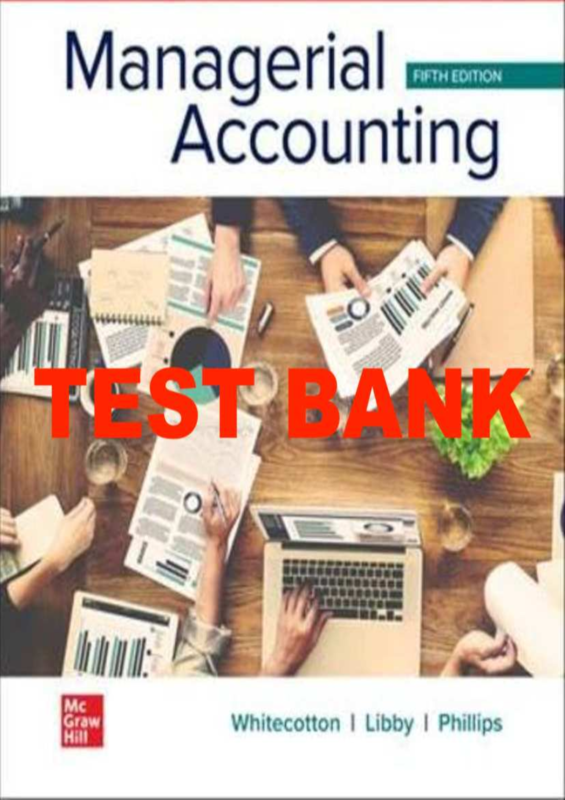
Test Bank For Managerial Accounting 5th Edition By Stacey Whitecotton, Robert Libby, Fred Phillips (All Chapters 1-13
$25.00
Secure checkout
Instant digital download
PDF document
Document details
- Pages
- 797
- File size
- 4.29 MB
- Format
- Digital PDF
- Course
- Accounting
- Category
- TEST BANKS
Sign in or create a free account to continue. Your purchase will be saved in My Downloads.
About this ebook
The Test Bank for Managerial Accounting (5th Edition) by Stacey Whitecotton, Robert Libby, and Fred Phillips covers 13 core chapters. The assessment materials focus heavily on internal decision-making, using financial and non-financial data within manufacturing, service, and retail contexts. [1, 2, 3, 4]
Cost Accumulation & Product Costing Systems
- Chapter 1: Introduction to Managerial Accounting – Comparing financial vs. managerial accounting, the role of management, cost classifications (direct vs. indirect, product vs. period), and ethical standards. [1, 2]
- Chapter 2: Job Order Costing – Tracking manufacturing costs to unique jobs, calculating predetermined overhead rates, and tracking underapplied or overapplied overhead. [1, 2]
- Chapter 3: Process Costing – Accounting for mass-produced homogeneous goods, determining equivalent units of production, and computing costs per equivalent unit. [1, 2]
- Chapter 4: Activity-Based Costing and Cost Management – Assigning indirect costs based on activities, identifying cost drivers, and analyzing activity-based management (ABM) for accurate pricing. [1, 2]
Cost Behavior, Planning, & Short-Term Decisions
- Chapter 5: Cost Behavior – Analyzing fixed, variable, and mixed costs using methods like the high-low method and scattergraph plots.
- Chapter 6: Cost-Volume-Profit Analysis – Calculating breakeven points, target profit metrics, margin of safety, and evaluating operating leverage.
- Chapter 7: Incremental Analysis for Short-Term Decision Making – Identifying relevant costs and revenues for special orders, make-or-buy decisions, keeping or dropping segments, and sell-or-process-further scenarios.
- Chapter 8: Budgetary Planning – Creating operational plans including master budgets, sales budgets, production budgets, cash budgets, and budgeted financial statements. [1, 2, 3, 4]
Control, Evaluation, & Long-Term Financial Performance
- Chapter 9: Standard Costing and Variance Analysis – Setting standard costs and evaluating direct material, direct labor, and manufacturing overhead variances (spending, efficiency, and volume).
- Chapter 10: Decentralized Performance Evaluation – Measuring performance in decentralized segments using Return on Investment (ROI), Residual Income, and the Balanced Scorecard.
- Chapter 11: Capital Budgeting – Screening and evaluating long-term projects using Net Present Value (NPV), Internal Rate of Return (IRR), Payback Period, and Accounting Rate of Return (ARR).
- Chapter 12: Statement of Cash Flows – Preparing and interpreting cash movements divided into operating, investing, and financing activities.
- Chapter 13: Measuring and Evaluating Financial Performance – Using financial statement analysis tools like horizontal, vertical, and ratio analysis to assess company liquidity, solvency, and profitability. [1, 2]
File included
Test-Bank-For-Managerial-Accounting-5th-Edition-By-Stacey-Whitecotton-Robert-Libby-Fred-Phillips-All-Chapters-1-13.pdf
4.29 MB
Related ebooks