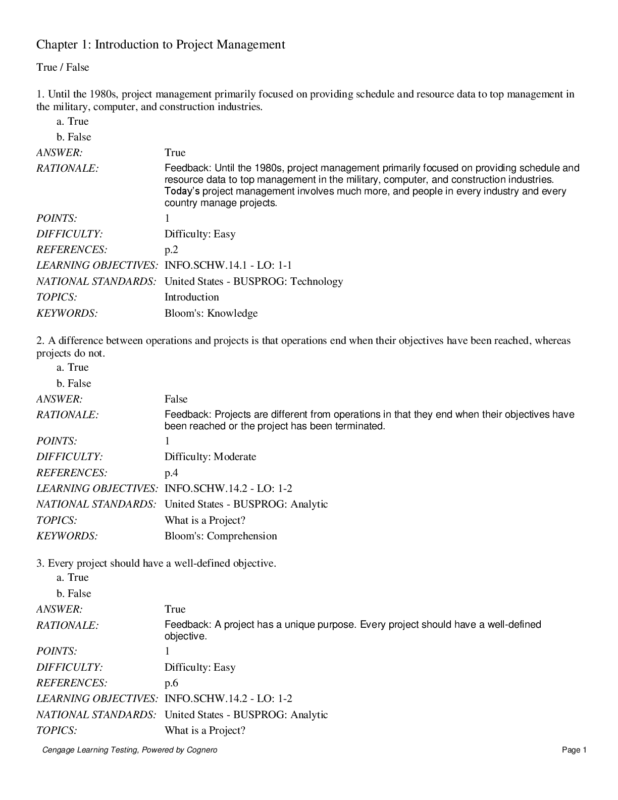
TEST BANK for Information Technology Project Management, 8the Edition by Schwalbe. Chapters 1-13. Q&A and Rationale..
$24.00
Secure checkout
Instant digital download
PDF document
Document details
- Pages
- 365
- File size
- 4.98 MB
- Format
- Digital PDF
- Course
- Information Technology
- Category
- TEST BANKS
Sign in or create a free account to continue. Your purchase will be saved in My Downloads.
About this ebook
The Test Bank for Information Technology Project Management, 8th Edition by Kathy Schwalbe covers all 13 chapters of the textbook, testing students on the 10 Project Management Knowledge Areas and the 5 Process Groups mapped specifically to IT environments.
The core topics and chapters covered in the test bank include:
Foundational Concepts
- Chapter 1: Introduction to Project Management – The definition of a project, the triple constraint (scope, time, cost), the role of the project manager, project portfolios, and the history of project management.
- Chapter 2: The Project Management and Information Technology Context – A systems view of project management, organizational structures, stakeholder management, and the unique lifecycle phases of IT projects.
- Chapter 3: The Project Management Process Groups: A Case Study – In-depth testing on the five core process groups: Initiating, Planning, Executing, Monitoring and Controlling, and Closing.
The 10 Project Management Knowledge Areas
- Chapter 4: Project Integration Management – Strategic planning, project selection techniques, project charters, and managing project changes.
- Chapter 5: Project Scope Management – Scope planning, collecting requirements, defining scope, creating the Work Breakdown Structure (WBS), and scope validation.
- Chapter 6: Project Time Management – Activity sequencing, estimating activity resources and durations, developing the schedule (Gantt charts, Critical Path Method), and schedule control.
- Chapter 7: Project Cost Management – Cost estimation principles, budgeting, and controlling costs using Earned Value Management (EVM).
- Chapter 8: Project Quality Management – Quality planning, quality assurance, quality control, and specific IT quality standards (like Six Sigma or CMMI).
- Chapter 9: Project Human Resource Management – Managing project teams, resource leveling, motivation theories, and leadership.
- Chapter 10: Project Communications Management – Communication planning, information distribution, performance reporting, and managing expectations.
- Chapter 11: Project Risk Management – Identifying, analyzing (qualitative and quantitative), and responding to common IT project risks.
- Chapter 12: Project Procurement Management – Planning procurement, selecting sellers, contracts (fixed-price, cost-reimbursable), and outsourcing dynamics.
- Chapter 13: Project Stakeholder Management – Identifying stakeholders, analyzing their engagement levels, and managing stakeholder relationships throughout the project lifecycle.
File included
Test-Bank-Information-Technology-Project-Management-8e-Schwalbe.pdf
4.98 MB
Related ebooks
![[eBook] [PDF] Technology In Action 17th Edition By Alan Evans](https://greatpricebooks.com/wp-content/uploads/2026/09/oQnF1Gvn2025-10-17-01-5968f178bc34f3c.png)