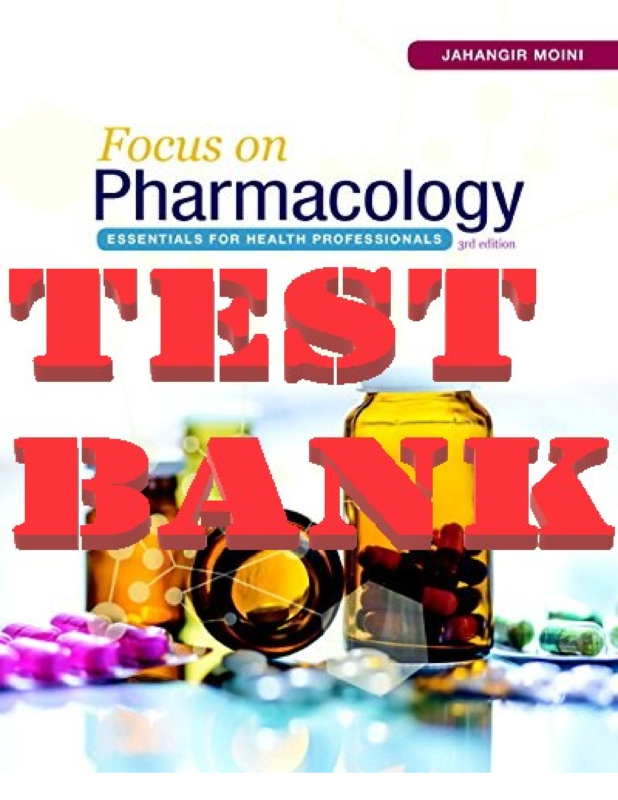
TEST BANK for Focus on Pharmacology: Essentials for Health Professionals 3rd Edition by Jahangir Moini | Complete Chapters 1-40.
$23.00
Secure checkout
Instant digital download
PDF document
Document details
- Pages
- 294
- File size
- 2.48 MB
- Format
- Digital PDF
- Course
- Pharmacology
- Category
- TEST BANKS
Sign in or create a free account to continue. Your purchase will be saved in My Downloads.
About this ebook
TEST BANK for Focus on Pharmacology: Essentials for Health Professionals 3rd Edition by Jahangir Moini | Complete Chapters 1-40.
📘 1. Core Textbook Structure & Key Themes
The textbook organizes pharmacology into manageable building blocks, moving from foundational science to clinical application:
- Part I: General Principles: Focuses heavily on the "journey" of a drug. You must master Pharmacokinetics (Absorption, Distribution, Metabolism, Excretion) and Pharmacodynamics (how drugs interact with receptors). [1]
- Part II: Math and Dosage Calculations: Covers the metric system, household measurements, and the specific formulas used for oral, parenteral, and intravenous medications.
- Parts III to IX: Systematic Pharmacology: Groups drugs by body systems (e.g., Cardiovascular, Nervous, Endocrine). Every chapter uniformly covers:
- Disease pathophysiology brief
- Drug mechanisms of action (MOA)
- Primary therapeutic uses
- Critical adverse effects and life-threatening toxicities
- Patient Education & Health Professional Responsibilities (a major focus of Moini's text)
🧮 2. Essential Math Formulas You Must Memorize
Moini emphasizes that dosage calculation errors are entirely preventable. Here are the three most heavily tested formulas in the text:
A. The Basic Formula (Oral and Parenteral Dosages)
Used when you need to find how many tablets or milliliters to administer based on what is on hand.
\(\text{Amount\ to\ Administer}=\frac{\text{Desired\ Dose\ (D)}}{\text{Have\ on\ Hand\ (H)}}\times \text{Vehicle\ /\ Quantity\ (V)}\)
\(\text{Amount\ to\ Administer}=\frac{\text{Desired\ Dose\ (D)}}{\text{Have\ on\ Hand\ (H)}}\times \text{Vehicle\ /\ Quantity\ (V)}\)
- Example: Order is for Amoxicillin 500 mg. Available is 250 mg / 5 mL.
- Calculation: (500 ÷ 250) × 5 mL = 10 mL
B. Intravenous Flow Rate (Drops per Minute)
Used when administering IV fluids using manual gravity tubing.
\(\text{Flow\ Rate\ (gtt/min)}=\frac{\text{Total\ Volume\ (mL)}\times \text{Drop\ Factor\ (gtt/mL)}}{\text{Total\ Time\ (in\ minutes)}}\)
\(\text{Flow\ Rate\ (gtt/min)}=\frac{\text{Total\ Volume\ (mL)}\times \text{Drop\ Factor\ (gtt/mL)}}{\text{Total\ Time\ (in\ minutes)}}\)
- Key Watchpoint: Always convert hours to minutes by multiplying by 60 before plugging into the denominator.
C. Weight-Based Dosing
Commonly used in pediatrics, critical care, and emergency medicine.
\(\text{Step\ 1:\ Convert\ pounds\ to\ kilograms\ (if\ necessary)}\rightarrow \frac{\text{Weight\ in\ lbs}}{2.2}\)
\(\text{Step\ 2:\ Total\ Daily\ Dose}=\text{Weight\ in\ kg}\times \text{Prescribed\ mg/kg}\)
\(\text{Step\ 1:\ Convert\ pounds\ to\ kilograms\ (if\ necessary)}\rightarrow \frac{\text{Weight\ in\ lbs}}{2.2}\)
\(\text{Step\ 2:\ Total\ Daily\ Dose}=\text{Weight\ in\ kg}\times \text{Prescribed\ mg/kg}\)
💊 3. High-Yield Drug Classifications Cheat Sheet
When studying the systemic chapters, focus on these benchmark drug classes, which represent the bulk of board exam questions:
| System | Drug Class | Blueprint Example | Key Mechanism / Clinical Pearl |
|---|---|---|---|
| Autonomic | Sympathomimetics | Albuterol | Stimulates β₂-receptors to cause bronchodilation. |
| Cardiovascular | ACE Inhibitors | Lisinopril | Blocks Angiotensin II production; watch for dry cough and angioedema. |
| Cardiovascular | Beta-Blockers | Metoprolol | Lowers HR and BP; never stop abruptly (rebound hypertension). |
| Nervous System | Opioid Agonists | Morphine | Binds to mu receptors; priority assessment is respiratory depression. |
| Endocrine | Biguanides | Metformin | Decreases hepatic glucose production; hold 48 hrs before/after contrast dye. |
| Antimicrobial | Aminoglycosides | Gentamicin | Inhibits protein synthesis; highly toxic to kidneys (nephro) and ears (oto). |
🚨 4. Moini’s "Golden Rules" for Health Professionals
The text repeatedly underscores the safety checks that protect both the patient and your license:
- The "Right" Checkpoints: Always verify the 7 Rights of medication administration: Right Patient, Right Drug, Right Dose, Right Route, Right Time, Right Documentation, and Right Reason.
- Look-Alike/Sound-Alike (LASA) Drugs: Be explicitly careful with pairs like Hydralazine (antihypertensive) and Hydroxyzine (antihistamine).
- High-Alert Medications: Drugs like Insulin, Heparin, and Potassium Chloride require double-validation because errors cause catastrophic outcomes.
File included
Focus-on-Pharmacology-Essentials-for-Health-Professionals-3e-Jahangir-Moini-TB.pdf
2.48 MB
Related ebooks