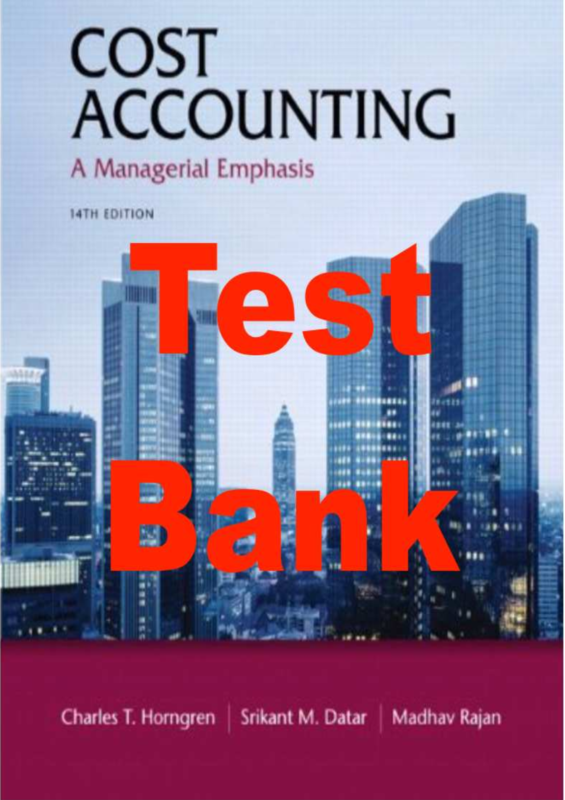
Test Bank for Cost Accounting (Global Edition) 14th Edition By Horngren Srikant Madhav Rajan
$26.00
Secure checkout
Instant digital download
PDF document
Document details
- Pages
- 1,339
- File size
- 5.79 MB
- Format
- Digital PDF
- Course
- Accounting
- Category
- TEST BANKS
Sign in or create a free account to continue. Your purchase will be saved in My Downloads.
About this ebook
The Test Bank for Cost Accounting (Global Edition) 14th Edition by Charles T. Horngren, Srikant M. Datar, and Madhav Rajan covers a comprehensive range of foundational and advanced managerial accounting topics. Organized by chapter, it tests students on core concepts, calculations, and strategic decision-making applications. [1, 2, 3, 4]
Foundational Cost Accounting Concepts
- Chapter 1: The Accountant’s Role in the Organization – Core distinctions between management accounting and financial accounting, strategic decision-making, and organizational structures. [1, 2]
- Chapter 2: An Introduction to Cost Terms and Purposes – Defining cost objects, distinguishing direct from indirect costs, and variable vs. fixed cost behaviors. [1, 2]
- Chapter 3: Cost–Volume–Profit (CVP) Analysis – Breakeven point calculations, target net income, operating leverage, and margin of safety. [1, 2]
- Chapter 4: Job Costing – Tracking specific jobs, actual vs. normal costing systems, and disposing of under- or overallocated overhead. [1, 2]
- Chapter 5: Activity-Based Costing (ABC) and Activity-Based Management (ABM) – Refining costing systems by identifying activities, cost pools, and cost drivers to reduce product-cost cross-subsidization. [1, 2]
Budgeting and Variance Analysis
- Chapter 6: Master Budget and Responsibility Accounting – Formulating operating and financial budgets, and tracking decentralized organizational performance.
- Chapter 7: Flexible Budgets, Direct-Cost Variances, and Management Control – Creating flexible budgets to isolate price and efficiency variances for direct materials and labor.
- Chapter 8: Flexible Budgets, Overhead Cost Variances, and Management Control – Planning and analyzing variable and fixed overhead spending and efficiency variances.
- Chapter 9: Inventory Costing and Capacity Analysis – Evaluating variable vs. absorption costing methods and assessing capacity constraints (theoretical, practical, normal, master-budget). [1, 2]
Cost Behavior and Information for Decision-Making
- Chapter 10: Determining How Costs Behave – Estimating linear cost functions using quantitative tools like industrial engineering, conference, and regression analysis methods.
- Chapter 11: Decision Making and Relevant Information – Identifying relevant costs and revenues for short-run business decisions like make-or-buy, special orders, and product line adjustments.
- Chapter 12: Pricing Decisions and Cost Management – Major factors affecting pricing (customers, competitors, costs), cost-plus pricing strategies, and target-costing models.
- Chapter 13: Strategy, Balanced Scorecard, and Strategic Profitability Analysis – Evaluating corporate strategy using the Balanced Scorecard perspectives and analyzing growth, price-recovery, and productivity components of profit. [1, 2, 3]
Cost Allocation and Product Costing Methods
- Chapter 14: Cost Allocation, Customer-Profitability Analysis, and Sales-Variance Analysis – Evaluating individual customer profitability and breaking down sales volume and mix variances.
- Chapter 15: Allocation of Support-Department Costs, Common Costs, and Revenues – Allocating support services to production using the direct, step-down, and reciprocal allocation methods.
- Chapter 16: Cost Allocation: Joint Products and Byproducts – Distributing joint production costs using sales value at splitoff, physical measure, net realizable value (NRV), and constant gross-margin percentage NRV methods.
- Chapter 17: Process Costing – Calculating equivalent units of production under the Weighted-Average and FIFO inventory costing methods.
- Chapter 18: Spoilage, Rework, and Scrap – Accounting for normal vs. abnormal spoilage under both job costing and process costing applications. [1, 2]
Performance Measurement and Inventory Systems
- Chapter 19: Balanced Scorecard: Quality and Time – Measuring financial and nonfinancial components of quality (prevention, appraisal, internal failure, external failure costs) and delivery metrics.
- Chapter 20: Inventory Management, Just-in-Time (JIT), and Simplified Costing Methods – Utilizing Economic Order Quantity (EOQ), tracking JIT impacts, and executing backflush costing.
- Chapter 21: Capital Budgeting and Cost Analysis – Long-term investment evaluation using Discounted Cash Flow methods (Net Present Value, Internal Rate of Return) and non-DCF models.
- Chapter 22: Management Control Systems, Transfer Pricing, and Multinational Considerations – Setting domestic and international internal transfer prices (market-based, cost-based, negotiated).
- Chapter 23: Performance Measurement, Compensation, and Multinational Considerations – Designing management incentives using metrics like Return on Investment (ROI), Residual Income (RI), and Economic Value Added (EVA). [1, 2, 3, 4, 5]
File included
Test-Bank-for-Cost-Accounting-Global-Edition-14th-Edition-By-Horngren-Srikant-Madhav-Rajan.pdf
5.79 MB
Related ebooks