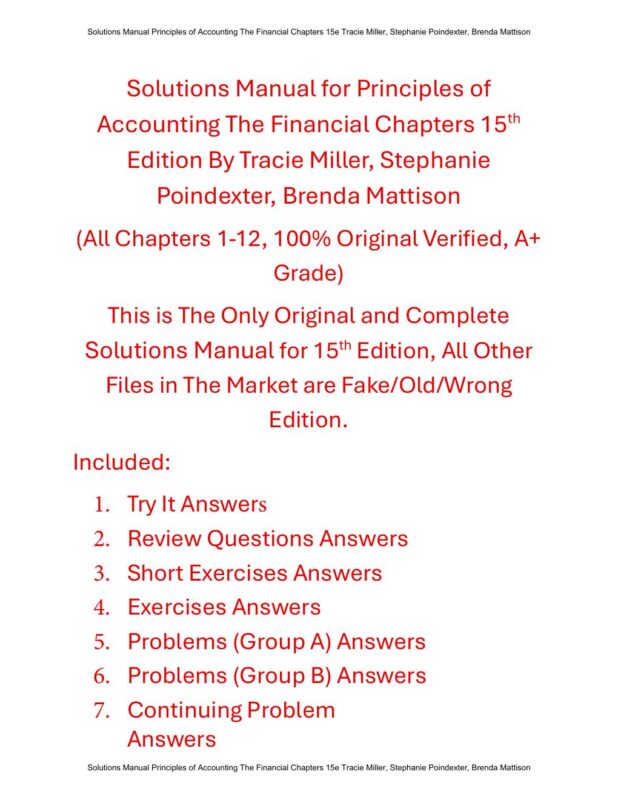
Solutions Manual for Principles of Accounting The Financial Chapters 15th Edition By Tracie Miller, Stephanie Poindexter, Brenda Mattison
$30.00
Secure checkout
Instant digital download
PDF document
Document details
- Pages
- 2,225
- File size
- 10.96 MB
- Format
- Digital PDF
- Course
- Accounting
- Category
- SOLUTIONS MANUAL
Sign in or create a free account to continue. Your purchase will be saved in My Downloads.
About this ebook
The Solutions Manual for Principles of Accounting, The Financial Chapters (15th Edition) by Tracie Miller and Stephanie Poindexter covers the core foundations of financial accounting. Published by Pearson, this textbook structures its topics around mastering the complete accounting cycle, asset management, and financial statement analysis. [1, 2, 3, 4]
Below is the structured breakdown of the specific chapters and core themes covered in this edition:
🗒️ The Accounting Cycle & Foundations
- Accounting and the Business Environment: Explores the role of accounting in business, the regulatory framework, and the foundational accounting equation. [1]
- Recording Business Transactions: Introduces the double-entry accounting system, the use of T-accounts, journals, and ledgers. [1, 2, 3]
- The Adjusting Process: Covers accrual accounting concepts, including deferrals, accruals, and preparing adjusted trial balances. [1, 2]
- Completing the Accounting Cycle: Focuses on preparing formal financial statements, journalising closing entries, and the post-closing trial balance. [1, 2]
📊 Operations & Internal Controls
- Merchandising Operations: Covers the purchase, sale, and recording of inventory transactions for retail businesses.
- Merchandising Inventory: Examines inventory costing methods such as FIFO, LIFO, and Weighted-Average Cost.
- Accounting Information Systems: Covers manual versus automated ledger systems and modern data management.
- Internal Control and Cash: Explores methods for safeguarding corporate assets, cash management, bank reconciliations, and preventing fraud. [1, 2]
📈 Asset & Liability Management
- Receivables: Focuses on accounting for bad debts, direct write-offs, allowance methods, and notes receivable.
- Plant Assets, Natural Resources, and Intangibles: Details long-term asset acquisition, depreciation methods, depletion, and amortisation.
- Current Liabilities and Payroll: Covers short-term obligations, sales tax liabilities, and the mechanics of payroll accounting.
- Long-Term Liabilities: Focuses heavily on the pricing, issuance, interest amortization, and retirement of corporate bonds. [1, 2]
⚖️ Business Entities & Corporate Capital
- Partnerships: Explores accounting for partnership formation, income allocations, partner admission, and liquidation.
- Stockholders' Equity: Covers the issuance of stock, cash and stock dividends, treasury stock, and retained earnings.
- Investments: Focuses on debt and equity investments, including the equity and fair value methods. [1]
🔍 Financial Statement Analysis & Cash Flows
- The Statement of Cash Flows: Breaks down cash inflows and outflows into operating, investing, and financing activities.
- Financial Statement Analysis: Teaches horizontal, vertical, and ratio analysis to evaluate a company's liquidity, profitability, and solvency. [1, 2, 3]
💡 Notable Modern Updates in the 15th Edition
Beyond the core table of contents, this specific 15th edition incorporates contemporary corporate finance realities, including: [1]
- Data Analytics & Visualisation: Built-in instructions and projects on leveraging tools like Microsoft Excel to visualize financial reporting and drive data-backed business choices. [1]
- Emerging Tech & Auditing: New specialized material exploring fraud evaluation via the fraud triangle, alongside the business impacts of Artificial Intelligence (AI) and robotic process automation (RPA). [1]
File included
tmpphp9zGKAd
10.96 MB
Related ebooks