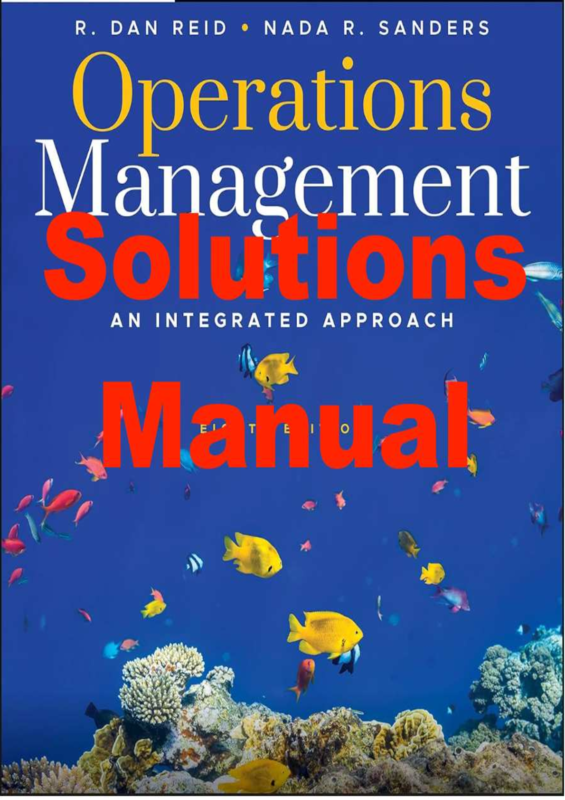
Solutions Manual For Operations Management An Integrated Approach 8th Edition By Dan Reid, Nada Sanders
$22.00
Secure checkout
Instant digital download
PDF document
Document details
- Pages
- 339
- File size
- 6.63 MB
- Format
- Digital PDF
- Course
- Management
- Category
- SOLUTIONS MANUAL
Sign in or create a free account to continue. Your purchase will be saved in My Downloads.
About this ebook
The Solutions Manual for Operations Management: An Integrated Approach, 8th Edition by R. Dan Reid and Nada R. Sanders covers all 16 main chapters and 3 quantitative supplements from the textbook. It provides detailed solutions to end-of-chapter problems, discussion questions, cases, and spreadsheet exercises across both qualitative and quantitative concepts. [1, 2]
The complete breakdown of the chapters and topics included in the solutions manual features:
Core Concepts & Strategy
- Chapter 1: Introduction to Operations Management – Role of operations, differences between manufacturing and services, historical milestones, and cross-functional integration. [1, 2]
- Chapter 2: Operations Strategy and Competitiveness – Developing operations strategy, competitive priorities (cost, quality, time, flexibility), and productivity measurement. [1, 2, 3]
- Chapter 3: Product Design and Process Selection – Product development steps, process flow analysis, technology choices (automation, robotics, 3-D printing), and process design. [1, 2]
- Chapter 4: Supply Chain Management – Supply chain design, supplier selection, bullwhip effect, logistics, and integration. [1]
Quality Control & Lean Systems
- Chapter 5: Total Quality Management (TQM) – Defining quality, TQM philosophy, quality awards (Baldrige, ISO), and cost of quality.
- Chapter 6: Statistical Quality Control (SQC) – Statistical process control (SPC), control charts for variables (x-bar and R charts) and attributes (p and c charts), and process capability.
- Chapter 7: Just-in-Time and Lean Systems – Lean principles, JIT philosophy, waste elimination, Kanban pull systems, and lean services. [1, 2, 3]
Planning, Forecasting, & Layouts
- Chapter 8: Forecasting – Qualitative methods, quantitative time-series models (moving averages, exponential smoothing, linear regression), forecast accuracy tracking, and predictive analytics.
- Chapter 9: Capacity Planning and Facility Location – Measuring capacity, decision trees for capacity, and location analysis techniques (factor-rating, load-distance model, center-of-gravity).
- Chapter 10: Facility Layout – Layout types (product, process, fixed-position, cellular) and line balancing algorithms.
- Chapter 11: Work System Design – Job design, work measurement (time studies, work sampling), and setting standard times. [1, 2, 3]
Inventory & Resource Management
- Chapter 12: Inventory Management – Fixed-order quantity models (Economic Order Quantity/EOQ, Economic Production Quantity), safety stock, and fixed-time period models.
- Chapter 13: Aggregate Planning – Aggregate planning strategies (level, chase), options for modifying demand/capacity, and evaluation of planning costs.
- Chapter 14: Resource Planning – Material Requirements Planning (MRP) mechanics (bill of materials, inventory records, MRP explosion), Capacity Requirements Planning (CRP), and Enterprise Resource Planning (ERP) systems.
- Chapter 15: Scheduling – High-volume vs. low-volume scheduling, sequencing rules (SPT, EDD, FCFS), Johnson’s rule for two-work centers, and workforce scheduling.
- Chapter 16: Project Management – Project life cycle, Network planning techniques (CPM/PERT), calculating critical paths, slack, and project crashing. [1, 2, 3]
Quantitative Supplements Covered
- Supplement A: Spreadsheet Modeling: An Introduction
- Supplement B: Introduction to Optimization
- Supplement C: Waiting Line Models (Queuing Theory) [1]
File included
Solutions-Manual-For-Operations-Management-An-Integrated-Approach-8th-Edition-By-Dan-Reid-Nada-Sanders.pdf
6.63 MB
Related ebooks