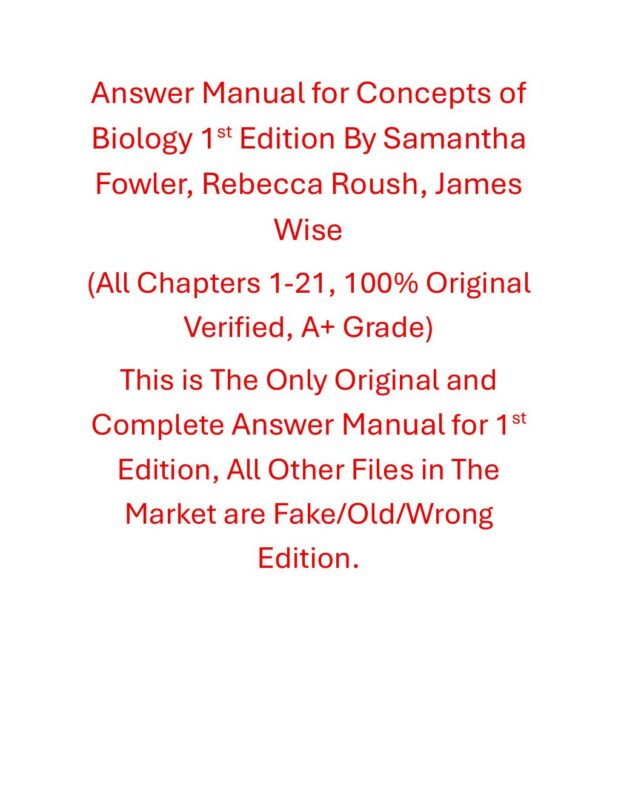
Solutions Manual For Concepts of Biology 1st Edition By Samantha Fowler, Rebecca Roush, James Wise
$30.00
Secure checkout
Instant digital download
PDF document
Document details
- Pages
- 87
- File size
- 2.23 MB
- Format
- Digital PDF
- Course
- Biology
- Category
- SOLUTIONS MANUAL
Sign in or create a free account to continue. Your purchase will be saved in My Downloads.
About this ebook
The Solutions Manual For Concepts of Biology (1st Edition) by Samantha Fowler, Rebecca Roush, and James Wise—published by OpenStax—is organized into 6 core units encompassing 21 chapters. It is structured specifically for introductory, single-semester biology courses for non-science majors. [1, 2, 3, 4]
The detailed breakdown of topics and chapters covered in the text includes:
Unit 1: The Cellular Foundation of Life
This unit introduces the scientific method and the fundamental chemical and cellular building blocks of life. [1, 2]
- Chapter 1: Introduction to Biology – Themes of biology, the properties of life, and the process of science.
- Chapter 2: Chemistry of Life – Basic chemical building blocks, atoms, properties of water, and biological macromolecules.
- Chapter 3: Cell Structure and Function – Comparison of prokaryotic and eukaryotic cells, cell organelles, and plasma membrane function.
- Chapter 4: How Cells Obtain Energy – Cellular respiration, metabolism, metabolic pathways, and enzymes.
- Chapter 5: Photosynthesis – The light-dependent and light-independent reactions of plants capturing solar energy. [1, 2, 3, 4, 5, 6]
Unit 2: Cell Division and Genetics
This section transitions from how cells reproduce to the foundational laws governing how traits are passed down. [1]
- Chapter 6: Reproduction at the Cellular Level – Mitosis, the cell cycle, and cell division regulation.
- Chapter 7: The Cellular Basis of Inheritance – Meiosis, sexual reproduction, and genetic variation.
- Chapter 8: Patterns of Inheritance – Mendelian genetics, Punnett squares, laws of inheritance, and non-Mendelian trait extensions. [1, 2, 3, 4, 5]
Unit 3: Molecular Biology and Biotechnology
Covers DNA structure, replication, gene expression, and modern applications like genetic engineering and forensics. [1, 2, 3, 4]
- Chapters 9-10: Molecular Biology & Biotechnology. [1]
Unit 4: Evolution and the Diversity of Life
Explores the mechanisms of evolution and the classification of organisms across the three domains. [, 2, 3, 4]
Unit 5: Animal Structure and Function
Introduces vertebrate anatomy, physiology, and key systems including immunity and reproduction. [1, 2]
Unit 6: Ecology
File included
tmpphpWNyN5z
2.23 MB
Related ebooks