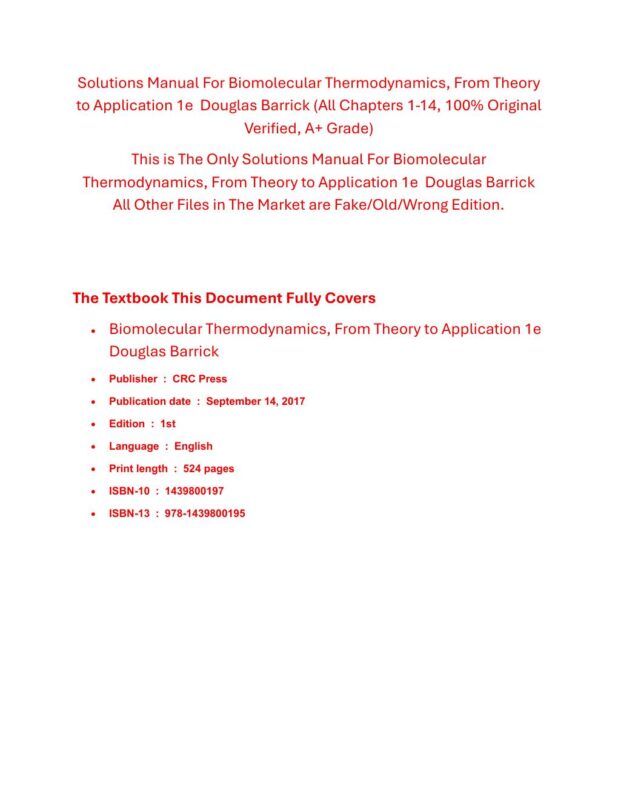
Solutions Manual For Biomolecular Thermodynamics: From Theory to Application 1st Edition By Douglas Barrick
$25.00
Secure checkout
Instant digital download
PDF document
Document details
- Pages
- 86
- File size
- 2.13 MB
- Format
- Digital PDF
- Course
- Education
- Category
- SOLUTIONS MANUAL
Sign in or create a free account to continue. Your purchase will be saved in My Downloads.
About this ebook
Solutions Manual For Biomolecular Thermodynamics: From Theory to Application (1st Edition) by Douglas Barrick is a premier textbook that bridges classical physical chemistry with practical biophysical research. Released by CRC Press as part of the Foundations of Biochemistry and Biophysics series, it focuses heavily on developing a quantitative understanding of how macromolecules behave. [1, 2, 3, 4, 5]
The book is widely available across major academic and retail platforms, including Amazon, Barnes & Noble, VitalSource, and AbeBooks. [1, 2]
Key Publication Details
- Author: Douglas E. Barrick (T.C. Jenkins Professor of Biophysics at Johns Hopkins University).
- Publisher: CRC Press / Taylor & Francis Group.
- Publication Date: September 14, 2017.
- Print ISBNs: 9781138068841, 1138068845.
- eTextbook ISBNs: 9781439800201, 1439800200. [1, 2, 3, 4]
Core Structural & Conceptual Breakdown
Unlike traditional physical chemistry textbooks that pull examples from ideal gases, this text is built entirely around biologically relevant systems like protein folding, DNA melting, and molecular binding. It is structured in three logical phases: [1, 2, 3, 5]
[Math & Probability Foundations] ➔ [Classical / Bulk Thermodynamics] ➔ [Statistical Formalisms & Models]
          (Chapters 1-2)                      (Chapters 3-8)                     (Chapters 9-14)
1. Foundational Tools (Chapters 1–2)
- Probability & Statistics: Covers Venn diagrams for molecular events and chemical biothermodynamics.
- Multivariate Calculus: Builds the mandatory math framework for multi-component data fitting. [1, 2, 3]
2. Classical Bulk Thermodynamics (Chapters 3–8)
- First & Second Laws: Introduces energy conservation, enthalpy, and the macroscopic laws of entropy.
- Biomolecular Observables: Connects experimental data (like calorimetry) to macroscopic thermodynamic properties. [1, 2, 3, 4]
3. Statistical Formalism & Application (Chapters 9–14)
- Partition Functions: Connects microscopic molecular states directly to macroscopic observables.
- Mathematical Simulations: Teaches readers how to code and build mechanistic models to analyze real-world laboratory data. [1, 2]
Why This Text Stands Out
- Code and Simulations: It emphasizes hands-on mathematical simulations, teaching students how equations map to active biophysical research. [1, 2]
- Targeted Audience: It serves as a cornerstone reference for graduate and advanced undergraduate programs in molecular biophysics, biochemistry, and computational biology. []
- Companion Materials: Verified, step-by-step problem sets and chapter solutions (spanning Chapters 1–14) are commonly used alongside the core text for biophysical modeling coursework. [1, 2]
File included
tmpphp4aQPCn
2.13 MB
Related ebooks