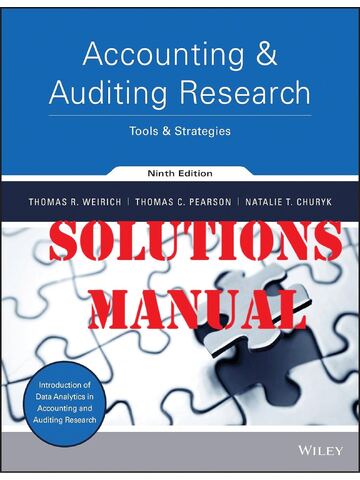
SOLUTIONS MANUAL for Accounting and Auditing Research: Tools and Strategies 9th Edition Weirich Thomas; Pearson Thomas and Churyk Tatiana | All 10 Chapters and CASE SOLUTIONS
$29.00
Secure checkout
Instant digital download
PDF document
Document details
- Pages
- 456
- File size
- 167.14 KB
- Format
- Digital PDF
- Course
- Accounting
- Category
- SOLUTIONS MANUAL
Sign in or create a free account to continue. Your purchase will be saved in My Downloads.
About this ebook
SOLUTIONS MANUAL for Accounting and Auditing Research: Tools and Strategies 9th Edition Weirich Thomas; Pearson Thomas and Churyk Tatiana | All 10 Chapters
Table of Contents:
1 Introduction to Applied Professional Research 1
What is Research? 2
Research Questions 3
Nature of Professional Research 5
Critical Thinking and Effective Communication 7
Economic Consequences of Standards Setting 7
Role of Research in the Accounting Firm 7
Skills Needed for the CPA Exam and Practice 9
Overview of the Research Process 11
Step One: Identify the Relevant Facts and Issues 11
Step Two: Collect the Evidence 12
Step Three: Analyze the Results and Identify the Alternatives 13
Step Four: Develop a Conclusion 14
Step Five: Communicate the Results 14
Data Analytics in Accounting and Auditing Research 14
Appendix: Research Focus on the CPA Exam 17
2 Critical Thinking and Effective Writing Skills for the Professional Accountant 21
Critical Thinking Skills 21
Levels of Thinking 23
Universal Elements of Reasoning 26
An Example of Using Critical Thinking Skills 27
Effective Writing Skills 28
Writing as a Process 29
Punctuation Primer 30
Improved Writing Skills Required 33
Active Voice 33
Short Sentences 33
Definite Concrete Everyday Language 34
Tabular Presentation 34
Limited Jargon and Technical Terms 34
No Multiple Negatives 35
Elements of Plain English 35
Writing Effective Texts e-mails and Letters 36
Writing Memos to the File 37
3 The Environment of Accounting Research 41
The Accounting Environment 41
The SEC and the Standard-Setting Environment 42
Rules-Based vs. Principles-Based Accounting Standards 43
Financial Accounting Standards Board 44
FASB Strives to Simplify Standards 45
Content of Authorities 45
FASB Due Process 46
FASB Conceptual Framework Project 48
Statements of Financial Accounting Concepts Nos. 1–8 49
American Institute of Certified Public Accountants (AICPA) 49
Governmental Accounting Standards Board 50
Other Organizations Influencing Standard Setting 52
U.S. Generally Accepted Accounting Principles (U.S. GAAP) 54
The FASB Accounting Standards Codification TM 55
Using Authoritative Support 56
Reading an Authoritative Pronouncement 57
Accounting Choices Have Economic Consequences 59
4 Financial Accounting Research Tools 61
Accounting Research Online 62
Database Research Strategies 62
Step One: Define the Information Needed 62
Step Two: Determine the Sources to Search 62
Step Three: Use Appropriate Search Methods 63
Step Four: View the Results and Manage the Information 63
Step Five: Communicate the Search Results 63
FASB Accounting Standards CodificationTM Research System 63
The Research Process 65
Locating U.S. GAAP Using the Codification 68
Examples Using the Codification 68
SEC Accounting for Public Companies 68
SEC Regulations and Sources 69
The SEC’s Published Views and Interpretations 70
SEC Staff Policy 71
Accessing SEC Filings and Regulations 72
Cases to Practice Accounting Research 74
Data Analytics for the Accounting Researcher 74
Knowledge Busters: The Codification 78
Appendix: CPA Exam—Financial Accounting Simulations 81
Document Review Simulation 84
5 The Environment of International Research 86
International Accounting Environment 86
International Accounting Standards Board (IASB) 88
IASB Authorities 90
IASB Due Process 91
Interpretations Committee Due Process 92
IASB’s Conceptual Framework 92
Principles-Based Accounting Standards 93
IFRS Funding Regulation and Enforcement 94
International Financial Reporting Standards (IFRS) Research 95
IFRS Hierarchy 95
Electronic International Financial Reporting Standards (eIFRS) 96
6 Other Research Databases and Tools 103
Other Database Research Strategies 103
Step One: Define the Information Needed 104
Step Two: Determine the Sources to Search 104
Step Three: Use Search Techniques and Tools 105
Step Four: View the Results and Manage the Information 105
U.S. Accounting Research Tools 106
Leading Publishers of Global Financial Information 106
Commercial Accounting Databases 107
AICPA’s Reference Sources 108
U.S. Government Accounting Databases 108
GASB’s Government Accounting Research SystemTM (GARS Online) 109
Federal Accounting Standards Advisory Board Handbook of
Authorities 109
Financial Research Databases 109
S&P Capital IQ 111
Mergent Online 112
Thomson ONE 113
Other Financial Databases and Sources 113
Financial Research Challenges 114
Business Research Databases and Tools 115
Article Index Databases 115
International Business Sources 116
Specialized Research 116
Massive Legal Research Databases 117
LexisNexis and its Lexis Advance 117
Nexis UniTM Replaces LexisNexis Academic 118
Westlaw 119
Emerging Legal Databases: Bloomberg Law and Fastcase 119
7 Tax Research for Compliance and Tax Planning 124
Tax Planning Concepts and Tax Research Goals 124
Tax Research Goals 125
Tax Research Challenges 126
Specialized Tax Research Databases 127
Thomson Reuters Checkpoint® 128
Primary Tax Authorities 128
The Code 129
Treasury Regulations 131
Steps in Conducting Tax Research 137
Step One: Investigate the Facts and Identify the Issues 137
Step Two: Collect the Appropriate Authorities 137
Step Three: Analyze the Research 140
Step Four: Develop the Reasoning and Conclusion 142
Step Five: Communicate the Results 143
Evolving Professional Concerns and Changes 145
Professional Standards for Tax Services 147
Data Analytics in Tax Research 149
8 Assurance Services and Auditing Research 155
Assurance Services 156
Consulting Services and Standards 156
Attestation Services and Standards 158
Auditing Standard-Setting Environment 160
Auditing Standard-Setting Process 161
Auditing Standards Board (ASB) 161
Public Company Accounting Oversight Board (PCAOB) 165
International Auditing & Assurance Standards Board (IAASB) 167
AICPA Online Professional Library 167
AICPA Code of Professional Conduct 169
Auditing Standards in the Public Sector 171
RIA Checkpoint 172
Compilation and Review Services 174
Role of Judgment and Professional Skepticism in Accounting and Auditing 175
Economic Consequences 175
Data Analytic in Auditing Research 176
9 Refining the Research Process 181
Method for Conducting Research 181
Step One: Identify the Issues or Problems 183
Step Two: Collect the Evidence 184
Step Three: Analyze the Results and Identify Alternatives 188
Step Four: Develop a Conclusion 188
Step Five: Communicate the Results 189
Lessons Learned for Professional Practice 190
Remain Current in Knowledge and Skills 190
International Complexities in Practice 192
Developing Professional Skills Needed for Practice 192
Appendix 9A-1: Sample Brief Memorandum Using IFRS 194
RE: Sony’s Goodwill and Segment Reporting 194
pplication of authorities 196
Appendix 9A-2: Abbreviations and Websites for Accounting Auditing and Tax 196
10 Forensic Accounting Research 202
Definition of Fraud 203
Types of Fraud 204
The Fraud Triangle 206
Overview of a Financial Statement Fraud Examination 207
Step One: Identify the Issue and Plan the Investigation 209
Step Two: Gather the Evidence and Complete the Investigation Phase 209
Step Three: Evaluate the Evidence 210
Step Four: Report Findings to Management or Legal Counsel 210
Business Investigations 211
Computer Technology in Fraud Investigations 212
Data-Mining Software 212
Fraud Investigation Regulations 217
File included
SOLUTIONS-MANUAL-for-Accounting-and-Auditing-Research-Tools-and-Strategies-9th-Edition-Weirich-Thomas-Pearson-Thomas-and-Churyk-Tatiana-Complete-10-Chapters.pdf
167.14 KB
Related ebooks