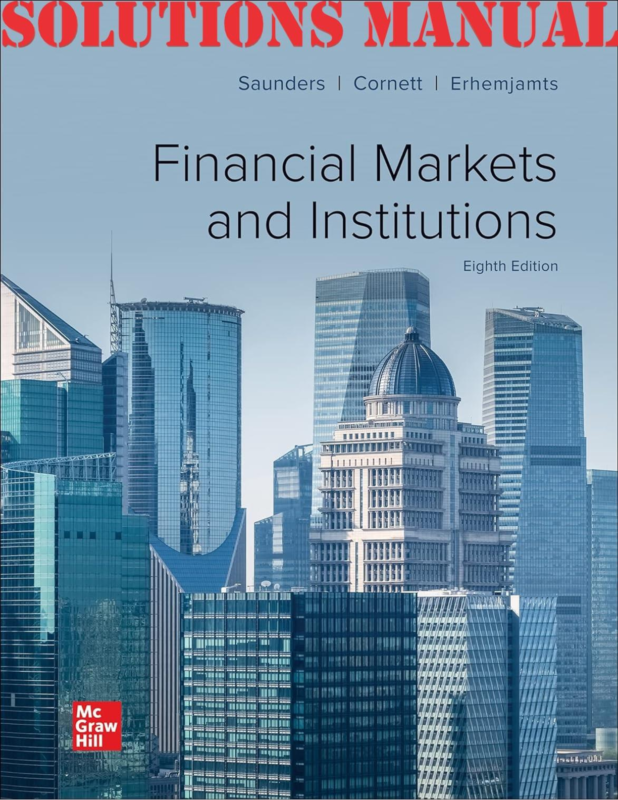
SOLUTIONS MANUAL for Financial Markets and Institutions, 8th Edition By Anthony Saunders, Marcia Cornett and Otgo Erhemjamts
$24.00
Secure checkout
Instant digital download
PDF document
Document details
- Pages
- 240
- File size
- 3.21 MB
- Format
- Digital PDF
- Course
- Finance
- Category
- SOLUTIONS MANUAL
Sign in or create a free account to continue. Your purchase will be saved in My Downloads.
About this ebook
SOLUTIONS MANUAL for Financial Markets and Institutions (8th Edition) by Anthony Saunders, Marcia Millon Cornett, and Otgo Erhemjamts is a comprehensive higher-education textbook published by McGraw-Hill Education. It is designed for undergraduate and MBA finance courses. [1, 2, 3]
The text focuses on the measurement and management of risk faced by investors, savers, and financial managers in changing domestic and international landscapes. [1, 2]
🔎 Key Concepts & Core Themes
- Risk and Return Framework: Emphasizes how modern financial managers expand return while controlling and managing exposure to systemic and institutional risks. [1, 2]
- Globalization & Innovation: Analyzes the erosion of barriers between domestic and foreign financial markets, along with the growth of financial technology (FinTech). [1, 2]
- Off-Balance-Sheet & Securitization: Deeply explores contemporary practices such as asset securitization and off-balance-sheet activities. [1, 2]
🗒 Detailed Topics Covered by Section
The textbook is typically structured into 24 to 25 verified chapters broken down into distinct educational sections: [1, 2]
📌 Part 1: Introduction and Overview of Financial Markets
- Introduction: Why study financial markets and institutions, and the unique economic functions they perform.
- Interest Rates: Determinants of interest rate levels, the loanable funds theory, and nominal versus real interest rates.
- The Structure of Interest Rates: Yield curves, term structure theories (unbiased expectations, liquidity premium, market segmentation), and credit risk premiums.
- The Federal Reserve and Monetary Policy: Structure of the Federal Reserve, monetary policy tools (open market operations, discount rate, reserve requirements), and their impact on the economy. [1, 2]
📌 Part 2: Securities Markets
- Money Markets: Low-risk, short-term debt instruments like Treasury bills, federal funds, commercial paper, and negotiable CDs.
- Bond Markets: Long-term debt instruments including Treasury notes/bonds, municipal bonds, and corporate bonds.
- Mortgage Markets: Residential and commercial mortgages, fixed-rate vs. adjustable-rate mortgages, and mortgage-backed securities (MBS).
- Stock Markets: Equity market structures, primary vs. secondary stock offerings, and stock market indexes (e.g., S&P 500, Dow Jones).
- Foreign Exchange Markets: Currency trading, spot vs. forward markets, and the economic factors impacting exchange rates.
- Derivative Securities Markets: Mechanics of forward contracts, futures, options, and swaps used for hedging or speculation. [1, 2, 3, 4, 5]
📌 Part 3: Commercial Banks
- Commercial Banks Overview: Structure, products, and financial statements (balance sheet and income statement components).
- Bank Regulation: The regulatory framework, the role of agencies (FDIC, OCC, Fed), and international basel accords (Basel III/IV). [1]
📌 Part 4: Other Financial Institutions
- Insurance Companies: Operations and risks of Life Insurance and Property-Casualty (P&C) insurers.
- Securities Firms and Investment Banks: Underwriting, market making, corporate finance advisory, and venture capital.
- Mutual Funds and Hedge Funds: Structures of open-end vs. closed-end funds, exchange-traded funds (ETFs), and alternative investment pools.
- Pension Funds: Defined benefit versus defined contribution plans and public vs. private pension systems. [1]
📌 Part 5: Managing Risk in Financial Institutions [1]
- Types of Risks Facing FIs: Detailed analysis of credit risk, liquidity risk, interest rate risk, market risk, foreign exchange risk, sovereign risk, and operational risk.
- Credit Risk Management: Evaluating loan applications, credit scoring models, and managing loan portfolios.
- Liquidity Risk Management: Measuring and managing asset-side and liability-side liquidity strains.
- Interest Rate Risk & Asset-Liability Management: Repricing models, duration gap analysis, and immunization techniques.
- Futures and Options Hedging: Using derivative instruments directly to mitigate structural institutional risks. [1, 2, 3]
📊 Textbook Features & Tools
To bridge the gap between academic theory and the professional workforce, the 8th edition integrates several applied tools: [1, 2, 3]
- Kaplan CFA Questions: Practice questions styled after the Chartered Financial Analyst (CFA) curriculum.
- Integrated Excel & Tableau: Activities designed to build data analytics proficiency directly applicable to financial market careers.
- Visual Anchor Explanations: Core theoretical concepts are simplified using graphs, simple financial math equations, and concise case studies. [1, 2]
File included
SOLUTIONS-MANUAL-for-Financial-Markets-and-Institutions-8th-Edition-By-Anthony-Saunders-Marcia-Cornett-and-Otgo-Erhemjamts.pdf
3.21 MB
Related ebooks