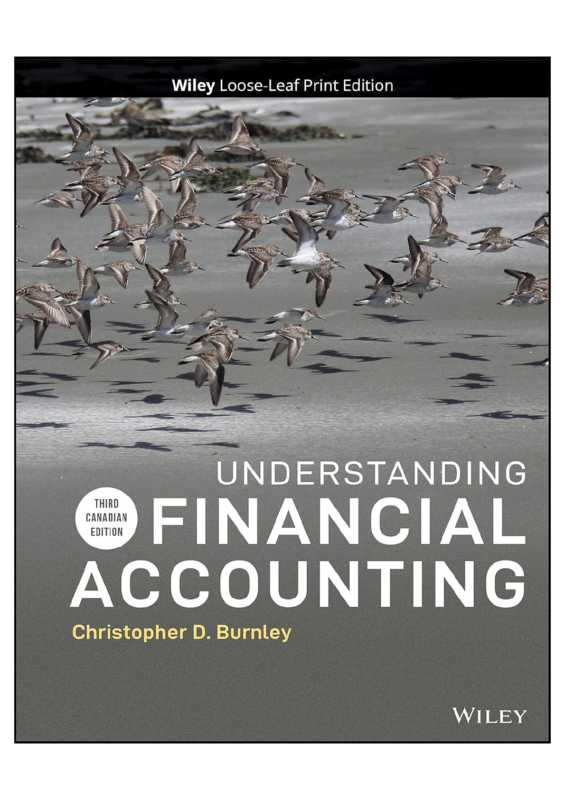
Solutions manual for Understanding Financial Accounting, 3rd Canadian edition by Christopher D. Burnley
$23.00
Secure checkout
Instant digital download
PDF document
Document details
- Pages
- 679
- File size
- 3.38 MB
- Format
- Digital PDF
- Course
- Accounting
- Category
- SOLUTIONS MANUAL
Sign in or create a free account to continue. Your purchase will be saved in My Downloads.
About this ebook
The Solutions manual for 3rd Canadian edition of Understanding Financial Accounting by Christopher D. Burnley provides a comprehensive introduction to introductory financial accounting. It bridges conceptual framework with practical technical application, tailored to Canadian financial reporting standards (IFRS and ASPE). [1, 2, 3]
🗒 Foundations & The Accounting Cycle
-
- Overview of Corporate Financial Reporting: Introduction to the business environment, forms of business organization, users of financial information, and the purpose of the primary financial statements. [1, 2, 3, 4, 5]
- Analyzing Transactions and Their Effects on Financial Statements: Understanding the fundamental accounting equation (Assets = Liabilities + Shareholders' Equity), analyzing business transactions, and recording their initial impact. [1, 2]
- Double-Entry Accounting and the Accounting Cycle: The mechanics of debits and credits, journal entries, ledger accounts, trial balances, and the mechanics of the accrual system. [1, 2]
- Accrual Accounting and Adjusting Entries: Mastering the time period assumption, revenue recognition principles, expense recognition (matching), and formatting adjusting and closing entries. [1]
📈 Operating Elements & Financial Statements
-
- Revenue Recognition and the Statement of Income: In-depth criteria for recognizing revenue under Canadian standards and structuring the multi-step income statement.
- Cash and Accounts Receivable: Internal controls over cash, bank reconciliations, managing credit sales, and accounting for uncollectible accounts (bad debts).
- Inventory: Cost flow assumptions (FIFO, Weighted Average), inventory valuation systems (perpetual vs. periodic), and the lower-of-cost-and-net-realizable-value rule. [1, 2, 3, 4]
📊 Assets & Liability Management
-
- Long-Term Assets: Acquisition, depreciation methods (straight-line, diminishing balance), subsequent expenditures, and the disposal or impairment of tangible and intangible assets.
- Current Liabilities: Accounting for short-term obligations including accounts payable, accrued liabilities, sales taxes, and notes payable.
- Long-Term Liabilities: Deep dive into bonds payable, installment notes, time-value of money concepts, and long-term debt presentation. [1, 2, 3]
🔍 Equity, Cash Flows & Analysis
-
- Shareholders' Equity: Issuance of common and preferred shares, cash and stock dividends, stock splits, and the statement of changes in equity.
- The Statement of Cash Flows: Preparing cash flows using both the direct and indirect methods, categorized by operating, investing, and financing activities.
- Financial Statement Analysis: Utilizing horizontal, vertical, and ratio analysis (liquidity, solvency, and profitability ratios) to evaluate a company's financial health. [1, 2, 3, 4]
💡 Notable 3rd Edition Highlights
File included
Solution-manual-for-Understanding-Financial-Accounting-3e-Canadian-Burnley.pdf
3.38 MB
Related ebooks