
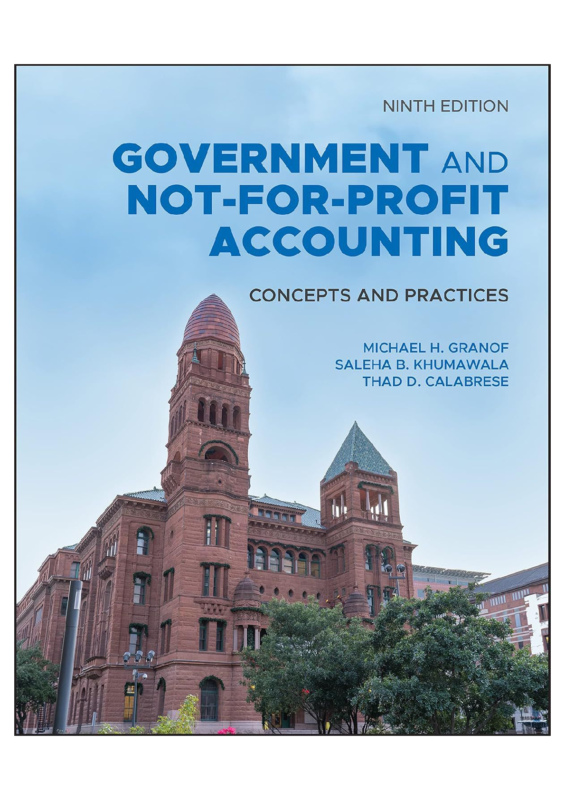
Solutions manual for Government and Not-for-Profit Accounting Concepts and Practices, 9th Edition by Michael H. Granof
$23.00
Secure checkout
Instant digital download
PDF document
Document details
- Pages
- 430
- File size
- 3.78 MB
- Format
- Digital PDF
- Course
- Accounting
- Category
- SOLUTIONS MANUAL
Sign in or create a free account to continue. Your purchase will be saved in My Downloads.
About this ebook
Solutions manual for Government and Not-for-Profit Accounting: Concepts and Practices (9th Edition) by Michael H. Granof, Saleha B. Khumawala, Thad D. Calabrese, and Daniel L. Smith provides a comprehensive breakdown of financial standards governing public and non-profit sectors. Fully updated to align with modern GASB, FASB, and AICPA regulations, the book balances technical compliance with conceptual critical thinking. [1, 2, 3]
The textbook is divided into 17 primary chapters spanning foundational environments, state and local government practices, specific non-profit entities, and oversight: [1, 2]
Foundations of Non-Profit and Public Accounting
- The Government and Not-for-Profit Environment: Core operational and financial differences separating public entities from commercial, for-profit businesses.
- Fund Accounting: The fundamental architecture, purpose, and logic behind utilizing fund structures to manage public resources. [1, 2, 3, 4]
State and Local Government Accounting
- Issues of Budgeting and Control: Mechanics of budgetary formulation, legal frameworks, and tracking compliance. [1, 2, 3, 4]
- Recognizing Revenues in Governmental Funds: Criteria for non-exchange transactions, tax levies, and modified accrual revenue recognition. [1, 2, 3, 4]
- Recognizing Expenditures in Governmental Funds: The timing, recording, and allocation of spending within governmental funds. [1, 2, 3]
- Accounting for Capital Projects and Debt Service: Managing long-term capital assets, infrastructure, and matching funds dedicated to principal and interest payments. [1, 2, 3, 4]
- Capital Assets and Long-Term Obligations: Valuing public capital infrastructure and recording long-term liabilities on both fund and government-wide levels. [1, 2]
- Business-Type Activities: Tracking government-run internal service funds and enterprise funds like municipal utilities. [1]
- Fiduciary Funds: Custodial and trust activities where the government oversees resources belonging to outside parties. [1, 2, 3, 4]
- Financial Reporting (The Government Reporting Model): Creating the Annual Comprehensive Financial Report (ACFR) alongside government-wide statements. [1, 2, 3, 4]
Special Entities and Deep-Dive Topics
- Managing and Auditing Public Sector Performance: Evaluating service efforts, achievements, and structural public-sector operations.
- Federal Government Accounting: Standards unique to federal agencies as mandated by the Federal Accounting Standards Advisory Board (FASAB).
- Not-for-Profit Organizations: FASB financial rules for standard non-governmental non-profits and charities.
- Health Care Providers: Financial accounting methods tailored to hospitals and medical institutions.
- Colleges and Universities: Structural accounting practices unique to higher education facilities.
- Auditing Government and Not-for-Profit Entities: Internal control standards, compliance reporting, and Single Audit rules.
- Financial Capability Analysis: Tools, ratios, and evaluation strategies to gauge the long-term financial health of public and not-for-profit entities. [1, 2, 3, 4, 5, 6, 7, 8, 9]
File included
Solution-manual-for-Government-and-Not-for-Profit-Accounting-Concepts-and-Practices-9th-Edition-by-Michael-H.-Granof.pdf
3.78 MB
Related ebooks