
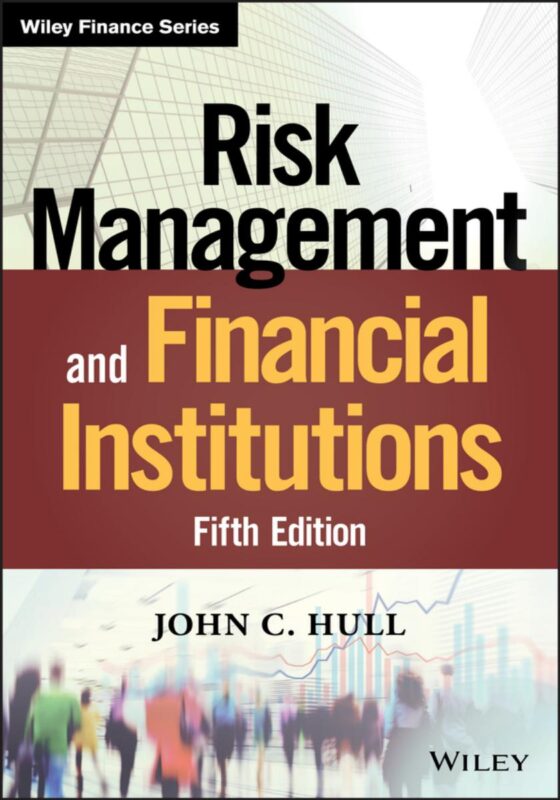
Risk Management and Financial Institutions 5th Edition By John C. Hull
$30.00
Secure checkout
Instant digital download
PDF document
Document details
- Pages
- 830
- File size
- 7.46 MB
- Format
- Digital PDF
- Course
- Management
- Category
- eBook[PDF]
Sign in or create a free account to continue. Your purchase will be saved in My Downloads.
About this ebook
The Risk Management and Financial Institutions, 5th Edition by John C. Hull provides comprehensive coverage of how different financial institutions operate, the core risks they face, and how these risks are quantified, managed, and regulated. [1, 2]
1. Financial Institutions and Their Markets
- Introduction to Risk-Return Trade-offs: Exploring investor preferences, the efficient frontier, the Capital Asset Pricing Model (CAPM), and risk management fundamentals for corporations. [1]
- Types of Financial Institutions: In-depth operations and risks of Banks, Insurance Companies, Pension Plans, and Fund Managers (including mutual funds and hedge funds). [1]
- Financial Instruments & Trading: How products trade in financial markets, the role of derivatives (options, futures, forwards, swaps), and the mechanics of the Over-the-Counter (OTC) Derivatives Market. [1, 2]
- Financial Crises: Analysis of historical financial stability, including securitization and the Global Credit Crisis of 2007–2008. [1]
2. Market Risk Measurement & Management
- Risk Measures: Mathematical application of Value at Risk (VaR) and Expected Shortfall (ES).
- Quantifying Volatility and Correlation: Statistical approaches including EWMA and GARCH models, as well as the use of copulas to model tail dependencies.
- VaR Approaches: Implementing the Historical Simulation approach (along with Extreme Value Theory) and the Model-Building Approach.
- Interest Rate Risk: Duration, convexity, and managing exposures along the yield curve. [1, 2]
3. Credit Risk Assessment & Modeling
- Estimating Default Probabilities: Historical default rates, credit ratings, credit scoring, and deriving implied default probabilities from bond yields and Credit Default Swaps (CDS).
- Credit Value at Risk (Credit VaR): Models used to capture portfolio credit losses (e.g., CreditMetrics).
- Counterparty Credit Risk: Managing risk in derivatives transactions using Collateralization, Central Clearing Parties (CCPs), and metrics like Credit Value Adjustment (CVA) and Debt Value Adjustment (DVA). [1, 2, 3, 4]
4. Operational, Liquidity, and Model Risk
- Operational Risk: Identifying, preventing, and allocating capital for losses resulting from internal failures, human error, cyber risks, or external events.
- Liquidity Risk: Differentiating between trading liquidity and funding liquidity risk, liquidity metrics, and emergency liquidity management.
- Model Risk: The dangers of utilizing flawed financial models or misinterpreting model assumptions. [1, 2]
5. Regulatory Frameworks & Capital Requirements
- The Basel Accords: Chronological progression through Basel I, Basel II, Basel III, and the Fundamental Review of the Trading Book (FRTB).
- Dodd-Frank Act: Major structural and regulatory transformations in US financial markets post-2008.
- Solvency II: The regulatory capital framework governing European insurance firms. [1, 2, 3]
6. Risk Governance and Innovation
- Enterprise Risk Management (ERM): Firm-wide risk culture, risk appetite statements, and sound risk corporate governance.
- Scenario Analysis and Stress Testing: Generating forward-looking macro stress scenarios to evaluate capital adequacy.
- Financial Innovation: New to the 5th edition, this covers how emerging technologies like blockchain, cryptocurrency, and machine learning reshape risk environments in financial services. [1, 2, 3]
File included
tmpphpYyCX9r
7.46 MB
Related ebooks