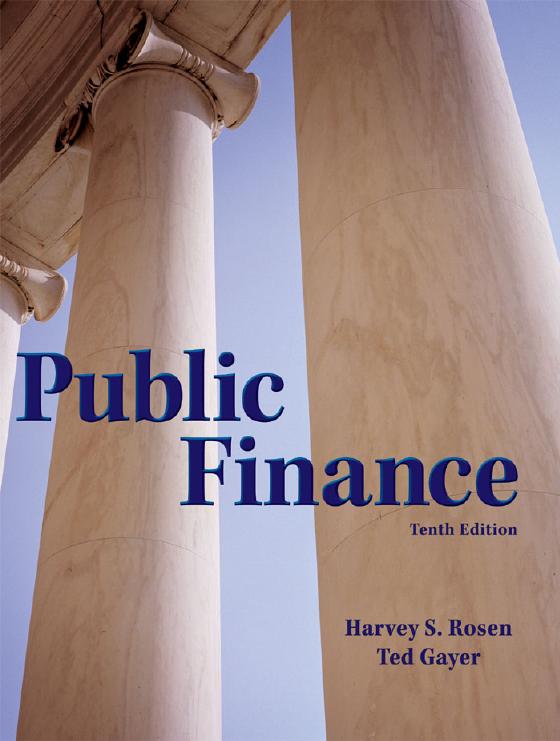
Public Finance, 10th Edition By Harvey Rosen, Ted Gayer
$30.00
Secure checkout
Instant digital download
PDF document
Document details
- Pages
- 609
- File size
- 14.45 MB
- Format
- Digital PDF
- Course
- Business
- Category
- eBook[PDF]
Sign in or create a free account to continue. Your purchase will be saved in My Downloads.
About this ebook
The 10th Edition of Public Finance by Harvey S. Rosen and Ted Gayer covers the economic tools used to analyze government spending, revenue generation, and fiscal policies. The textbook is structured into five core parts, encompassing 20 chapters and a microeconomic appendix: [1, 2, 3]
Part I: Getting Started
This section introduces the core analytical and economic tools required to evaluate public policy.
- Chapter 1: Introduction – The role of government in the economy and a historical overview of public expenditures.
- Chapter 2: Tools of Positive Analysis – Empirical methods used by economists to determine cause-and-effect relationships in policy.
- Chapter 3: Tools of Normative Analysis – Welfare economics, efficiency vs. equity trade-offs, and the rationale for government intervention. [1, 2, 3]
Part II: Public Expenditure: Public Goods and Externalities
Focuses on market failures and how government intervention attempts to resolve them. [1]
- Chapter 4: Public Goods – Defining non-rival and non-excludable goods, alongside the free-rider problem.
- Chapter 5: Externalities – Positive and negative externalities (e.g., pollution) and market-based solutions like Pigouvian taxes.
- Chapter 6: Political Economy – Public choice theory, voting models, and how government decisions are actually made.
- Chapter 7: Education – Government involvement, public funding, subsidies, and the economics of school vouchers.
- Chapter 8: Cost-Benefit Analysis – Techniques for measuring and comparing the present value of social costs and benefits. [1, 2]
Part III: Public Expenditures: Social Insurance and Income Maintenance
- Chapter 9: The Health Care Market – Market failures in private health insurance markets (asymmetric information and moral hazard). [1, 2]
- Chapter 10: Government and the Market for Health Care – The economic structure of Medicare, Medicaid, and comprehensive evaluations of the Affordable Care Act (ACA). [1, 2]
- Chapter 11: Social Security – The structure, financing, economic effects, and long-term viability of federal retirement systems. [1, 2]
- Chapter 12: Income Redistribution: Conceptual Issues – Poverty measurement, philosophical rationales for redistribution, and welfare criteria. [1]
- Chapter 13: Expenditure Programs for the Poor – Means-tested safety-net programs including TANF, SNAP, and the Earned Income Tax Credit (EITC). [1]
Part IV: Framework for Tax Analysis
Lays the theoretical groundwork for understanding how taxes alter economic incentives. [1]
- Chapter 14: Taxation and Income Distribution – Tax incidence, analyzing who ultimately bears the economic burden of taxation.
- Chapter 15: Taxation and Efficiency – Deadweight loss (excess burden) and how taxes distort consumer and producer decisions.
- Chapter 16: Efficient and Equitable Taxation – Optimal taxation theory, tax evasion, and designing fair tax frameworks. [1, 2]
Part V: The United States Revenue System
Dives into the real-world application of tax systems, federal deficits, and potential overhauls. [1]
- Chapter 17: The Personal Income Tax – The mechanics of the federal income tax code, deductions, exemptions, and the Alternative Minimum Tax (AMT).
- Chapter 18: Personal Taxation and Behavior – How taxes affect real-world choices regarding labor supply, savings, and housing.
- Chapter 19: The Corporation Tax – The structure of corporate taxes and the debate over global vs. territorial taxation for multinational firms.
- Chapter 20: Deficit Finance – Macroeconomic impacts of government borrowing, measuring the national debt, and the burden of debt across generations.
- Chapter 21: Fundamental Tax Reform: Taxes on Consumption and Wealth – Evaluating alternatives like a flat tax, national sales tax, Value-Added Tax (VAT), and estate taxes. [1, 2, 3]
File included
tmpphpQZFIUb
14.45 MB
Related ebooks