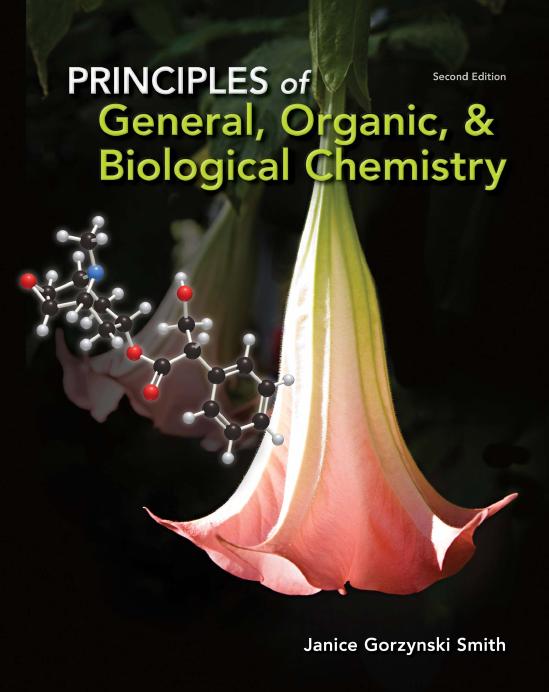
Principles of general, organic & biological chemistry 2nd Edition By Smith, Janice Gorzynski Smith
$30.00
Secure checkout
Instant digital download
PDF document
Document details
- Pages
- 705
- File size
- 921.78 KB
- Format
- Digital PDF
- Course
- Medicine
- Category
- eBook[PDF]
Sign in or create a free account to continue. Your purchase will be saved in My Downloads.
About this ebook
The Principles of General, Organic, & Biological Chemistry (2nd Edition) by Janice Gorzynski Smith covers foundational concepts tailored for a one-semester course, commonly taken by nursing and health professions students. [1, 2, 3]
The chapters and topics are organized into three primary sections: [1]
General Chemistry
- Matter and Measurement: Units, conversions, states of matter, and problem-solving techniques.
- Atoms and the Periodic Table: Atomic structure, isotopes, electron configurations, and periodic trends.
- Ionic and Covalent Compounds: Chemical bonding, drawing Lewis structures, naming compounds, and molecular shapes.
- Energy and Matter: Changes of state, energy alterations, and thermochemical processes.
- Chemical Reactions: Balancing equations, chemical calculations, types of reactions, and chemical equilibrium.
- Gases: Gas laws, behavior of gas particles, and partial pressures.
- Solutions: Solubility, concentration expressions, and the properties of solutions.
- Acids and Bases: pH scale, strong and weak acids/bases, and buffers.
- Nuclear Chemistry: Radioactivity, half-lives, and applications of radiation in medical fields. [1, 2, 3, 4, 5, 6]
Organic Chemistry
- Introduction to Organic Molecules: Carbon bonding, drawing organic compounds, and identifying functional groups.
- Unsaturated Hydrocarbons: Structure and reactivity of alkenes, alkynes, and aromatic compounds.
- Organic Compounds That Contain Oxygen, Halogen, or Sulfur: Alcohols, ethers, alkyl halides, and thiols.
- Carboxylic Acids, Esters, Amines, and Amides: Properties, naming, and reactions of carbonyl compounds and nitrogen-containing bases. [1, 2]
Biological Chemistry
- Carbohydrates: Monosaccharides, disaccharides, polysaccharides, and their roles as energy sources.
- Lipids: Fats, oils, fatty acids, cell membranes, and steroids.
- Amino Acids, Proteins, and Enzymes: Structure of amino acids, protein folding levels, and enzyme catalysis.
- Nucleic Acids and Protein Synthesis: DNA, RNA, replication, transcription, and translation.
- Energy and Metabolism: Biochemical pathways, ATP production, digestion, and how nutrients are converted into energy. [1, 2]
File included
tmpphpfYumsE
921.78 KB
Related ebooks