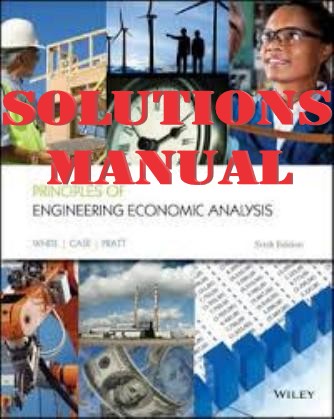
Solutions Manual for Principles of Engineering Economic Analysis 6th Edition By John White, Kenneth Case , David Pratt |
$29.00
Secure checkout
Instant digital download
PDF document
Document details
- Pages
- 105
- File size
- 1.7 MB
- Format
- Digital PDF
- Course
- Economic Analysis
- Category
- SOLUTIONS MANUAL
Sign in or create a free account to continue. Your purchase will be saved in My Downloads.
About this ebook
The Solutions Manual for Principles of Engineering Economic Analysis (6th Edition) by John A. White, Kenneth E. Case, and David B. Pratt delivers a comprehensive, cash-flow-driven approach to evaluating engineering and technical projects. [1, 2]
The book is structured into 16 core chapters and specialized appendices that cover the following topics: [1, 2]
Foundations & The Time Value of Money
-
- Chapter 1: Engineering Economic Analysis – Introduction to the Systematic Economic Analysis Technique (SEAT) and the 10 core principles of engineering economics. [1]
- Chapter 2: Time Value of Money (TVOM) – Cash flow diagrams, simple vs. compound interest, multiple compounding periods per year, and continuous compounding. [1, 2]
- Chapter 3: Borrowing, Lending, and Investing – Loan repayment methods, real estate investment applications, principal and interest breakdowns, retirement planning, bonds, and variable interest rates. [1]
- Chapter 4: Establishing the Planning Horizon and the Minimum Attractive Rate of Return (MARR) – Setting time frames for analysis and determining the hurdle rate required for investments. [1, 2]
Core Evaluation Methodologies
-
- Chapter 5: Present Worth Analysis – Evaluating alternatives by converting all cash flows into today's equivalent dollar value.
- Chapter 6: Future Worth Analysis – Assessing the future values of accumulated investments or project outcomes.
- Chapter 7: Annual Worth Analysis – Converting irregular cash flows into an equivalent uniform annual series, addressing equal vs. unequal project lives, and calculating capital recovery costs.
- Chapter 8: Rate of Return Analysis – Calculating and comparing the Internal Rate of Return (IRR) and External Rate of Return (ERR) for single and multiple alternatives. [1, 2, 3]
Taxes, Inflation & Operational Analysis
-
- Chapter 9: Depreciation Methods – Methods for determining asset wear and accounting devaluation for tax purposes.
- Chapter 10: After-Tax Economic Analysis – Incorporating income tax implications into the financial assessment of a project.
- Chapter 11: Replacement Analysis – Determining the optimal time to retire or replace an existing physical asset with a new alternative.
- Chapter 12: Inflation Effects – Adjusting economic evaluations and after-tax calculations to account for purchasing power changes over time. [1, 2, 3, 4]
Advanced Decisions & Public Sector Projects
-
- Chapter 13: Supplementary Analysis – Methods dealing with real-world uncertainty, including Break-Even analysis, Sensitivity analysis, Risk analysis, and Decision Trees.
- Chapter 14: Economic Analysis in the Public and Regulated Sectors – Applying benefit-cost ratios and evaluation metrics to government or highly regulated projects.
- Chapter 15: Capital Budgeting – Addressing classical capital restrictions, handling unequal investment durations, and optimizing divisible investments.
- Chapter 16: Obtaining and Estimating Cash Flows – Cost terminology, cost estimation strategies, and basic concepts of cost and general accounting. [1, 2, 3, 4]
Appendices
- Appendix A & B: Discrete and Continuous Compound Interest Tables used for manual formulation and reference calculations. [1]
File included
tmpphp1IpeWh
1.7 MB
Related ebooks