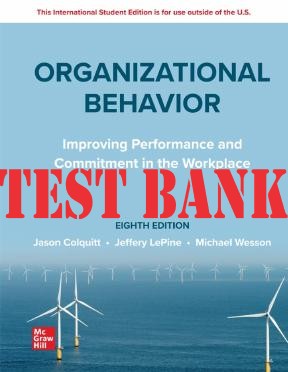
Test Bank for Organizational Behavior Improving Performance and Commitment in the Workplace 8th Edition By Jason Colquitt, Jeffery LePine, Michael Wesson
$30.00
Secure checkout
Instant digital download
PDF document
Document details
- Pages
- 1,385
- File size
- 6.11 MB
- Format
- Digital PDF
- Course
- Organizational Behavior
- Category
- TEST BANKS
Sign in or create a free account to continue. Your purchase will be saved in My Downloads.
About this ebook
Test Bank for Organizational Behavior: Improving Performance and Commitment in the Workplace (8th Edition) by Jason A. Colquitt, Jeffery A. LePine, and Michael J. Wesson is structured around a unique integrative model. This model maps out how individual characteristics, group mechanisms, and organizational mechanisms feed into individual core processes, which ultimately dictate the two primary outcomes of organizational behavior: Job Performance and Organizational Commitment. [1, 2, 3]
The book is divided into 5 distinct parts across 16 chapters: [1]
Part 1: Introduction to Organizational Behavior
-
- Chapter 1: What Is Organizational Behavior? – Defines the field, introduces the integrative model, explores why OB matters using evidence-based scientific research methods, and explains how we know what we know. [1, 2]
- Chapter 2: Job Performance – Focuses on task performance, citizenship behavior, and counterproductive work behavior, alongside performance management systems (e.g., MBO, 360-degree feedback, social performance management) and modern trends like gig work. [1, 2]
- Chapter 3: Organizational Commitment – Examines why employees stay or leave an organization, detailing affective, continuance, and normative commitment, as well as employee responses to negative workplace events (voice, loyalty, neglect, exit). [1, 2]
Part 2: Individual Mechanisms
These core mechanisms directly shape an employee's daily experience and psychological state. [1]
-
- Chapter 4: Job Satisfaction – Explores what makes work satisfying (value-percept theory) and the emotional experience of work (moods and emotions).
- Chapter 5: Stress – Examines transaction theories of stress, stressors (hindrance vs. challenge), strain, and how individuals cope with stress.
- Chapter 6: Motivation – Focuses on theories that drive employee effort, including Expectancy Theory, Goal Setting Theory, Equity Theory, and Psychological Empowerment.
- Chapter 7: Trust, Justice, and Ethics – Analyzes corporate social responsibility, the types of organizational justice (distributive, procedural, interpersonal, informational), trust-building, and ethical decision-making models.
- Chapter 8: Learning and Decision Making – Explores how expertise is built through tacit and explicit learning, reinforcement, decision-making biases, and problems with heuristics. [1, 2, 3]
Part 3: Individual Characteristics
Factors unique to each person that influence the individual mechanisms. [1]
-
- Chapter 9: Personality and Cultural Values – Details the "Big Five" personality traits (Conscientiousness, Agreeableness, Neuroticism, Openness, Extraversion), the Myers-Briggs Type Indicator (MBTI), and Hofstede's dimensions of cultural values. [1, 2]
- Chapter 10: Ability – Evaluates cognitive abilities (verbal, quantitative, reasoning), emotional intelligence (ability/EI), and physical capabilities. [1, 2]
Part 4: Group Mechanisms
How team-level interactions and dynamics impact individual performance. [1]
-
- Chapter 11: Teams: Characteristics and Diversity – Covers team types, models of team development, interdependence (task, goal, outcome), and team composition/diversity.
- Chapter 12: Teams: Processes and Communication – Analyzes team states (cohesion, mental models), communication barriers, and team processes (transition, action, interpersonal).
- Chapter 13: Leadership: Power and Negotiation – Focuses on organizational and personal power, influence tactics, conflict resolution styles, and negotiation strategies.
- Chapter 14: Leadership: Styles and Behaviors – Explores leader decision-making styles (delegative, facilitative, consultative, autocratic) and transformational versus transactional leadership behaviors. [1, 2, 3]
Part 5: Organizational Mechanisms
Macro-level structures that envelope all other behaviors within the company. [1]
-
- Chapter 15: Organizational Structure – Focuses on the building blocks of structure (work specialization, chain of command, span of control, centralization, formalization) and common organizational design types.
- Chapter 16: Organizational Culture – Evaluates culture components (observable artifacts, espoused values, basic underlying assumptions), culture types, socialization, and managing organizational change. [1, 2]
File included
ScholarFriends.com-tb-ready.pdf
6.11 MB
Related ebooks