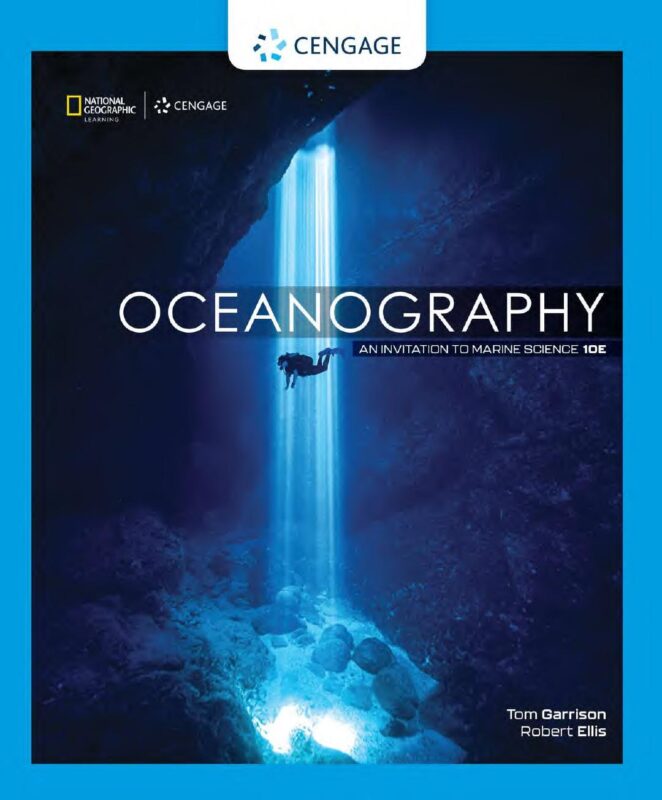
Oceanography: An Invitation to Marine Science 10th Edition By Tom Garrison
$30.00
Secure checkout
Instant digital download
PDF document
Document details
- Pages
- 674
- File size
- 44.27 MB
- Format
- Digital PDF
- Course
- Biological Sciences
- Category
- eBook[PDF]
Sign in or create a free account to continue. Your purchase will be saved in My Downloads.
About this ebook
Oceanography: An Invitation to Marine Science, 10th Edition by Tom Garrison and Robert Ellis covers the full interdisciplinary scope of marine science, spanning geological, chemical, physical, and biological oceanography. [1, 2]
The textbook is divided into 19 comprehensive chapters outlining how the ocean functions, how it interacts with Earth's systems, and how humans impact marine environments: []
Foundations & Marine Geology
- Chapter 1: The Origin of the Ocean – The formation of the universe, stars, solar systems, and early Earth's atmosphere and primitive oceans. [1]
- Chapter 2: A History of Marine Science – Early voyaging for trade, the history of ocean exploration, and the rise of modern oceanography. [1]
- Chapter 3: Earth Structure and Plate Tectonics – The inner layers of the Earth, evidence for continental drift, seafloor spreading, and tectonic plates. [1]
- Chapter 4: Ocean Basins – Continental margins, deep-ocean basins, hydrothermal vents, and submarine topography. [1]
- Chapter 5: Ocean Sediments – Classification and distribution of marine sediments (neritic, pelagic) and what they reveal about Earth's climate history. []
Physical & Chemical Oceanography
- Chapter 6: Water and Ocean Structure – The physical properties of pure water and seawater, heat capacity, and how light and sound travel through water.
- Chapter 7: Ocean Chemistry – Salinity, dissolved gases, the ocean's acid-base balance, and chemical cycles.
- Chapter 8: Circulation of the Atmosphere – Weather, atmospheric density, wind patterns, and storms like tropical cyclones.
- Chapter 9: Circulation of the Ocean – Surface currents, gyres, boundary currents, and deep thermohaline circulation.
- Chapter 10: Waves – The physics of wind waves, deep-water and shallow-water waves, tsunamis, and seiches.
- Chapter 11: Tides – The gravitational pull of the sun and moon, dynamic theory of tides, and tidal patterns around the globe.
- Chapter 12: Coasts – Erosional and depositional coastlines, beaches, estuaries, lagoons, and human interactions with shifting shores. [, 2]
Biological Oceanography & Ecosystems
- Chapter 13: Life in the Ocean – The mechanics of marine life, evolution, energy transfer, and the classification of marine organisms. []
- Chapter 14: Primary Producers – Expanded coverage on photosynthetic and chemosynthetic organisms (phytoplankton, algae, plants) that form the base of the marine food web. [, 2]
- Chapter 15: Marine Animals – Invertebrates, vertebrates (fishes, reptiles, birds, mammals), and their unique physiological adaptations to the sea. []
- Chapter 16: Marine Communities – Ecological relationships across specific ecosystems like coral reefs, deep-sea floors, and rocky intertidal zones. []
Resources, Human Impact & Freshwater Systems
- Chapter 17: Marine Resources – Physical resources (petroleum, minerals), biological resources (fisheries, aquaculture), renewable energy, and ocean law.
- Chapter 18: The Ocean and the Environment – Pollution (including plastics), habitat destruction, and extensively revised modules detailing anthropogenic climate change.
- Chapter 19: A Closer Look at Freshwater Processes and Ecosystems – A newer addition analyzing freshwater dynamics and how they link with marine ecosystems. [, 2, 3, 4]
File included
tmpphp8iw0Ut
44.27 MB
Related ebooks