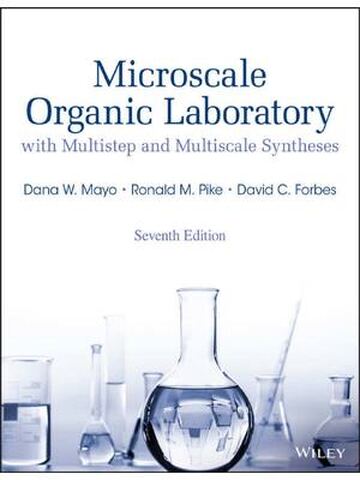
Microscale Organic Laboratory With Multistep and Multiscale Syntheses 7th Edition By Dana Mayo, Ronald Pike, David Forbes
$30.00
Secure checkout
Instant digital download
PDF document
Document details
- Pages
- 1,086
- File size
- 25.74 MB
- Format
- Digital PDF
- Course
- Education
- Category
- eBook[PDF]
Sign in or create a free account to continue. Your purchase will be saved in My Downloads.
About this ebook
The 7th Edition of Microscale Organic Laboratory: With Multistep and Multiscale Syntheses by Dana W. Mayo, Ronald M. Pike, and David C. Forbes covers a modern curriculum for the mainstream organic chemistry laboratory. The text balances foundational microscale procedures with multi-step sequential reactions, options for scaling up to macroscale, and greener chemistry practices. [1, 2, 3]
The primary chapters and core topics covered in this edition include: [1]
🧪 Core Laboratory & Safety Principles
- Chapter 1: Introduction: Overview of experimental organic chemistry and the foundational philosophy of microscale methods. [1, 2]
- Chapter 2: Safety: Comprehensive guidelines on modern laboratory instrumentation safety, chemical exposure management, and hazardous waste disposal. [1, 2]
- Chapter 3: Introduction to Microscale Organic Laboratory Equipment and Techniques: Familiarization with specialized microscale glassware, apparatus setups, and basic handling maneuvers. [1, 2]
⚖️ Separation, Purification, & Physical Characterization
- Chapter 4 & 4a: Determination of Physical Properties: Measuring melting points, boiling points, and the Refractive Index to assess chemical purity. [1, 2]
- Chapter 5: Microscale Laboratory Techniques: Practical isolation and purification skills, which focus on:
🔬 Synthesis and Sequential Experiments
- Chapter 6: Microscale Organic Laboratory Experiments: A diverse series of traditional organic chemistry reactions (such as nucleophilic substitutions, eliminations, additions, and acyl transfers) utilizing query-driven experimentation. [1, 2]
- Chapter 7 & 7a: Sequential Syntheses and Advanced Laboratory Experimentation: Transition strategies from macroscale to microscale alongside sophisticated multi-step reaction Sequences (D, E, and F) to maximize student hands-on compound manipulation. [1, 2]
📊 Structure Analysis & Characterization
- Chapter 8: Spectroscopic Identification of Organic Compounds: Utilizing modern analytical instrumentation like Infrared (IR) Spectroscopy and Nuclear Magnetic Resonance (NMR) to deduce molecular architecture.
- Chapter 9: Qualitative Identification of Organic Compounds: Classic wet-chemical functional group testing and derivative preparation for unknowns.
- Chapter 10: Advanced Topics: Higher-level methodologies, including greener processes (such as microwave-assisted synthesis) and rigorous validation of purification pipelines. [1, 2, 3, 4]
File included
tmpphpcdbjw3
25.74 MB
Related ebooks