
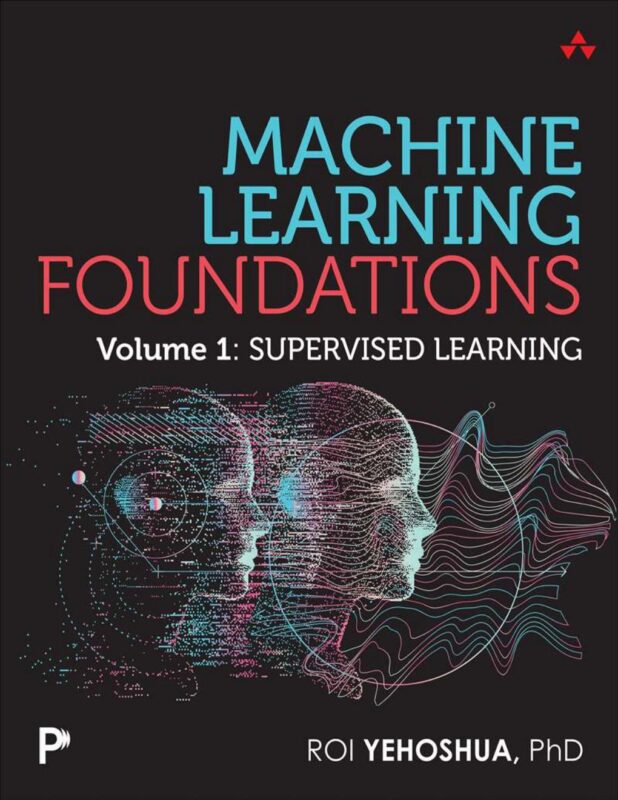
Machine Learning Foundations, Volume 1 Supervised Learning 1st Edition By Roi Yehoshua
$30.00
Secure checkout
Instant digital download
PDF document
Document details
- Pages
- 722
- File size
- 9.88 MB
- Format
- Digital PDF
- Course
- Business
- Category
- eBook[PDF]
Sign in or create a free account to continue. Your purchase will be saved in My Downloads.
About this ebook
The Machine Learning Foundations, Volume 1: Supervised Learning(1st Edition) by Roi Yehoshua, PhD—published by Addison-Wesley Professional—is a comprehensive textbook designed to balance mathematical rigor with hands-on Python programming. [1, 2]
The book covers the essential concepts, foundational algorithms, workflow pipelines, and practical tools needed to master supervised learning. [1, 2]
The core topics and chapters covered in this volume include:
1. Core Machine Learning Concepts & Foundations
- Theoretical Frameworks: Model capacity, empirical risk minimization, generalization error, and the data-generating process.
- The Bias-Variance Tradeoff: Understanding underfitting versus overfitting, regularization techniques, and optimization.
- Learning Tasks: Formal definitions and execution of classification, regression, multi-label, and multi-output problems. [1, 2, 3, 4]
2. Foundational & Linear Algorithms
- Linear Regression: Foundational regression analysis, optimization, and parameter estimation.
- Logistic Regression: Classification metrics, baseline probabilistic modeling, and decision boundaries.
- Instance-Based & Probabilistic Models: K-Nearest Neighbors (KNN) and Naive Bayes classifiers. [1, 2, 3]
3. Tree-Based Models & Ensemble Methods
- Decision Trees: Building tree architectures from scratch for both classification and regression tasks.
- Ensemble Learning: Implementation of bagging, Random Forests, and AdaBoost.
- Advanced Boosting Frameworks: Deep dives into Gradient Boosting, XGBoost, LightGBM, and CatBoost. [1, 2, 3]
4. Advanced Vector Machines
- Support Vector Machines (SVMs): Maximum margin classifiers and structural risk minimization.
- Kernel Methods: Transforming non-linearly separable data into higher dimensions. [1, 2]
5. Practical Implementation, Pipelines & Tools
- Hands-on Frameworks: Utilizing industry-standard libraries like Scikit-Learn, XGBoost, and NLTK.
- Data Processing Pipeline: Comprehensive strategies for feature engineering, data preparation, data preprocessing, and handling diverse data types like tabular data, text, and images.
- Model Optimization: Evaluating performance metrics, setting up cross-validation, hyperparameter tuning, and model calibration.
- Custom Architectures: Guidance on building custom estimators using the Scikit-Learn Estimator API. [1, 2, 3]
File included
tmpphp7RszZF
9.88 MB
Related ebooks