
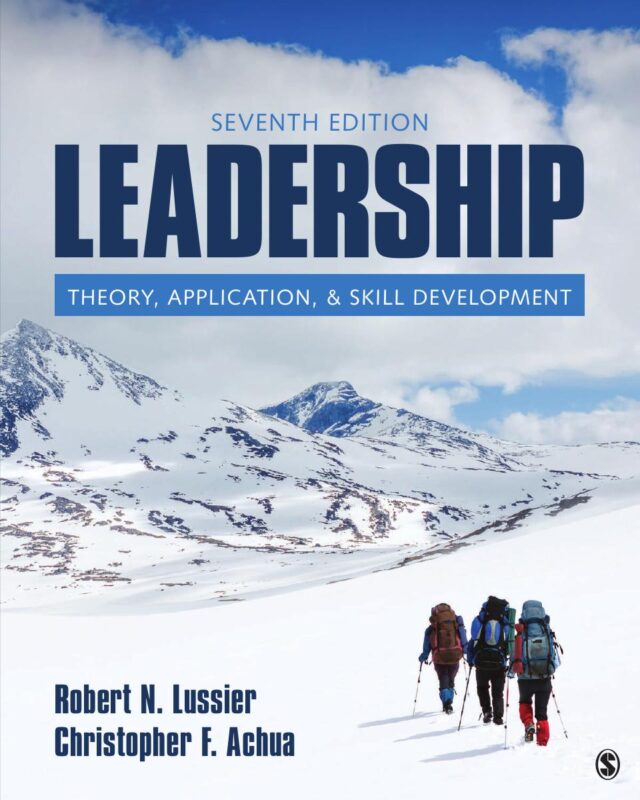
Leadership Theory Application & Skill Development 7th Edition By Robert Lussier, Christopher Achua
$28.00
Secure checkout
Instant digital download
PDF document
Document details
- Pages
- 649
- File size
- 6.27 MB
- Format
- Digital PDF
- Course
- Education
- Category
- eBook[PDF]
Sign in or create a free account to continue. Your purchase will be saved in My Downloads.
About this ebook
The Leadership: Theory, Application, & Skill Development by Robert N. Lussier and Christopher F. Achua is a 12-chapter comprehensive textbook. It utilizes a three-pronged approach targeting leadership theory, evidence-based application, and behavioral skill development. [1, 2]
Core Topics by Chapter
The book covers the following major topics across its 12 chapters: [1]
- Chapter 1: Who Is a Leader and What Skills Do Leaders Need? – Introduces the shift from management to leadership paradigms, the five elements of leadership, the skills approach (interpersonal, technical, conceptual), and managerial roles.
- Chapter 2: Leadership Traits and Ethics – Analyzes individual personality traits (such as the Big Five model), the importance of leadership ethics, and moral development.
- Chapter 3: Leadership Behavior and Motivation – Focuses on leadership styles, behavioral models (e.g., the Leadership Grid), and key motivation theories used to inspire followers.
- Chapter 4: Contingency Leadership Theories – Covers situational variables and models that determine how leadership styles must adapt to different environment-driven contexts.
- Chapter 5: Communication, Coaching, and Conflict Skills – Outlines practical tools for active communication, giving feedback, peer coaching, and managing workplace conflicts.
- Chapter 6: Influencing, Power, Politics, Networking, and Negotiation Skills – Explores politics within organizations, building networks, tactical negotiation, and exercising structural or personal power.
- Chapter 7: Leader–Member Exchange and Followership – Examines the dyadic relationship between leaders and followers, including in-group/out-group dynamics and effective followership roles.
- Chapter 8: Team Leadership and Self-Managed Teams – Focuses on leading cross-functional teams, group dynamics, and guiding self-managed work units.
- Chapter 9: Managing Change and Crisis Leadership – Addresses navigating organizational transitions and guiding entities through critical emergencies or crises.
- Chapter 10: Charismatic, Transformational, and Servant Leadership – Evaluates contemporary leadership frameworks, emphasizing visionary style, social impact, and servant-minded leadership models.
- Chapter 11: Leadership of Culture, Diversity, and Inclusion – Explores the role of leadership in shaping corporate culture, navigating global environments, and advancing Diversity, Equity, and Inclusion (DEI).
- Chapter 12: Strategic Leadership and High-Performing Organizations – Focuses on long-term strategy, execution, and sustaining competitiveness to build high-performing organizations. [1, 2, 3, 4, 5]
Key Updates in the 7th Edition
If you are comparing this to older versions, the 7th edition explicitly expands on: [1]
- Crisis Leadership – Dedicated methodologies for leading through unexpected disruptions.
- DEI & Social Impact – Enhanced modules regarding equity, inclusion, and the broader social footprint of organizational choices.
- Servant Leadership – Greater emphasis on putting employee growth and community well-being first.
- New Case Studies – Integrates 23 new case profiles showcasing modern, diverse business leaders. [1, 2]
File included
ScholarFriends.com-leadership-theory-application-skill-development-7th-edition-by-robert-lussier-christopher-.pdf
6.27 MB
Related ebooks