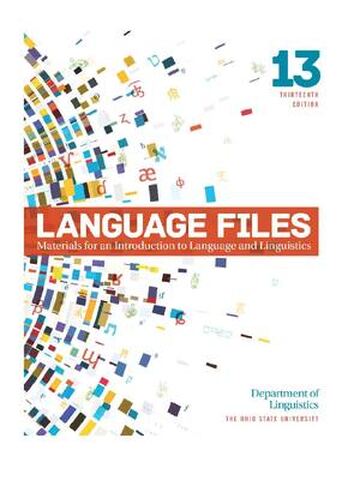
Language Files: Materials for an Introduction to Language and Linguistics 13th Edition By Department of Linguistics | eBook
$25.00
Secure checkout
Instant digital download
PDF document
Document details
- Pages
- 779
- File size
- 14.56 MB
- Format
- Digital PDF
- Course
- Education
- Category
- eBook[PDF]
Sign in or create a free account to continue. Your purchase will be saved in My Downloads.
About this ebook
Language Files: Materials for an Introduction to Language and Linguistics (13th Edition), published by the Ohio State University Press and authored by the OSU Department of Linguistics, is divided into 17 chapters. Each chapter is structured as a collection of modular "files" designed for flexible learning. [1, 2]
The primary topics and chapters covered in this edition include:
Core Theoretical Linguistics
- Chapter 1: Introduction — Explores what language is, mental grammar, descriptive vs. prescriptive grammar, and what it means to "know" a language. [1, 2]
- Chapter 2: Phonetics — Examines the production, transmission, and reception of speech sounds, with a focus on articulatory mechanisms and phonetic transcription. [1, 2]
- Chapter 3: Phonology — Analyzes how sounds function systematically within a language, covering phonotactic constraints, phonemes, allophones, and phonological rules. [1, 2]
- Chapter 4: Morphology — Investigates word structure and word formation. The 13th edition features expanded coverage of allomorphy, templatic morphology, suprasegmental morphology, and morphological metathesis. [, 2]
- Chapter 5: Syntax — Focuses on sentence organization, word order, syntactic categories, constituency, and structural properties. It introduces new material on non-generative rule systems and syntactic non-constituents. [1, 2, 3]
- Chapter 6: Semantics — Looks at linguistic meaning, including lexical semantics (word meanings) and compositional semantics (sentence meanings). [1, 2]
- Chapter 7: Pragmatics — Studies how context affects meaning, detailing speech acts, implicature, presupposition, and conversational rules. [1, 2]
Psycholinguistics & Language Acquisition
- Chapter 8: Language Acquisition — Examines how children learn their native language, milestones in development, and the traits of first-language vs. second-language acquisition. [1, 2]
- Chapter 9: Psycholinguistics — Focuses on language processing, human cognitive systems, speech perception, and neurolinguistics (how language is represented in the brain). [1, 2]
Language in Society & Culture
- Chapter 10: Language Variation — Covers sociolinguistics, regional and social dialects, socio-economic language patterns, and stylistic registers.
- Chapter 11: Language and Culture — Investigates the intersection of language structure and cultural worldview, including linguistic relativity.
- Chapter 12: Language Contact — Looks at pidgins, creoles, bilingualism, and lexical borrowing. The 13th edition features a completely rewritten file on creole languages.
- Chapter 13: Language Change — Explores historical linguistics, sound shifts, morphological and syntactic change, and language reconstruction methods. [1, 2, 3, 4, 5]
Structural & Applied Domains
- Chapter 14: Animal Communication — Contrasts human language traits with the communication systems used by other species.
- Chapter 15: Writing Systems — Reviews the history, development, and classification of written scripts (e.g., logographic, syllabic, alphabetic).
- Chapter 16: Language and Computers — Focuses on computational linguistics. This chapter has been updated with brand new sections covering deep learning, artificial neural networks, and modern speech technologies.
- Chapter 17: Practical Applications — Covers real-world uses of linguistics, including forensic linguistics, language education, policy, and clinical speech therapy. [, 2]
File included
tmpphpLx0NWA
14.56 MB
Related ebooks