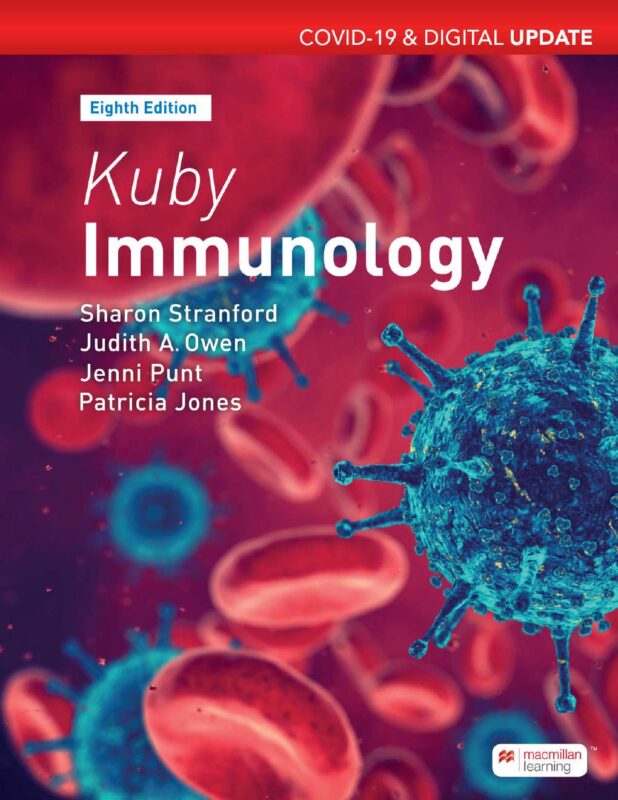
Kuby’s Immunology, Media Update 8th Edition By Sharon Stranford, Judy Owen, Patricia Jones, Jenni Punt
$30.00
Secure checkout
Instant digital download
PDF document
Document details
- Pages
- 2,630
- File size
- 45.45 MB
- Format
- Digital PDF
- Course
- Education
- Category
- eBook[PDF]
Sign in or create a free account to continue. Your purchase will be saved in My Downloads.
About this ebook
Kuby Immunology, Media Update 8th Edition by Sharon Stranford, Judy Owen, Jenni Punt, and Patricia Jones covers a comprehensive, experimental approach to understanding the immune system. This specific update integrates foundational immunology with critical digital updates, modern research case studies, and content regarding global health crises like COVID-19. [1, 2, 3]
The textbook is structurally organized into 20 core chapters grouped logically by foundational, mechanical, and clinical immunology: [1, 2]
🛡️ Part I: Introduction & Foundational Concepts
- Chapter 1: Overview of the Immune System — Basic concepts of self vs. non-self, innate vs. adaptive responses, and historical perspectives. [1, 2]
- Chapter 2: Cells, Organs, and Microenvironments of the Immune System — Hematopoiesis, structure and function of primary/secondary lymphoid organs (bone marrow, thymus, lymph nodes, spleen). [1, 2]
- Chapter 3: Recognition and Response — Molecular mechanics of how receptors interact with ligands to initiate immune signals. [1, 2]
🧬 Part II: Innate Immunity & Signaling
- Chapter 4: Innate Immunity — Cellular and molecular components of the first line of defense, including pattern recognition receptors (PRRs).
- Chapter 5: The Complement System — Classical, lectin, and alternative pathways, along with complement regulation and deficiencies. [1, 2, 3]
🧬 Part III: Antigen Receptors & Genetics
- Chapter 6: The Organization and Expression of Lymphocyte Receptor Genes — V(D)J recombination, and how the massive diversity of B- and T-cell receptors is genetically generated. [1, 2]
- Chapter 7: The Major Histocompatibility Complex (MHC) and Antigen Presentation — Structure of MHC Class I and II, antigen processing pathways, and presentation to T cells. [1, 2]
🔄 Part IV: Lymphocyte Development
- Chapter 8: T-Cell Development — Thymic selection (positive and negative selection) and lineage commitment.
- Chapter 9: B-Cell Development — Bone marrow stages, receptor editing, and selection of functional B cells. [1, 2]
🚀 Part V: Adaptive Immune Responses & Effector Mechanics
- Chapter 10: T-Cell Activation, Helper Subset Differentiation, and Memory — Costimulation, Th1/Th2/Th17/Treg polarization, and the generation of memory T cells.
- Chapter 11: B-Cell Activation, Differentiation, and Memory Generation — T-dependent vs. T-independent activation, germinal center reactions, somatic hypermutation, and class-switch recombination.
- Chapter 12: Effector Responses: Antibody- and Cell-Mediated Immunity — Cytotoxic T lymphocytes (CTLs), Natural Killer (NK) cells, and antibody-mediated neutralization/opsonization.
- Chapter 13: Barrier Immunity: The Immunology of Mucosa and Skin — Specialised immune systems safeguarding the gut, respiratory tract, and skin barrier.
- Chapter 14: The Adaptive Immune Response in Space and Time — How immune cells traffic through tissues sequentially over the course of an active infection. [1, 2, 3]
🏥 Part VI: Clinical Immunology: Health & Disease
- Chapter 15: Allergy, Hypersensitivities, and Chronic Inflammation — Mechanisms behind Type I to Type IV hypersensitivity reactions and long-term inflammatory damage.
- Chapter 16: Tolerance, Autoimmunity, and Transplantation — Mechanisms of central/peripheral tolerance, failure leading to autoimmune diseases, and graft rejection immunology.
- Chapter 17: Infectious Diseases and Vaccines — Host defenses against viruses, bacteria, parasites, and the design/principles of modern vaccines (including updated digital modules on COVID-19 mRNA technology).
- Chapter 18: Immunodeficiency Diseases — Primary immunodeficiencies (e.g., SCID) and secondary immunodeficiencies (e.g., HIV/AIDS).
- Chapter 19: Cancer and the Immune System — Tumor antigens, immune evasion by cancer cells, and modern immunotherapies (like checkpoint inhibitors and CAR-T cell therapy). [1, 2, 3]
🔬 Part VII: Methodology
File included
Kubys-Immunology-Media-Update-8th-Edition.pdf
45.45 MB
Related ebooks