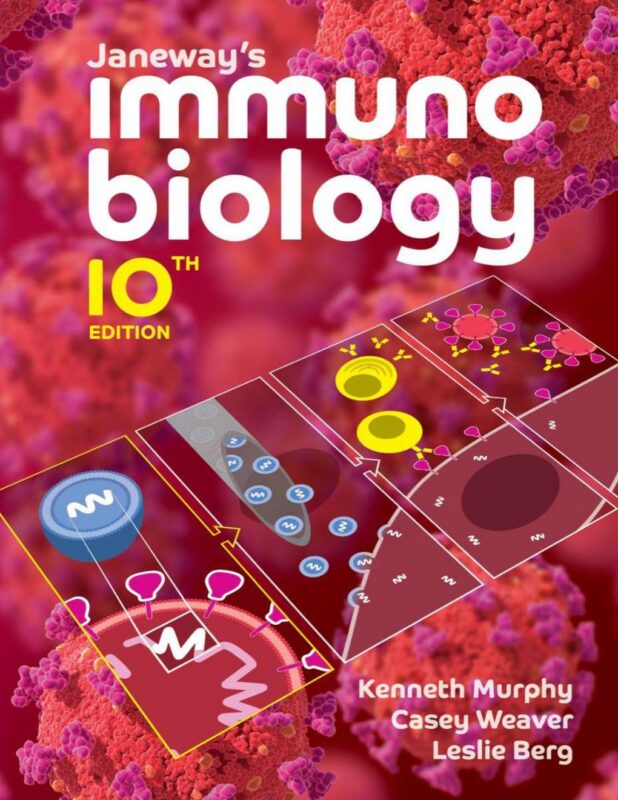
Janeway’s Immunobiology 10th Edition By Kenneth Murphy, Casey Weaver, Leslie Berg
$30.00
Secure checkout
Instant digital download
PDF document
Document details
- Pages
- 2,396
- File size
- 38.16 MB
- Format
- Digital PDF
- Course
- Education
- Category
- eBook[PDF]
Sign in or create a free account to continue. Your purchase will be saved in My Downloads.
About this ebook
Janeway's Immunobiology, 10th Edition by Kenneth Murphy, Casey Weaver, and Leslie Berg covers the core fundamental mechanisms of the immune system. The textbook is structured sequentially, moving from baseline innate defense layers to advanced lymphocyte biology, adaptive immunity, and clinical health implications. [1, 2]
The primary sections and chapters include:
Part I: An Introduction to Immunobiology and Innate Immunity
- Chapter 1: Basic Concepts in Immunology – Overview of the immune framework, pathogen classes, and primary/secondary lymphoid organs. [1, 2]
- Chapter 2: Innate Immunity: The First Lines of Defense – Initial chemical and physical barriers, host-pathogen interactions, and the complement system pathways. [1, 2]
- Chapter 3: Cellular Mechanisms of Innate Immunity – Deep dive into phagocytes, natural killer (NK) cells, pattern recognition receptors (PRRs), and the initiation of inflammation. [1]
Part II: The Recognition of Antigen
- Chapter 4: Antigen Recognition by B-cell and T-cell Receptors – Structural characteristics of antibodies, immunoglobulins, and T-cell receptors (TCRs). [1]
- Chapter 5: The Generation of Lymphocyte Antigen Receptors – Mechanics behind V(D)J recombination, receptor gene rearrangement, and clonal diversity.
- Chapter 6: Antigen Presentation to T Lymphocytes – Major Histocompatibility Complex (MHC) Class I and II pathways, peptide loading, and processing. [1, 2]
Part III: The Development of Mature Lymphocyte Receptor Repertoires
- Chapter 7: Lymphocyte Receptor Signaling – Intracellular signaling cascades, kinase pathways, and transcription factor activation following antigen binding.
- Chapter 8: The Development of B and T Lymphocytes – Positive and negative selection, central tolerance, and cell maturation steps inside the bone marrow and thymus. [1, 2]
Part IV: The Adaptive Immune Response
- Chapter 9: T Cell–Mediated Immunity – Activation of naive T cells, differentiation into distinct helper T cell subsets (\(T_{H}1\), \(T_{H}2\), \(T_{H}17\), Treg), and cytotoxic T-cell actions.
- Chapter 10: The Humoral Immune Response – B-cell activation, germinal center reactions, isotype switching, affinity maturation, and antibody-mediated neutralization/opsonization.
- Chapter 11: Integrated Dynamics of Innate and Adaptive Immunity – How the innate and adaptive systems coordinate timing and signals to clear specific pathogen types.
- Chapter 12: The Mucosal Immune System – Specialized immune architecture protecting the gut, respiratory tract, and urogenital surfaces. [1]
Part V: Clinical Immunology
- Chapter 13: Failures of Host Defense Mechanisms – Inherited primary immunodeficiencies and acquired deficiencies (such as HIV/AIDS).
- Chapter 14: Allergy and Allergic Diseases – Mechanisms behind Type I–IV hypersensitivities, IgE-mediated responses, and chronic inflammation.
- Chapter 15: Autoimmunity and Transplantation – Breakdown of self-tolerance, autoimmune disease pathogenesis, and the immunology of graft rejection.
- Chapter 16: Manipulation of the Immune Response – Principles of vaccine design, immunotherapy strategies, monoclonal antibody therapies, and cancer immunology. [1, 2]
Key Additions in the 10th Edition:
- cGAS/STING Pathway: Heavily expanded coverage of modern innate cytoplasmic DNA sensing mechanisms.
- Viral Immunology & SARS-CoV-2: Updated cellular contexts derived from global research on coronavirus immune responses and mRNA vaccine platforms.
- High-Throughput Data: Integrated insights from single-cell RNA sequencing and genomic profiling shaping modern cell heterogeneity models. [1]
File included
tmpphpZuB6Cp
38.16 MB
Related ebooks