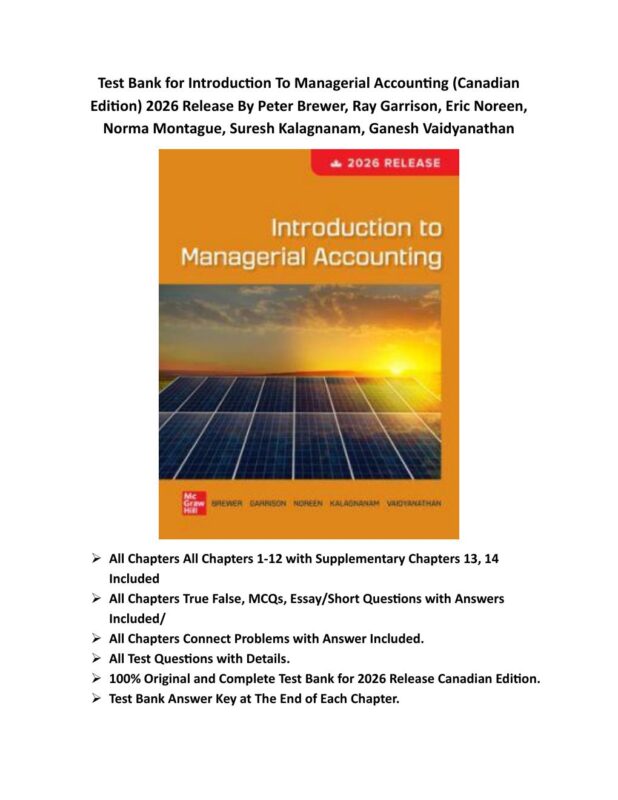
TEST BANK for Introduction To Managerial Accounting (Canadian Edition) 2026 Release By Peter Brewer, Ray Garrison, Eric Noreen, Norma Montague, Suresh Kalagnanam, Ganesh Vaidyanathan | Test Bank
$35.00
Secure checkout
Instant digital download
PDF document
Document details
- Pages
- 2,649
- File size
- 11.7 MB
- Format
- Digital PDF
- Course
- Accounting
- Category
- TEST BANKS
Sign in or create a free account to continue. Your purchase will be saved in My Downloads.
About this ebook
TEST BANK for The 2026 Release (Canadian Edition) of Introduction to Managerial Accounting by Peter Brewer, Ray Garrison, Eric Noreen, Norma Montague, Suresh Kalagnanam, and Ganesh Vaidyanathan is structured into 12 primary chapters. It segments its focus into product and service costing, planning and short-term decisions, and organizational performance evaluation. [1]
Product and Service Costing (Chapters 1–5)
- Managerial Accounting Overview: Distinguishes managerial accounting from financial accounting, highlighting its future-oriented focus, internal management users, and the absence of strict external GAAP/IFRS standards. It introduces core responsibilities (planning, controlling, decision-making) and details the Canadian context via the CPA Code of Professional Conduct. [1, 2, 3, 4]
- Managerial Cost Concepts: Classes of costs including direct/indirect, product vs. period costs, and manufacturing vs. service sector examples. [1, 2]
- Job-Order Costing: Calculating unit product and service costs, assigning overhead using predetermined rates, and managing cost flows for external financial reporting. [1]
- Activity-Based Costing (ABC): Utilizing ABC as a strategic tool to trace overhead costs more precisely to specific activities, services, or products to aid in managerial choices. [1, 2]
- Process Costing: Assigning mass production costs through continuous processing departments using equivalent units of production. [1]
Planning, Analysis, and Decision Making (Chapters 6–10)
- Cost-Volume-Profit (CVP) Relationships: Examining how changes in costs and volume affect operational profit, break-even points, safety margins, and operating leverage.
- Variable Costing and Segment Reporting: Tools for internal management to evaluate product lines, business territories, and individual segments without the distortion of fixed overhead allocations.
- Master Budgeting: Devising the comprehensive financial plan, including sales forecasting, production budgeting, cash budgets, and projected financial statements to drive corporate strategy.
- Flexible Budgets and Standard Costs: Creating dynamic budgets adjusted for actual activity levels and calculating material, labor, and overhead variances to control operational costs.
- Differential Analysis: Identifying relevant costs and revenues to handle short-term business choices such as make-or-buy scenarios, special orders, and dropping unprofitable segments. [1, 2]
Performance Measurement and Capital Projects (Chapters 11–12)
- Performance Evaluation in Decentralized Organizations: Responsibility accounting, assessing investment centres through Return on Investment (ROI) and Residual Income (RI), and utilizing modern balancing metrics like the Balanced Scorecard.
- Capital Budgeting Decisions: Analyzing long-term capital investments using discounted cash flow models (Net Present Value and Internal Rate of Return) alongside payback periods and simple rate of return methods. [1, 2]
Key Conceptual Adaptations
- Canada's Service Economy: Features localized application summaries tailored toward real-world Canadian corporate environments and service-centric logistics rather than just heavy manufacturing.
- ESG and Sustainability Integration: Threads corporate social responsibility, the Triple Bottom Line, and modern ethical dilemmas alongside technical accounting principles. [1, 2, 3, 4]
File included
ScholarFriends.com-tb-ready.pdf
11.7 MB
Related ebooks