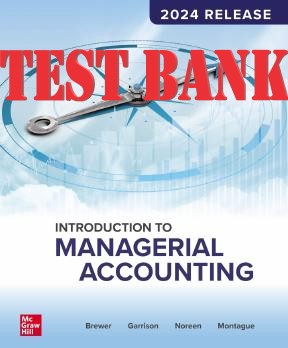
TEST BANK for Introduction to Managerial Accounting 10th Edition (2024 Release) By Peter Brewer, Ray Garrison, Eric Noreen
$30.00
Secure checkout
Instant digital download
PDF document
Document details
- Pages
- 7,507
- File size
- 29.82 MB
- Format
- Digital PDF
- Course
- Accounting
- Category
- TEST BANKS
Sign in or create a free account to continue. Your purchase will be saved in My Downloads.
About this ebook
The TEST BANK for Introduction to Managerial Accounting 10th Edition (2024 Release) by Peter Brewer, Ray Garrison, Eric Noreen, and Norma Montague organizes core management accounting logic into a prologue and 14 comprehensive chapters. The text transitions systematically from cost foundations to advanced planning and business decision metrics. [1, 2, 3]
The exact topics covered across all 14 chapters include:
Prologue & Foundations of Cost Accounting
-
- Prologue: Managerial Accounting: An Overview — Establishes the distinct differences between financial and managerial accounting, focusing on the management cycle (planning, controlling, decision-making) and professional ethics. [1, 2]
- Chapter 1: Managerial Accounting and Cost Concepts — Introduces cost classifications, including direct vs. indirect, product vs. period, and variable vs. fixed cost behaviors. [1]
- Chapter 2: Job-Order Costing: Calculating Unit Product Costs — Details the mechanics of tracking manufacturing costs and computing predetermined overhead rates for unique, custom jobs. [1, 2]
- Chapter 3: Job-Order Costing: Cost Flows and External Reporting — Traces the physical and journalized flow of costs through inventory accounts to final financial statements. [1, 2]
- Chapter 4: Activity-Based Costing (ABC) — Focuses on assigning overhead costs to products and services based on the specific organizational activities they consume. [1, 2]
- Chapter 5: Process Costing — Explains cost allocation mechanics for continuous, mass-production systems utilizing equivalent units of production. [1, 2]
Planning, Performance & Internal Decision Metrics
-
- Chapter 6: Cost-Volume-Profit (CVP) Relationships — Uses break-even points, target profit analysis, and contribution margin ratios to forecast profitability.
- Chapter 7: Variable Costing and Segment Reporting: Tools for Management — Explains internal profitability reporting by dropping fixed manufacturing overhead from inventory and evaluating individual business lines.
- Chapter 8: Master Budgeting — Lays out the structural assembly of profit plans, spanning sales forecasts, production requirements, cash flow budgets, and budgeted financial statements.
- Chapter 9: Flexible Budgets, Standard Costs, and Variance Analysis — Evaluates manufacturing efficiency by matching actual spending against adaptable budgets and isolated price/quantity variances.
- Chapter 10: Performance Measurement in Decentralized Organizations — Measures segment success using ROI (Return on Investment), Residual Income, and balanced scorecard metrics. [1, 2, 3, 4, 5, 6]
Advanced Business Analysis & Evaluation Tools
- Chapter 11: Differential Analysis: The Key to Decision Making — Emphasizes short-term analytical frameworks like make-or-buy decisions, special orders, and dropping/retaining business lines.
- Chapter 12: Capital Budgeting Decisions — Evaluates long-term, high-stakes investments using discounted cash flow models like Net Present Value (NPV) and Internal Rate of Return (IRR).
- Chapter 13: Statement of Cash Flows — Details the structural preparation and strategic interpretation of operational, investing, and financing cash flows.
- Chapter 14: Financial Statement Analysis — Applies horizontal analysis, vertical analysis, and liquidity/profitability ratios to evaluate external performance. [1, 2, 3, 4]
File included
ScholarFriends.com-tb-2024-release-ready.pdf
29.82 MB
Related ebooks