
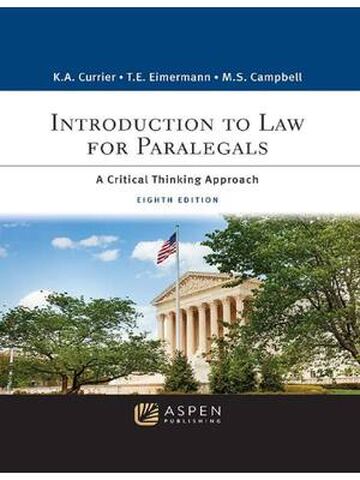
Introduction to Law for Paralegals A Critical Thinking Approach 8th Edition By Katherine Currier, Thomas Eimermann, Marisa Szabo Campbell
$28.00
Secure checkout
Instant digital download
PDF document
Document details
- Pages
- 734
- File size
- 9.92 MB
- Format
- Digital PDF
- Course
- Education
- Category
- eBook[PDF]
Sign in or create a free account to continue. Your purchase will be saved in My Downloads.
About this ebook
The Introduction to Law for Paralegals: A Critical Thinking Approach (8th Edition) by Katherine A. Currier, Thomas E. Eimermann, and Marisa S. Campbell is organized into a logical three-part structure designed to build core competencies in legal systems, analytical skills, and foundational legal areas. [1]
Part I: Paralegals and the American Legal System
This section grounds students in the structure of the U.S. legal framework and the foundational dynamics of the profession. Topics include: [1, 2]
- The Paralegal Profession: An introduction to the study of law and what paralegals do within the legal system. [1, 2]
- Sources of Law: Understanding where law comes from, including constitutional, statutory, and administrative law. [1, 2]
- Classification of the Law: Differentiating between categories such as state vs. federal, civil vs. criminal, and substantive vs. procedural law. [1]
- Structure of the Court System: An overview of how federal and state courts are organized. [1, 2]
- Civil Litigation and Alternatives: A baseline look at the litigation process alongside Alternative Dispute Resolution (ADR) like mediation and arbitration. [1]
Part II: Finding and Analyzing the Law
This part builds the necessary practical skills required to research and interpret legal authorities. Topics include: [1]
- Finding and Interpreting Statutory Law: Developing skill-sets for basic statutory analysis.
- Finding and Interpreting Court Opinions: Reviewing case law and understanding how judicial decisions shape the law.
- Legal Research and Writing: Basic skills necessary to navigate legal libraries, databases, and summarize findings.
- Applying the Law: Utilizing legal reasoning, stare decisis, and precedent to construct legal arguments. [1, 2, 3, 4]
Part III: Legal Ethics and Substantive Law
This comprehensive segment details the core rules of professional conduct followed by the primary conceptual areas of law. Topics include: [1, 2]
- Legal Ethics: Deep dives into professional responsibility, conflicts of interest, and confidentiality.
- Torts: Civil wrongs, negligence, intentional torts, and liability issues.
- Criminal Law: Substantive definitions of crimes and societal offenses (re-ordered in the 8th edition to sit immediately after Torts for direct comparison between civil and criminal frameworks).
- Criminal Procedure: The step-by-step constitutional rules governing enforcement, arrests, and trials.
- Contract Law: The mechanics of agreements, offers, acceptance, and breach of contract.
- Property and Estate Law: Principles of real estate, ownership, wills, and trusts.
- Laws Affecting Business: Corporate structures, agency, and employment considerations.
- Family Law: Legal regulations surrounding marriage, divorce, custody, and support. [1, 2, 3, 4]
File included
ScholarFriends.com-introduction-to-law-for-paralegals-a-critical-thinking-approach-8th-edition-by-katherine-c.pdf
9.92 MB
Related ebooks



